The MagSafe connector was supposed to make accessory attachment effortless, and for a few months it feels that way. Then the slide begins. A wallet tilts a half degree and catches nothing. A battery pack slips sideways in a coat pocket. The phone flips over on a car mount and hangs by one magnet, swinging like a pendulum until the whole assembly drops onto the center console. The standard fixes are weak. Buying a new case with a stronger magnet ring works sometimes, but it treats the symptom with a rougher texture instead of addressing why the grip degrades in the first place. The real problem has three sources, and each needs a different kind of correction.
The first thing to understand is that MagSafe is not one magnet. It is a ring of 18 individual magnets arranged in a circle with alternating polarity, and the ring is surrounded by an alignment magnet in the center that is mostly there to spin accessories into the right orientation. Apple's own spec calls for a pull force of roughly 1,200 grams against a bare iPhone back. Almost nothing in real life tests at that number. A case with 0.8 mm of polycarbonate cuts that pull force by close to a third. A leather case cuts it by more. The accessory makers who claim "compatible with MagSafe" have no obligation to meet Apple's magnetic strength, and many of them ship rings that hit roughly half the spec.
So the first honest fix is not a product. It is a measurement. Take the accessory, place it against the back of a bare phone, and try to slide it off horizontally. If it resists, the accessory itself is strong. Then put the case on and repeat. The difference between the two is the case's fault. Knowing which element is weak changes the entire repair path.
Single hand, not smartphone: grips wear out
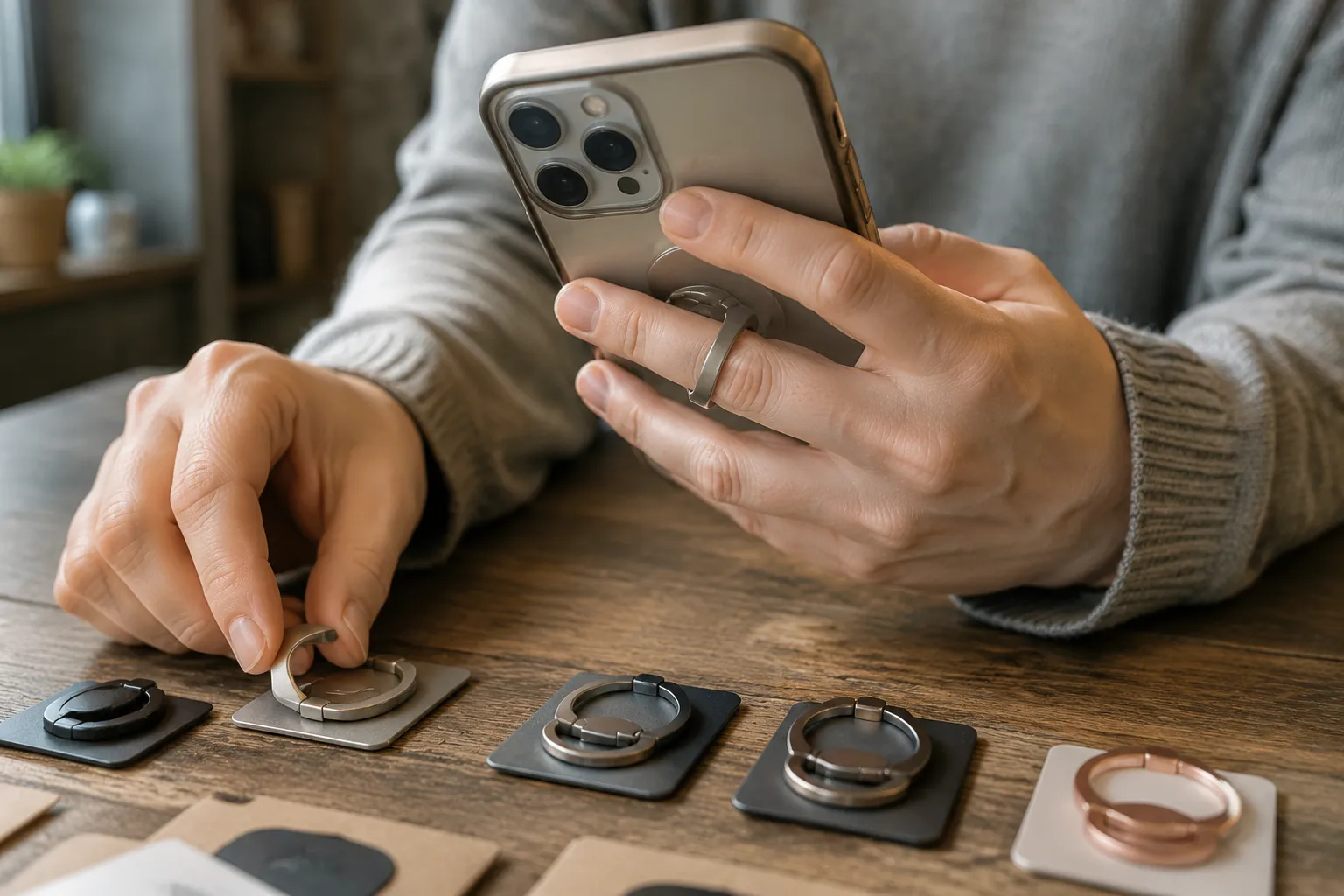
The most common source of a slide is not the ring at all. It is the finger grip attachment, the silicone or fabric loop that already spins freely when the phone is new. These accessories rely on a thin metal plate permanently glued into their base, and that plate sits flush against the phone back while the grip's pivot mechanism lives above it. The magnetic attraction works through the plate, but the pivot introduces play. A person grips the loop, pulls the phone out of a bag, and the loop holds while the plate tilts a fraction of a millimeter. That tilt breaks the full-surface contact the magnets need.
Manufacturers rate these grips for "500,000 spins" or similar marketing language, but the pivot wears unevenly because the pull of the magnets constantly pressures one side of the bearing. Six months of daily use leaves the pivot slightly oval. The fix is to replace the grip, not to buy a stronger magnet ring. Some grips now use a ball-and-socket joint instead of a flat bearing, and those keep the plate parallel to the phone back for much longer. If the grip wobbles at all before attachment, it will only wobble more under magnetic load.
The cheap fix that works for a while is a thin piece of double-sided tape between the grip base and the phone case, which locks the grip's orientation and removes the pivot from the equation. But that glues the grip in place and makes the whole point of a detachable grip moot. The better move is to pick a grip with a metal plate that covers the full diameter of the base. Many budget grips use a plate smaller than their footprint, leaving a gap at the edge where the magnets cannot reach.
Car mounts need a different kind of hold
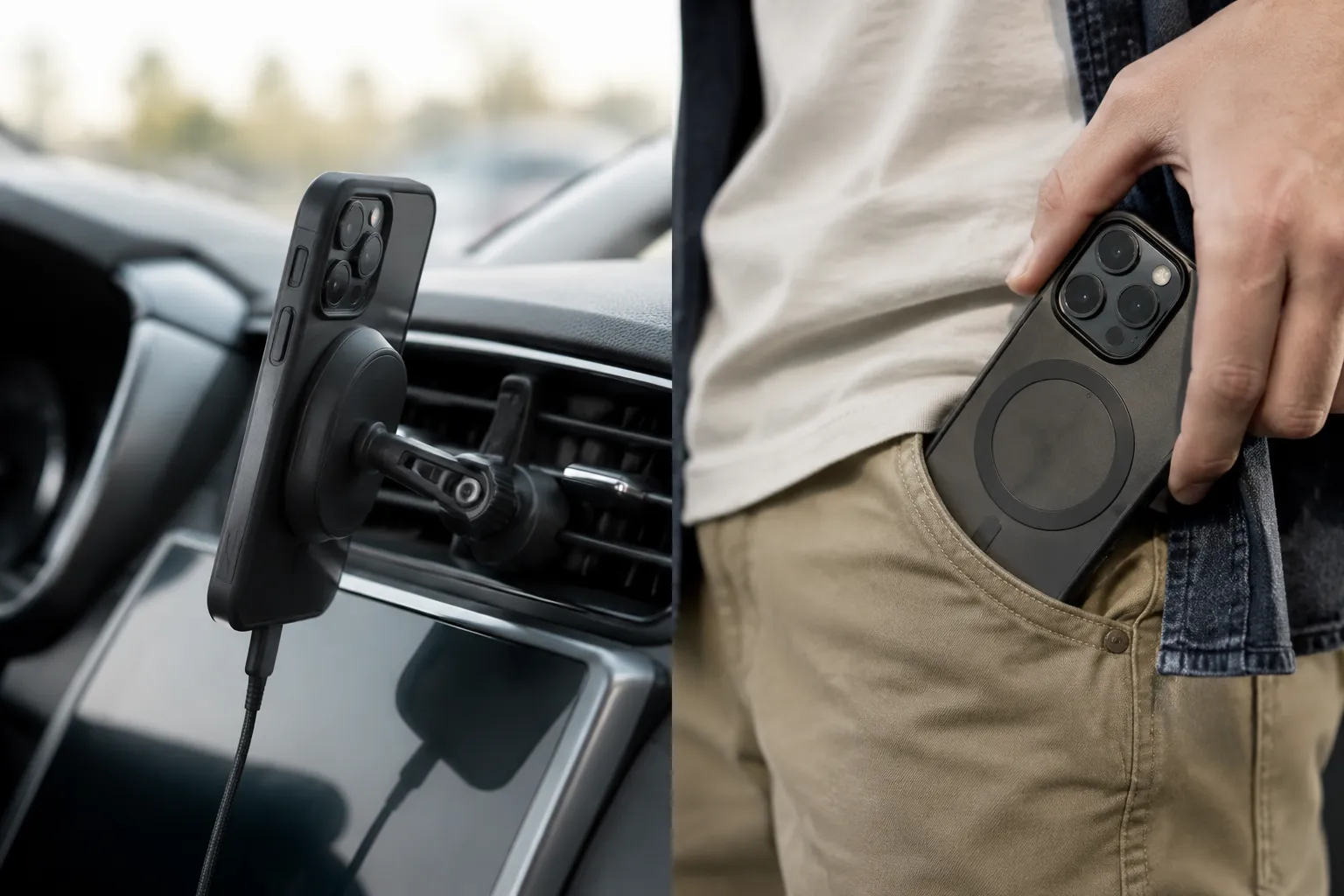
Car mounts are the harshest test for MagSafe because they add acceleration. A phone on a dashboard mount experiences sustained vibration, sudden braking, and the constant micro-shaking of the engine at idle. Under those conditions, even a strong magnetic hold fails eventually because the magnets are designed for perpendicular pull, not shear force. When a car hits a pothole, the phone momentarily becomes airborne and the magnetic connection has to re-engage while the phone is moving sideways. That is the exact direction magnets resist least.
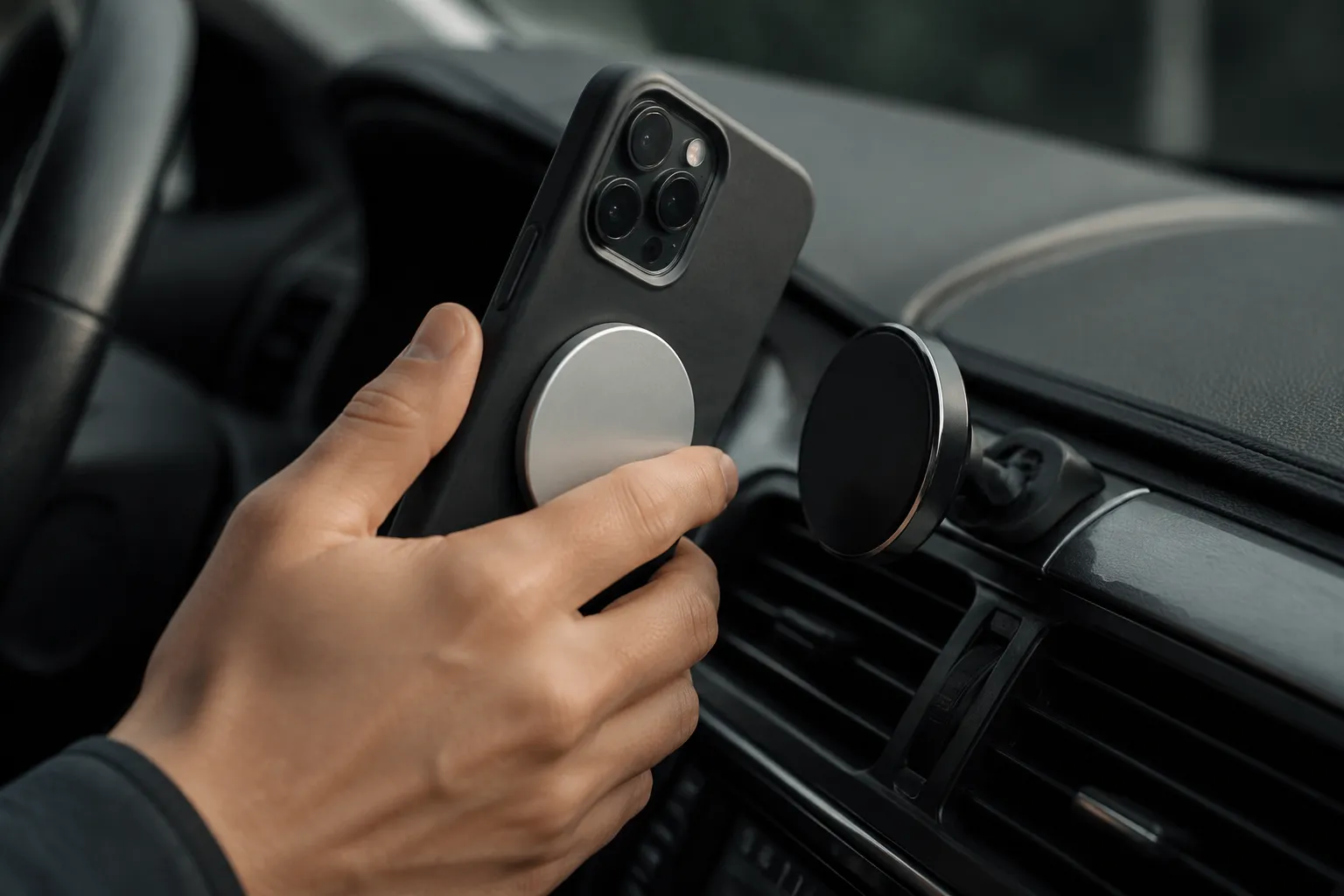
A magnetic car mount needs a mechanical backup. The best designs on the market now combine MagSafe ring with two small side claws that swing closed after the phone seats. The claws do not do the holding during normal driving. They only catch the phone if the magnet lets go. That design costs more, but the alternative is a phone on the floor of the passenger seat or, worse, a phone sliding under the brake pedal.
For people who refuse to use a claw mount, the workaround is placement. Mount the phone horizontally instead of vertically. A phone mounted sideways puts the long axis of the magnet ring parallel to the direction of travel, and the magnetic connection resists shear better along that axis. It looks odd and it blocks the air vent at an awkward angle, but it survives potholes in a way a vertical mount never will.
The case thickness math nobody does
Case manufacturers have figured out the magnetic weakness and most have responded by adding a metal plate inside the case. But a metal plate increases the magnetic pull only if it can concentrate the field. A plate made of thin steel can work, but many cases use aluminum or a stainless steel alloy that does not have the same ferromagnetic properties. The result is a case that feels heavier and looks premium but has no better magnetic performance than a plain plastic shell.
There is an easy way to check without any tools. Place the accessory on the bare phone back and then, holding the phone, try to dislodge the accessory with a quick flick of the wrist. Note how much effort it takes. Then put the case on and repeat the same flick. If the case is magnetic-friendly, the effort difference should be nearly undetectable. If the accessory slides off easily, the case has a metal plate that is not doing its job or no plate at all.
The correct case thickness for MagSafe is around 0.8 mm at the back panel. Anything thicker, and the magnet ring cannot pull the accessory through the material. Some rugged cases run 2 mm or more at the back, and those essentially convert MagSafe into a positioning aid rather than a holding mechanism. For those cases, the only fix is to remove the case when attaching accessories or to use a separate magnetic sticker adhered directly to the case exterior. That sticker adds a new magnet ring on top of the case, and it restores the hold but leaves a visible circle on the back of the case permanently.
Battery packs are the worst offenders
MagSafe battery packs are the heaviest common accessory, and they fail the most dramatically because their weight multiplies the problem. A wallet weighs 40 grams. A battery pack weighs 180 to 250 grams depending on capacity. The magnet ring in the pack has to hold that entire weight against gravity, and the larger the pack, the longer the lever arm when the phone is held at one corner.
Most MagSafe battery packs place their magnet ring at the same position as the phone's ring, which seems sensible. But the pack's internal battery cells are not distributed evenly. The cells sit below the magnet ring, which shifts the center of mass downward and away from the magnetic connection. The pack hangs slightly off-center, and that hanging weight slowly defeats the magnets. The slide on a battery pack is not instant. It develops over seconds as the pack tilts and the magnetic contact area shrinks.
A person can fight this with an elastic strap or a silicone sleeve, but the better answer is to buy a battery pack with a magnetic plate that is bigger than the pack's cell layout. A few manufacturers now make packs with the magnet ring mounted high, near the top of the pack, so the cells hang below but the magnetic connection point is closer to the center of mass. Those packs hold noticeably better, but they are rare and they cost more. The mass-market packs from major accessory brands are almost all bottom-heavy.
The thermal angle makes the problem worse. A battery pack warms up during charging, and the heat can soften the adhesive that holds the magnet ring inside the pack. After a few months of daily charging sessions, the ring can shift a millimeter or two inside the pack. That shift misaligns the magnets with the phone's ring, and the hold weakens by up to half. The fix is to stop charging the phone while the pack is attached if possible, which eliminates the heat source.
What the alignment ring actually does
The circular alignment feature in the center of MagSafe is not a magnet in the same sense as the outer ring. It is a smaller ring with its own polarity, and its job is to spin the accessory into the correct orientation and keep it from rotating. That function is valuable for accessories like stands and mounts that need a fixed angle, but it is also the source of a subtle failure. When the outer ring weakens due to case thickness or wear, the alignment ring can still engage. It holds the accessory in place but without enough force to resist lateral sliding. The accessory spins around the alignment ring and then slides off along the tangent.
Testing for this failure is simple. Attach the accessory and try to rotate it. If it spins freely, the outer ring has lost grip and only the alignment ring is active. Many people mistake this for a universal MagSafe problem when it is actually a degraded magnetic connection specific to their case or accessory. The correction is to address the case or accessory, not to abandon MagSafe entirely.
The tape that saves most setups
When no other fix applies, one product reliably restores the grip. It is the magnetic adhesive sticker, a thin disc of ferritic material with a 3M adhesive layer on one side and a smooth surface on the other. These stickers cost around 10 dollars and come in a five-pack. They are not accessories themselves. They are reinforcements meant to be applied to the exterior of a case or to the back of an accessory whose internal magnet ring sits too far from the surface.
The sticker works because it intercepts the magnetic field and redirects it. A phone case that is too thick prevents the accessory's magnets from reaching the phone's ring. A sticker on the outside of the case gives the accessory a ferromagnetic surface to grab, creating a stronger connection without requiring the magnets to travel through the case. The same sticker applied to the back of a battery pack compensates for a misaligned internal ring.
The sticker has one downside. It leaves a visible disc on the back of the case, and that disc is not removable without leaving adhesive residue. For a person who uses mostly one case and one main accessory, the sticker is a permanent solution to a permanent problem. For someone who switches cases weekly, it is a poor trade. The sticker also adds a tiny amount of thickness, enough that some accessories with very tight tolerances no longer seat flush.
There is a specific reason the sticker works better than buying a new case with a "30% stronger magnet" label. Most cases that advertise improved magnets achieve this by spacing the phone's ring closer to the accessory, but they cannot change the phone's internal magnet strength. The sticker adds a new ferromagnetic layer that both sides can grab, effectively amplifying the existing field. A stronger case can only do what the phone's magnets allow. The sticker operates outside that constraint.
Aligning the accessory to the phone
One failure mode that has no mechanical fix is a misaligned accessory. Some third-party accessories, especially cheap ones, place their magnet ring at a position that does not match the iPhone's ring. The accessory snaps on with a weak hold because only a fraction of its magnets align with the phone's magnets. The accessory often has a visible logo or seam that indicates where its ring sits, but a person cannot see the phone's ring through the back of the case.
Testing for this is straightforward. Attach the accessory and slide it in a small circle without lifting it. If the hold strengthens in one position and weakens in another, the rings are not aligned. The solution is to rotate the accessory 180 degrees and try again. Some accessories align in only one orientation, and the other orientation produces a noticeably weaker hold. For accessories with a fixed shape like a wallet, the orientation is not optional. The only fix is to choose a different accessory or a case with a thicker, repositioned magnet ring.
Apple's own accessories meet the spec, but the spec is not magic. The official MagSafe wallet holds well on a bare iPhone and poorly on any case thicker than 1 mm. Apple does not make a case with a reinforced magnetic ring, so the official accessory lineup is only reliable with a bare phone. Anyone who uses a case and official accessories at the same time will get a weak hold, and no firmware update will fix that.
The future of magnetic grip is mechanical
The accessory industry has begun to move toward a hybrid approach that combines the convenience of magnets with a mechanical lock. The newest iteration of MagSafe-like mounts uses a ring that physically expands or contracts with a lever and a twist, and a few wallet makers have added a small spring-loaded clip that catches the edge of the phone. These designs acknowledge that magnets alone are not enough for daily carry, and they admit that the slide problem is inherent to the magnetic connector rather than a defect in a particular product.
One wallet on the market uses a retractable tab that folds out and hooks over the camera bump. It looks inelegant, but it anchors the wallet so the magnets only need to keep it flush, not hold it against sliding. Another battery pack uses a friction pad on its top edge that presses against the phone's side frame, adding mechanical resistance to complement the magnetic hold. These designs work, but they each trade some of the clean detachability that made MagSafe appealing in the first place.
The user who wants the slide gone today needs to pick a lane. If the phone stays bare, buy quality accessories with full-size magnet rings and treat them as consumables, replacing them when the hold degrades. If the phone wears a case, the case is the system. The accessory is only as strong as the case allows, so a person must either choose a case built explicitly for magnetic strength or add a sticker to bridge the gap. The car mount needs mechanical backup or an acceptance of occasional drops.
A slide is rarely a single-point failure. It is the product of case thickness, accessory weight, misalignment, and wear adding up until the magnetic connection can no longer carry the load. Fixing it means addressing each contributing factor, and expecting one product to solve all of them is how the slide starts in the first place.
The next time a wallet tilts a degree and slides off, the first instinct is frustration at the whole MagSafe ecosystem. The measured response is to check the case, inspect the accessory's magnet ring, and decide which one is the weak link. In most cases, the phone itself is holding up its end of the bargain. The surrounding hardware is where the grip gets lost.