Carrying a phone and a pair of earbuds used to mean one pocket for each and no second thoughts. The devices have since grown into the two things a person touches more than any wallet or key, and the industry has answered with a flood of accessories that promise to make the pair feel complete. Most of that flood is noise. The genuine question for anyone who wants a light carry is not which gadgets to add, but how few can do the real work.
Minimalism in this context has drifted toward a visual aesthetic, all matte black and machined titanium, rather than a practical one. A person can spend a small fortune on a leather sleeve, a magnetic charger, and a dedicated pouch, and still walk out the door with a bag that jingles. The better goal is a checklist that holds up under actual conditions: a dead battery at 6 p.m., a dropped call in a parking garage, rain that starts without warning. Those moments decide what belongs in the carry.
The Phone Case as the Real Wallet
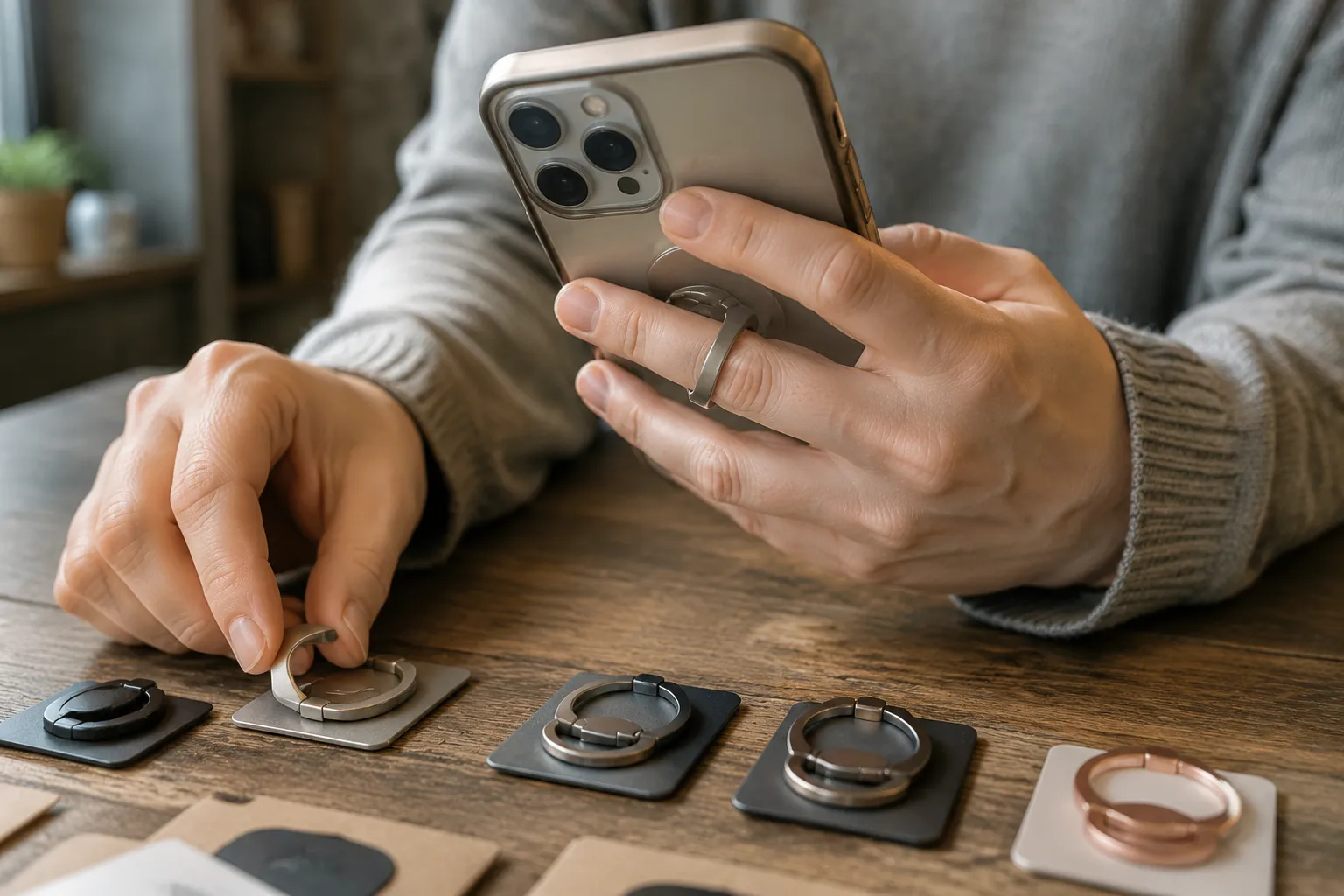
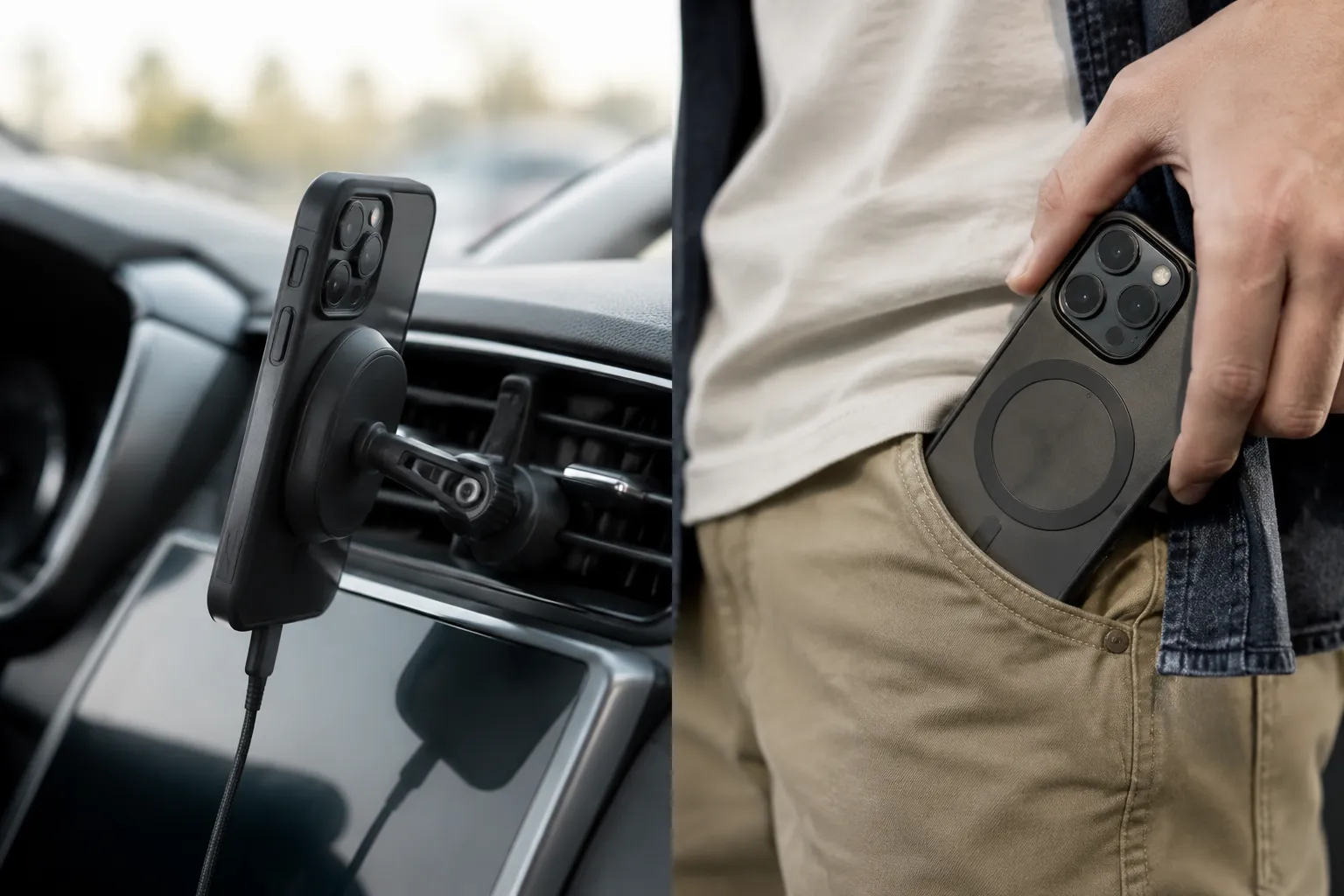
The single most useful change a person can make is to treat the phone case as a wallet and then stop carrying a separate one. This is not about the adhesive card holders that peel off after a month. The purpose-built cases with a sliding or hinged compartment have matured, and they hold two cards flush against the back. A driver's license and a single payment card cover nearly every daily transaction in a city. Transit passes live in the phone's wallet app anyway.
The objection is always about bulk. A card-carrying case adds maybe 3 millimeters of thickness, which sounds like a lot until a person actually compares it to the alternative: a front pocket with a phone, a back pocket with a bifold, and the occasional panic when one of them slides out on a car seat. The case consolidates the two bulkiest items in a man's pockets into one. Women who carry a small bag get the same benefit, because the phone goes in the bag and the separate card sleeve disappears entirely.
Choosing the right one matters more than the brand. The mechanism should be a sliding tray or a flap that opens away from the camera lenses, never a vertical slot that requires a fingernail to pry the card out. The magnet in the payment card is a non-issue in practice, since tap-to-pay has replaced swiping in most places. The case should feel slightly rough on the sides, because a polished aluminum edge in a bare hand is a drop waiting to happen.
This one change removes the need for a dedicated wallet, a money clip, a card sleeve, or any of the folding leather goods that people accumulate without meaning to. It also forces a decision about what actually belongs in the carry. A person who cannot fit eight store loyalty cards into a two-card case discovers quickly which ones matter. Most of them do not.
A Cable Strategy That Survives the Day
Every minimalist EDC list eventually mentions a backup battery, and most of them get the scale wrong. A 10,000 mAh brick is a brick. It weighs half a pound, takes up a whole pocket, and gets left behind on the days it would matter most. The honest assessment is that a phone with healthy battery health and a midday top-up habit does not need a brick for a normal day. It needs a cable and a wall adapter that live in a bag at all times.
The cable should be short, about 20 to 30 centimeters, because a long cable tangles and takes space. Braided nylon over a reinforced core survives the daily crush better than the rubber cable that ships with most devices. The connector will be USB-C on one end for the phone and either USB-C or Lightning on the other, depending on the earbuds. A person who owns an iPhone and AirPods can standardize on a single USB-C to USB-C cable and use it for both, since the AirPods case charges over the same standard. That single cable also tops up a laptop in an emergency.
The wall adapter should be the compact GaN type, which delivers 30 watts in a cube barely larger than a sugar packet. Leave it in the work bag or the car glovebox, not at home on the nightstand. A person who keeps one at home already finds it there every morning, which means it never gets packed. The point of this carry is that a forgotten overnight charge at a friend's place does not become a 6 percent battery panic on the commute home.
What a person does not need is a multi-port battery bank the size of a paperback. The scenario where a phone, earbuds, and a tablet all die at the same moment away from a wall outlet is rare enough that carrying 500 grams of lithium for it is a bad trade. The wall adapter covers the common case, which is a wall outlet at a coffee shop, an airport terminal, or a borrowed desk.
The Earbud Case That Earns Its Pocket
True wireless earbuds come with a charging case that is itself a small EDC problem. The case is too small to keep in a pocket comfortably, too big to ignore, and too expensive to lose. The standard answer has been a third-party hard shell with a carabiner, which adds bulk and turns the whole assembly into a keychain ornament that bangs against every door frame.
The better approach is to pick earbuds whose case fits the coin pocket of a pair of jeans or the small front pocket of a bag, and then to resist the urge to armor it. A bare polycarbonate case survives daily abuse remarkably well. Scratches on a case are cosmetic. The earbuds inside are the part that matters, and they are protected by the case's own lid and hinge. A silicone sleeve or a hard shell adds a layer of grip but also adds circumference that pushes the case out of the small pocket where it belongs.
The real EDC decision is whether the earbuds live on the person at all. Many people carry them constantly and use them twice a week. That is a pocket tax paid in full for no reason. The honest minimalist keeps the earbuds at home on days spent in a quiet office or running local errands, and brings them on commutes, gym sessions, and travel days. The case earns its place only when the buds get used.
For the days they do come along, a small fabric pouch is a better companion than a hard case. The pouch holds the earbud case, the short cable, and a single card adapter if the earbuds use an older connector. It all fits in a fist-sized bundle that slides into a jacket pocket or the top of a tote without creating a bulge. The pouch costs a few dollars and weighs nothing, which is exactly what an EDC item should do.
The Small Battery That Is Actually Small
There is one legitimate exception to the no-backup-battery rule, and it is the pocket-sized stick battery in the 2,500 to 5,000 mAh range. These are roughly the size and weight of a lip balm tube, and they exist specifically for the day when the wall adapter will not help: a long hike, a festival, a day of heavy navigation in an unfamiliar city, a flight with a long layover and no accessible outlet.
One full charge from a 5,000 mAh stick tops up a modern phone from empty to around 80 percent, which is enough to get through the worst case scenario without turning the carry into a burden. The stick lives in the bottom of a bag and gets forgotten until the moment it is needed. That is the mark of a good piece of EDC: invisible in the daily routine, essential once or twice a quarter.
The stick battery and the wall adapter do not overlap in purpose. The adapter handles the common case of a nearby outlet. The stick handles the absence of an outlet. Carrying both is redundant only if a person carries a brick instead of a stick. The stick fits in a jacket pocket or the small interior pocket of a backpack, and it pairs with the same short cable already in the pouch.
The mistake to avoid is the integrated cable design, where the battery has a short cable permanently attached. These look clever on the shelf and fail in practice, because the cable is always the wrong length and the connector is always the one a person does not need at that moment. A separate cable that pairs with the battery and the phone and the earbuds is more flexible and easier to replace when it wears out.
The Key Ring Is Not a Phone Accessory
Phone and earbud carries tend to attract key ring attachments, from tiny carabiners that clip the earbuds to a belt loop to magnetic pucks that promise to hold earbuds together. These are solutions to a problem that only exists because a person bought the wrong earbuds or the wrong case. A case with a smooth surface and a secure lid does not need a magnetic keeper. The attachment just adds a metal lump to the key ring and a dangling weight that swings when the keys come out.
The keys themselves are a separate carry that should get the same minimalist treatment. A small folding multi-tool on the key ring, the kind with scissors, a blade, and a bottle opener, is a genuinely useful addition that solves more problems than the dedicated phone accessories ever will. It lives on the keys, has no battery, and handles the daily cuts, packages, and loose screws that no piece of consumer electronics can touch.
The line between useful and clutter is the frequency of use. The multi-tool gets used weekly. The carabiner clip gets used never. The tiny flashlight on the key ring gets used rarely, since the phone's flashlight is brighter and always present. The key ring should hold keys, a multi-tool, and nothing else.
The Daily Audit That Keeps the Carry Honest
The minimalism in this system comes from a habit, not a purchase. Once a month, every item that lives in a pocket or a daily bag goes onto a table. Each item gets one question: has it been used in the last two weeks, or does it solve a problem that would ruin the day if it were absent? The phone case wallet passes both. The backup stick battery fails the first test but passes the second, so it stays. The promotional earbuds that came with an old phone fail both and go to a drawer.
The audit catches the slow creep that undoes every minimalist carry. A boarding pass stub, a receipt, a spare SIM card, a second pair of earbuds for the gym that never made it to the gym, a charging cable for a device that was replaced a year ago. Each item is small and harmless on its own. Together they fill the pockets and bury the items that actually matter under a layer of maybe-later.
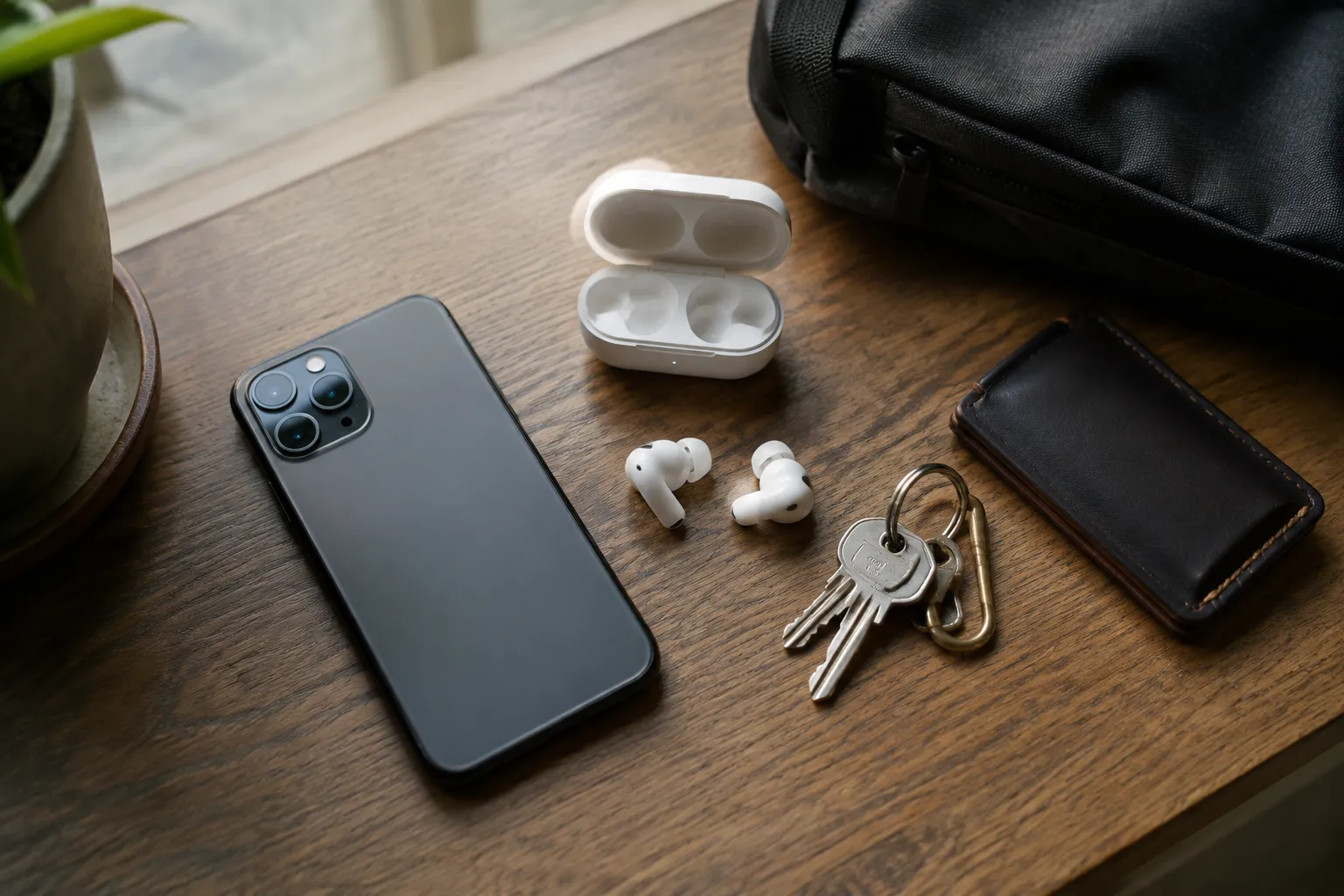
The phone and the earbuds are the two objects that a person touches more than any others, and the carry around them should reflect that priority. A phone in a card-holding case, a pair of earbuds that fit the coin pocket or stay home, a short cable with a compact adapter, and a stick battery for the rare long day. That is the whole list. Four things, none of them larger than a hand, all of them ready for the moment they get called into action.