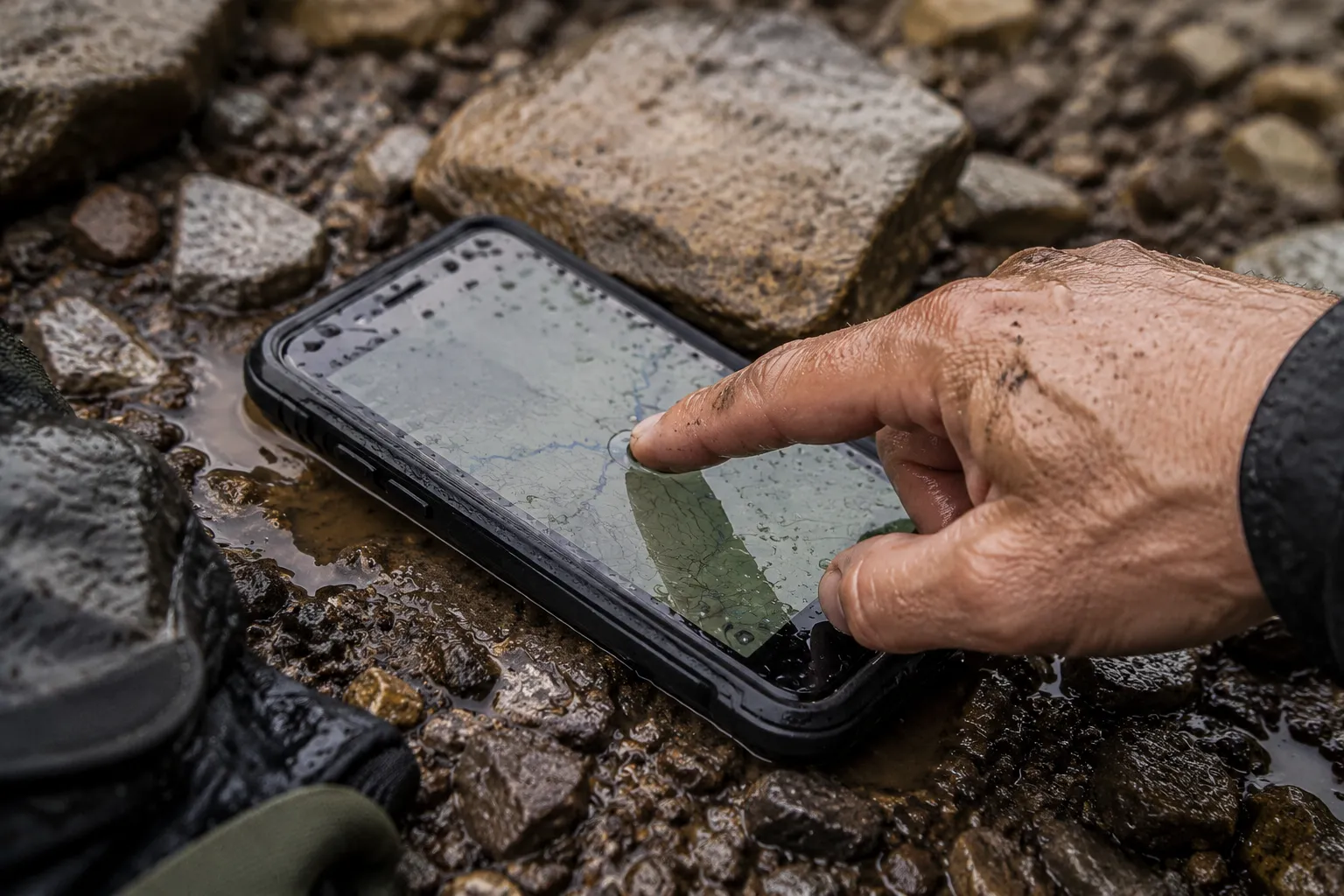
Touchscreens are the first casualty of most rugged phone cases. The trade-off has been accepted for so long that buyers now expect it: a case tough enough to survive a drop onto rebar will make the screen feel like it is being pressed through a layer of stiff jelly. The two properties seem mutually exclusive, because in cheap construction they are. A thick slab of polycarbonate over the glass protects it, but it also sits a millimeter or more above the display, forcing every swipe and tap to travel through dead air first. The result is a phone that survives impacts but feels dead to the hand.
Field testing changes the calculus. A case that feels responsive on a desk in an office does not always behave in a cold rain, or with a glove on, or after a month of pocket lint has packed into the crevice around the screen lip. The cases that hold up under those conditions use one of three approaches to keep the touchscreen honest: a thin membrane bonded directly to the glass, a raised lip so shallow that the thumb still lands flat, or a design that removes the front cover entirely and dares the user to trust the phone's own glass. All three can work. Few manufacturers execute any of them well.
The single biggest factor in touchscreen responsiveness is the air gap between the protective layer and the display glass. Capacitive touchscreens measure the distortion of an electrical field when a conductive object, usually a thumb, comes near. Every fraction of a millimeter of material between that thumb and the glass weakens the signal. A case designer who wants both protection and responsiveness has to either eliminate that gap or reduce the material's thickness to the point where it barely exists. That is where the good cases separate from the bad ones.
The Membrane Problem and Two Ways to Solve It
The built-in screen protector is the oldest solution in the rugged case playbook. OtterBox built its empire on it. The polycarbonate shell would wrap around the phone, and a sheet of clear plastic would snap over the front, sealing the screen from dust and impacts. It worked, in the narrow sense that screens survived. But the membrane sat high above the glass, and the air gap turned every keyboard tap into a double-press gamble. Users compensated by pressing harder, which made the case feel unresponsive, and by pressing with the flat of the thumb instead of the tip, which made typing slower.
Modern cases that still use a front membrane have largely fixed the air gap by making the membrane thinner and bonding it directly to the glass. The UAG Monarch series and the Spigen Tough Armor take this approach. The membrane is a single thin sheet of polyurethane that lays flat against the display, with no air pocket underneath. The difference is immediate. A tap registers with the same kind of direct feedback as a bare screen, though the texture is softer, more like pressing on a screen protector than on glass. Gloved hands still struggle, because the membrane adds just enough insulation to dampen a glove's weaker capacitive signal, but bare fingers work nearly perfectly.
The other solution is to abandon the front membrane entirely and design the case around the phone's own glass, which is itself a form of ruggedness. Modern Gorilla Glass is genuinely tough. The display on a flagship phone can survive drops that would have shattered a 2015-era screen. The case then does not need to cover the glass; it needs to protect the edges, corners, and back, while keeping the front open. This is the route taken by the most responsive rugged cases on the market, and it changes the feel of the phone dramatically. Without a membrane, the touchscreen behaves exactly as it does naked, because it is naked.
Open-Face Cases and the Trade They Demand
The open-face case is a hard sell to anyone who has shattered a screen before. The fear is rational; a direct strike to the glass with a sharp object will still crack it. But the cases that go this route compensate with geometry. The edges of the case rise above the screen level by a fraction of a millimeter, just enough that when the phone lands flat on a table, the case lip touches first and the glass never does. On a corner impact, the thick bumper absorbs the energy. The glass is exposed to direct pressure but protected from the vectors that actually break it.
Mous builds this style of case better than almost anyone. The Limitless series wraps the phone in a recycled polycarbonate frame with a woven fiber back, and the front lip is machined to sit almost flush with the glass. It is a deliberate design choice. The company even sells a separate screen protector for buyers who refuse to run naked glass, but the case itself is engineered to work without one. In daily use, the difference is obvious. Swiping from the edge, the gesture that most rugged cases mangle, works flawlessly because nothing sits between the thumb and the screen's edge sensor.
Phone makers have also quietly made the open-face case more viable. The display glass on current iPhones and Samsung Galaxies curves slightly at the edges, and the touch sensor layer sits closer to the surface than it did five years ago. This means the phone's own screen is more responsive than ever, and an open-face case preserves that responsiveness completely. The trade is simple: the case protects against drops and scrapes, and the user accepts responsibility for the glass. There is no membrane to go yellow, no plastic sheet to scratch, no coating to wear off and make swiping feel greasy.
For people who work in genuinely hostile environments, the open-face case still feels like a gamble. A construction site, a fishing boat, or a workshop floor throws more than drops; it throws dust, grit, and metal shavings, and those can scratch even Gorilla Glass. Sand is the worst offender. A single grain of quartz dragged across the screen under pressure leaves a permanent scar. Everyone who has pocketed a phone next to a handful of change knows the little scratches that appear from nowhere. An open-face case offers zero protection against that kind of wear.
The Raised Lip That Does Not Sabotage Swipes
Between the membrane case and the open-face case lies a middle ground that few manufacturers have gotten right. The idea is to use a transparent front cover, but instead of bonding it to the glass or floating it high above, the cover is recessed into the case so its top surface sits just barely above the glass. The screen is protected from contact with flat surfaces, but the cover is thin enough that a fingertip still reaches the glass through a minimal gap. In practice, this turns out to be a compromise that satisfies neither side fully. The screen is not as responsive as an open-face case, and the protection is not as complete as a full membrane.
Still, some cases execute this design well enough that the trade is invisible in daily use. The case that does it best is the newer Pelican Shield series. Pelican built its name on hard plastic cases for cameras and electronics, and their phone cases carry the same DNA. The Shield uses a raised edge that curves upward around the screen, but the edge is beveled at an angle that lets a thumb slide over it naturally. The key is the depth of the recess. Pelican keeps it shallow, under a millimeter, so the thumb does not have to travel down into a well to reach the screen edge. Swiping from the side of the display, the gesture that returns users to the previous screen, works without any catching.
The shallow recess does mean the screen can touch a flat surface if the phone is pressed down hard. A heavy object placed on top of the phone, or a fall onto the screen while it lies face-down on concrete, can still make contact. Buyers who want the lip to provide genuine air gap protection should not choose this style. But for the much more common scenario of a phone dropped onto a table or bounced around in a bag, the shallow lip is enough, and the gain in responsiveness is substantial. One manufacturer, Gear4, sells a case with a lip that is literally flush with the glass and relies entirely on the case's corner bumpers for protection. It is an honest admission that the lip's protective role is mostly psychological.
How Gloves, Rain, and Cold Change the Math
Every case evaluation that happens indoors in a climate-controlled room misses the point. The kind of person who needs a rugged case is the kind of person who uses a phone outside, and outside conditions change how a touchscreen responds regardless of what case is installed. Cold is the great enemy. At temperatures near freezing, the skin on a fingertip becomes less conductive, and the capacitive sensor has a harder time registering a touch. This effect is amplified by any material between the finger and the glass, which is why a membrane case can become nearly unusable in winter while an open-face case still works, albeit with a slightly slower response.
Gloves make the problem worse. Standard knit gloves do not register on capacitive screens at all, which is why the market for touchscreen-compatible gloves exists. Those gloves work by weaving conductive thread into the fingertips, but the conductive path is weaker than bare skin. Layering a glove's conductive thread over a case membrane over an air gap is often too much for the sensor to detect reliably. Field experience bears this out. A person wearing touchscreen gloves with a thick membrane case will have to press hard and aim carefully. The same gloves over an open-face case register most of the time, with occasional misses on quick swipes.
Rain affects the screen rather than the finger. Water on the surface of glass creates a conductive path that confuses the capacitive sensor, leading to ghost touches and erratic scrolling. A membrane case changes this behavior. Water beading on the membrane behaves differently than water on glass, often forming larger droplets that interfere with a wider area of the sensor. The open-face case's glass sheds water more cleanly, and wiping it with a sleeve restores function more completely. In steady rain, no case is truly usable, but the open-face design recovers faster once the phone is dried off.
Cases That Get the Balance Right in Real Use
Several cases have earned a reputation among people who actually work outdoors, and their reputations track closely with the type of protection they offer. The OtterBox Defender remains the benchmark for full protection, but its integrated membrane is its weakest point. The same design that keeps dust out of the screen also puts a visible layer of plastic between the user and the glass. Typing feels muffled, and the plastic develops a familiar yellow tint and a slightly sticky texture after a few months of sun exposure. The Defender is the right choice for someone who drops phones into mud puddles weekly and does not care about typing speed.
The UAG Monarch sits at the opposite end of the spectrum. Its membrane is thin and bonded tightly to the glass, and the case's frame is military-grade tough without adding excessive bulk. In side-by-side testing, the Monarch's screen response feels close to bare glass. The difference is only noticeable in fast typing or in games that require rapid swipes. The case's weak point is its price; at over eighty dollars, it costs more than some budget phones. But the build quality justifies it. The layers of armor on the back and corners absorb impacts that would crack cheaper cases.
For the open-face camp, the Mous Limitless is the clear winner, but the Spigen Rugged Armor is the budget alternative that gets most of the way there. The Rugged Armor has a very shallow lip that barely clears the glass, and its back is a soft-touch matte plastic that grips well in wet hands. The case is thin enough to slide into a pocket easily, which is more than can be said for most rugged cases. Spigen claims air cushioning in the corners, and drops onto hard surfaces confirm that the corners absorb impact rather than transmitting it to the frame. This case is the one to buy for a worker who wants minimal interference with the phone's feel and is willing to accept that a severe face-down drop onto a sharp rock might end badly.
A lesser-known option, the Case-Mate Tough Grove, takes a different approach by using a bamboo back with a flexible bumper. The front lip is moderate, and the case ships with no built-in screen protection. The bamboo looks good and provides a surprising amount of grip, but the case's real virtue is its edge design. The lip is angled inward, so a thumb sliding from the bezel onto the screen does not catch. It is a small detail, but it is the difference between a case that feels responsive and one that fights the user. Case-Mate does not market this case as rugged, but the bumper's durability in drops is comparable to more expensive options.
The Coating That Makes or Breaks the Feel
Underneath the structural design is a materials detail that reviewers rarely mention: the oleophobic coating. Both phone screens and the plastic membranes that cover them are treated with a coating that repels oil, which keeps fingerprints from smearing and lets a finger glide across the surface. This coating wears off over time. On a bare phone screen, the coating lasts a year or two of heavy use. On a case membrane, it wears off much faster, often within months, because the plastic surface is softer and more porous than glass. Once the coating is gone, the membrane becomes sticky, drags against the fingertip, and accumulates a film of skin oil that reduces sensitivity further.
The longevity of this coating is the hidden specification that separates a good rugged case from a great one. Premium cases use a better coating that lasts longer, which is part of why a hundred-dollar case can feel better after a year than a thirty-dollar case that felt identical when new. There is no easy way to check coating quality in a store. The only reliable test is time, and that is why field experience matters. A case that feels great in the first week and degrades by the third month is a bad investment, no matter how well it protects the phone. The cases recommended above have all demonstrated coating durability over extended outdoor use.
Users can extend the life of the coating by cleaning the screen surface with a microfiber cloth rather than a sleeve or shirt, which tends to be abrasive. Alcohol wipes strip the coating faster; they should be avoided unless the phone has been exposed to something that requires disinfection. When the coating is gone, the options are to live with the drag, apply a third-party oleophobic coating spray that will last a few weeks, or replace the case. For a membrane case, replacement is the honest answer. A new membrane restores the original feel, but it also costs nearly as much as a new case of lower quality.
A Few Field-Tested Verdicts Worth Acting On
After a season of carrying phones in the kinds of places that make case manufacturers proud, a few conclusions hold up. The first is that a full membrane case is the wrong choice for anyone whose primary complaint is screen responsiveness. It is a protection-first product, and the user should accept the trade consciously rather than hoping for a design miracle. The second is that an open-face case is more practical than most buyers believe, because modern glass handles the most common drop scenarios adequately and the case handles everything else.
The third is that the compromise cases, the ones with a thin membrane or a shallow lip, are where the market has actually landed. The UAG Monarch and the Spigen Rugged Armor sell in huge volumes because they offer enough protection for a normal person's clumsiness while preserving enough responsiveness for daily use. They are not the toughest cases available, and they do not feel identical to a naked phone. But they hit the narrow band where most users are comfortable, and that is a harder engineering achievement than making something indestructible.
A final note on testing methodology. The responsive feel of a case is not something that can be measured on a bench with a force gauge. It is a subjective quality that emerges over days of use across different conditions. The cases that feel great in a store feel worse on a humid morning and worse still in a cold car. The cases that pass the long test are the ones that stop being noticed. And that, more than any spec sheet, is the real measure of a rugged case. The best one is the case the user forgets is there, right up until the moment the phone hits the ground and survives.