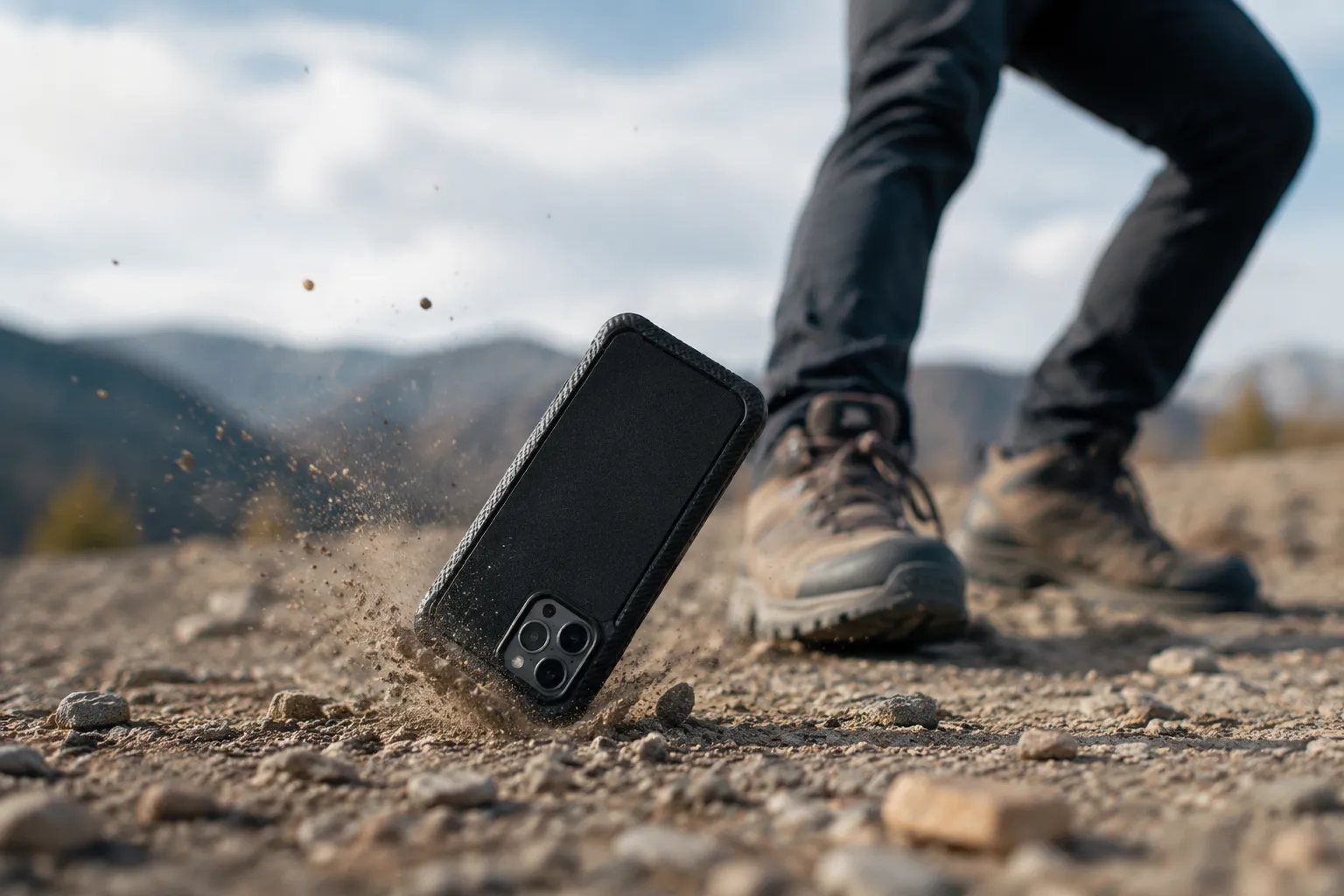
For years, the phone case industry sold a lie dressed up as a trade-off. The pitch went like this: if a person wanted a case that could actually survive a drop, they had to accept a slab of rubber and plastic that added half an inch to every dimension and turned a sleek device into something that looked like a tactical brick. The slim case was for people who babied their phones. The tough case was for people who dropped them. Rarely did the two groups overlap. That binary has crumbled, and the proof sits in a category of cases that measure under 12 mm thick, weigh less than 40 grams, and still walk away from a 2-meter concrete toss with nothing more than a scuff.
The engineering shift happened quietly. Instead of relying on a thick layer of shock-absorbing gel, modern thin cases use a combination of hard polycarbonate shells, raised bezels, and strategically placed air pockets or honeycomb structures that redirect impact energy away from the corners. The corners are the real battleground. A phone that lands flat on its back often survives even a flimsy case. A phone that catches a curb edge-on with its corner is the one that ends up with a spiderweb crack across the glass. The cases that pass the drop test at slim dimensions all share one trait: they obsess over corner geometry while keeping the rest of the case minimal.
What separates the legitimate thin-and-tough options from the marketing claims is not the material name printed on the box. It is the willingness of the manufacturer to publish actual drop test results with specific heights and surfaces. A case that says "military grade" with no accompanying data is a red flag. The MIL-STD-810G certification, despite its authoritative sound, is often self-reported and rarely verified by an independent lab. A person should look for cases that openly state the test height, the number of drops, and the surface type. The honest ones usually list 2 meters onto concrete or 3 meters onto a harder surface like asphalt. The vague ones say "drops from typical heights" and hope nobody asks for specifics.
The thin case market has also benefited from better adhesive technology. Many of the best performers use a micro-suction backing or a dual-layer grip that holds the phone rigidly inside the frame. A case that lets the phone shift even a millimeter inside its shell creates a hammer effect on impact. The phone accelerates within the case and strikes the inner wall with more force than the original drop delivered. A tight fit is not a luxury feature. It is the first line of defense. Cases that feel loose on day one will feel dangerously loose after a month of pocket wear, and no amount of corner cushioning can compensate for a phone that rattles around inside its own protection.
The Material Arms Race Has Settled on Two Winners
Thermoplastic polyurethane, or TPU, remains the workhorse of the category, but not all TPU is created equal. The cheap version, often found in cases priced under $15, uses a high plasticizer content that makes the material soft and grippy at first, then turns it yellow and brittle within six months. The better version uses a low-durometer TPU that stays flexible in cold weather and resists UV degradation. A case that feels stiff and glassy in the hand is often using a harder compound that transmits impact force directly to the frame. The ideal thin case feels slightly tacky, almost like soft-touch silicone, but holds its shape when twisted.
The second winner is aramid fiber, the same material used in ballistic vests and high-end automotive parts. Aramid cases, like those from Pitaka and a few niche manufacturers, measure around 1.4 mm thick, which is almost impossibly slim. They do not offer the same corner protection as a TPU case with air pockets, but they excel at preventing scratches, dents, and the kind of cosmetic damage that comes from sliding across a table or rubbing against keys in a pocket. For a person who drops a phone occasionally but treats it roughly on a daily basis, aramid offers a different kind of toughness. It does not absorb shock. It prevents the damage that happens before a drop.
The honest assessment is that aramid cases fail the "drop from head height onto a sharp rock" test. They are not designed for that scenario. But they pass the more common "phone slips out of a jacket pocket while sitting down" test with ease, and they do it while adding almost no bulk. The key is matching the case material to the actual risk profile. A construction worker dropping a phone from a ladder needs a different case than an office worker who mostly worries about the phone sliding off a gym bench. Both need protection. They do not need the same protection.
Corner Bezel Height Is the Hidden Spec Sheet Battle
Most buyers check the case thickness at the center of the back panel and ignore the edges. That is a mistake. The most important measurement is the height of the lip that surrounds the camera module and the raised edge that protects the screen when the phone lands face-down. A case can be 8 mm thin at its core and still have a 2.5 mm lip around the screen, creating a total drop distance of over 10 mm between the glass and the flat surface. That clearance is what prevents the screen from touching the ground on impact. Without it, a case made of diamond-infused unobtanium would still fail a face-down drop.
There is a frustrating trade-off here. A taller screen lip interferes with edge-swiping gestures, especially on phones with curved displays. The case catches a thumb mid-swipe, and the fluid motion becomes a stutter. Some manufacturers solve this by making the lip slightly concave on the left and right edges, preserving gesture access while maintaining a full-height lip at the top and bottom corners. Others simply make the lip uniformly shorter and rely on the glass strength alone. The latter approach works fine for phones using Ceramic Shield or Gorilla Glass Victus, but those materials are not invincible. They resist scratches better than previous generations. They still shatter when the impact point is a concentrated load like a pebble.
The camera bezel is the other overlooked component. Modern phones have camera modules that protrude 2 to 3 mm from the back panel. A case that sits flush with the camera housing offers zero protection when the phone is placed flat on a table. The lens glass takes the full weight and any grit on the surface becomes a grinding agent. The best thin cases extend 0.5 to 1 mm beyond the camera module, creating a small moat that keeps the lens suspended. This adds a tiny amount of visual bulk but protects the single most expensive component on the phone. Replacing a shattered camera lens costs more than replacing the back glass on most models.
Brands That Back Up the Slimness Claims
Mous has built its reputation on the Limitless series, which uses a recycled polycarbonate shell and a proprietary AiroShock inner core. The case measures around 10.8 mm at its thickest point and weighs 35 grams, yet the company publishes drop test videos from 3.5 meters onto concrete. The videos are not slick marketing productions. They show a phone being dropped repeatedly, corner-first, with a visible impact. There is no slow-motion trickery or careful camera angle. The phone survives. That kind of transparency is rare in the accessory industry, where most brands release one polished video and call it a day.
Spigen's Thin Fit line takes a different approach. Instead of claiming extreme drop protection, it focuses on a precise, minimal fit that adds 6.5 mm to the phone's profile. The case is hard polycarbonate with a matte finish that resists fingerprints. It lacks the corner air pockets of Mous or the shock-absorbing inner layer of UAG, but it excels at daily abrasion resistance and fits so snugly that the phone feels naked. Spigen positions it as a "just in case" case, not a primary armor system. For a person who has never cracked a screen but wants insurance against scratches and minor bumps, it is a rational choice.
UAG, or Urban Armor Gear, offers the Monarch series, which packs a five-layer construction into a 12 mm profile. The layers include a leather top sheet, a carbon fiber layer, and a TPU core. It is heavier than most thin cases at 42 grams, but it has passed independent drop tests from 4 meters onto steel. The Monarch is the case for someone who refuses to accept compromise. It is not the slimmest option on this list, but it is the toughest case that still fits in a standard pocket without creating an obvious bulge in tailored trousers.
Pitaka's MagEZ Pro series represents the aramid end of the spectrum. At 1.6 mm thick and 25 grams, it is barely there. The case uses a 600D aramid fiber weave with a magnetic ring embedded for accessory compatibility. It protects against scratches, minor drops, and the kind of wear that comes from daily handling. It will not survive a throw down a flight of stairs. Pitaka does not pretend otherwise. The company's marketing focuses on "everyday protection" rather than extreme drop claims, which is refreshing honesty in a market full of hyperbole.
The Wireless Charging and Magnet Compatibility Check
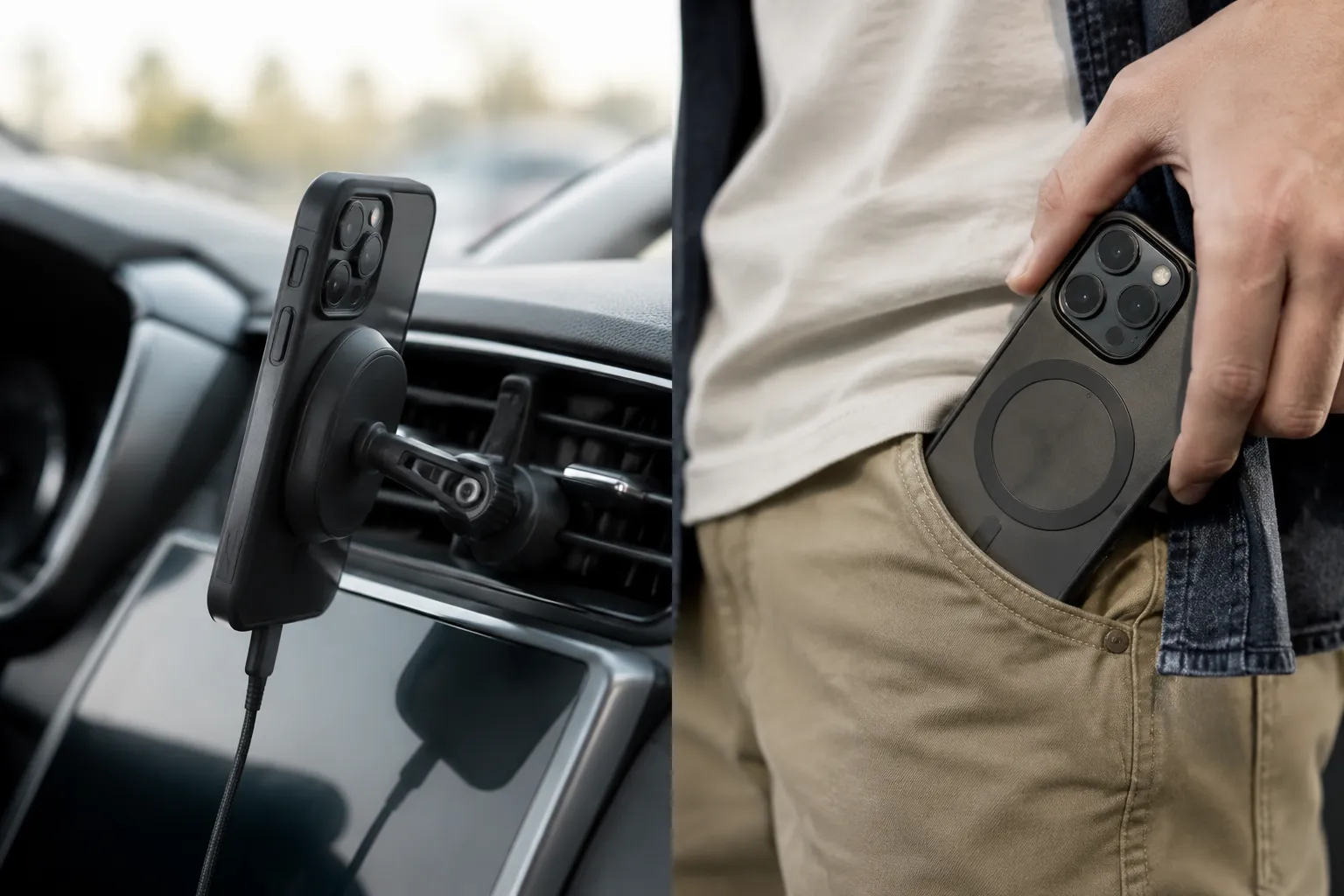
A slim case that blocks wireless charging or weakens the magnetic lock of an accessory ecosystem is a hidden cost. The issue emerges when manufacturers add dense materials or thick metal plates to reinforce the corners. Aluminum plates, in particular, interfere with the magnetic field used by MagSafe and Qi2 chargers. A person buys a thin case for convenience, then discovers the phone no longer snaps onto the car mount or charges at full speed on a bedside pad. That convenience loss defeats the purpose of a thin profile.
The good cases address this with a dedicated magnet ring that sits directly over the phone's internal magnet array. The ring is often neodymium, which passes the magnetic field cleanly while the rest of the case uses non-conductive materials. A case that does not advertise magnet compatibility but claims MagSafe support is likely using a metal plate somewhere in its construction. Check the fine print. A person should also verify that the case supports the phone's full wireless charging speed. Some thin cases, especially those with aramid fiber layers, add just enough distance between the charging coil and the pad to drop the speed from 15W to 7.5W. The phone charges, but slowly enough to matter on a busy morning.
There is also the question of how the case interacts with screen protectors. A thin case with a tight lip can peel up the edges of a glass screen protector during installation or after a drop. The case pushes against the protector, creating a small air gap that catches dust and eventually turns into a permanent white line along the edge. The fix is to choose a case and screen protector from the same ecosystem or to buy a case with a slightly recessed inner edge around the display. Brands like Spigen and Mous design their cases with enough inner clearance to accommodate their own screen protectors and most third-party options. Budget cases often skip this detail, and the frustration emerges within a week of use.
The Grip Factor That No Spec Sheet Captures
The most protective case in the world is useless if it slides out of a hand at the exact moment a phone is being pulled from a tight pocket. Grip is a subjective quality that depends on hand moisture, the finish of the case, and even the weather. A glossy case feels fine in a dry office but becomes a wet bar of soap during a summer walk. A matte case offers consistent friction but can feel chalky and unpleasant over time. The sweet spot is a case with a soft-touch coating that sits somewhere between rubber and silk, like the finish on the Mous Limitless or the Pitaka MagEZ Pro.
Several thin cases add textured side rails or a subtle dot pattern on the back panel to improve grip without adding bulk. The texture is barely visible from a distance but provides enough traction to prevent a phone from migrating across a sloped car seat. It is a small detail that makes a large difference in real-world use. A person who has lost a phone to a lap exit while getting out of a low car knows exactly what this means.
Cold weather is the great equalizer. Below 10 degrees Celsius, most TPU cases stiffen and lose their grippy quality. The phone becomes harder to hold and more likely to slip. Premium cases use a TPU compound with a lower glass transition temperature, which keeps the material flexible even near freezing. This is not a spec that appears on any product page. It is a quality that emerges through use and becomes apparent after the first winter walk. A person who lives in a cold climate should prioritize this trait over almost any other, because a case that turns into a hockey puck in January will fail at the moment it matters most.
The Weight of a Phone Is Part of the Drop Equation
A case that performs well on a 200-gram phone may fail on a 240-gram phone from the same height. The energy of an impact scales with mass. Every additional gram of phone weight increases the force transferred to the case on impact. This is why case manufacturers often list compatible phone models rather than a one-size-fits-all drop rating. A case tested on a Pixel 9 Pro, which weighs 199 grams, may not offer the same protection on a Samsung Galaxy S24 Ultra, which tips the scale at 232 grams. The difference seems small, but it translates to a roughly 16 percent increase in impact energy at the same drop height.
| Phone weight class | Case requirement for equivalent protection |
| Under 180 grams | Standard 10 mm profile with basic corner air pockets |
| 180 to 210 grams | 10 to 11 mm profile with dual-layer corner reinforcement |
| Over 210 grams | 11 to 12 mm profile with a dedicated shock-absorbing core |
The table above is a rough guide, not gospel. But it explains why a case that felt thin and protective on an iPhone 15 Pro feels slightly inadequate on an iPhone 15 Pro Max. The heavier phone demands more from the same case geometry. Some manufacturers address this by using a stiffer polycarbonate frame on their larger case variants, accepting a marginal weight increase in exchange for better structural rigidity. Others simply recommend the same case across both models and let the buyer take the risk.
There is also the question of how the case itself adds weight to the pocket. A 35-gram case is negligible on a belt or in a jacket. But a person who carries a phone in a front trouser pocket all day notices the difference between 25 grams and 45 grams. The lighter case creates less pull on the fabric and less sag in the pocket line. This is a cosmetic consideration that has nothing to do with drop protection, but it heavily influences satisfaction with a case over a long ownership period. A person who hates the way a case feels in a pocket will eventually remove it, and an unprotected phone will eventually crack.
The Mous Limitless 6.0 Tested at 3.5 Meters
Spending time with the Mous Limitless 6.0 clarifies what the thin-and-tough category is capable of at its current peak. The case measures 10.9 mm at the corners and tapers to 7.2 mm at the center of the back panel. The taper is visually deceptive. In a hand, the case feels much thinner than its corner measurement suggests, because the palm contacts the center while the fingers wrap around the edges. The aramid fiber back panel is smooth but not slippery, and the TPU bumper has a slightly tacky texture that inspires confidence during one-handed use.
The drop test data published by Mous claims survival from 3.5 meters onto concrete across 14 drops. The test unit shows visible scuffs on the corner bumper but no structural damage to the phone. The AiroShock core, visible through a transparent section of the bumper, uses a honeycomb pattern that collapses on impact and rebounds slowly, spreading the force over a longer time window. That slow rebound is the mechanical secret. A case that crushes instantly transfers all the energy to the frame. A case that crushes gradually gives the phone time to decelerate without damage.
The Limitless 6.0 also integrates a strong magnet ring that snaps firmly onto MagSafe accessories. The attachment is precise enough to hold the phone on a vertical car mount through rough roads. The wireless charging speed measures at the full 15W with a MagSafe charger, which confirms that the case does not add excessive distance between the charging coil and the pad. These are the secondary features that round out a case as a complete product.
The case costs around $65, which places it in the premium tier. That price is justified by the aramid fiber back, the independently tested drop rating, and the precise fit. A person could buy three budget cases for that amount, but those budget cases would not survive the same drop height. The math is simple: a cracked screen replacement costs anywhere from $200 to $400 depending on the phone model. A $65 case that prevents even one such incident pays for itself many times over.
What the Drop Test Videos Do Not Show
Every drop test video shares a common blind spot: the angle of impact is carefully chosen. A phone dropped flat onto its back or face is a best-case scenario. The more dangerous drop is the one where the phone hits a corner at a 45-degree angle, concentrating the entire impact force onto a single point. Some cases survive that test, and some do not, regardless of their advertised ratings. The honest manufacturers test both scenarios and publish the results. The less honest ones test only the flat drop and present it as representative.
There is also the matter of the surface. Concrete is the standard test surface because it is everywhere, but its hardness varies. Freshly poured concrete is softer than cured concrete. A sidewalk slab with exposed aggregate is significantly harder than a smooth interior floor. Drop tests conducted on "concrete" in a controlled studio may not replicate the surface of a parking garage or a brick patio. A person should treat any drop rating as a best-case scenario and add a meter of margin for real-world conditions.
The most revealing test is the repeated drop. A case that survives one drop from 2 meters may fracture on the second drop from the same height, because the first impact already compressed the air pockets and created micro-cracks in the TPU. Most drop test videos show a single drop or a series of drops onto fresh sections of the case. They do not test the case's performance on its tenth fall. In real use, a case takes multiple impacts over its lifetime. A case that deforms permanently after the first drop offers diminishing protection with each subsequent incident. The best thin cases use materials that return to their original shape within seconds of impact, maintaining their protective geometry over dozens of falls.
That rebound quality is difficult to assess from a spec sheet. It requires holding the case, dropping it, and watching how quickly the material recovers. A TPU case that stays dented after a drop has exhausted its protective life. A case that springs back within a few seconds is ready for the next fall. This is the quality that separates a $20 case from a $60 case, even when both claim the same height rating. The cheap case protects once. The premium case protects repeatedly.
The thin-and-tough category has matured to the point where a person no longer needs to choose between a pocket-friendly profile and genuine drop protection. The engineering solutions exist, the materials have been tested, and the honest brands publish their results. What remains is for buyers to read the fine print, match the case to their actual risk profile, and understand that no case is indestructible. The phone that survives a 3-meter drop onto concrete still loses to a 1-meter drop onto a sharp steel edge. The case is a risk reducer, not a force field. But a well-designed thin case reduces that risk to a level that most people can live with, and it does so without making the phone feel like a brick in a pocket.