The lobby at 8:47 on a Tuesday is where the decision gets made. A person walks in carrying a tote in one hand and a coffee in the other, and the security guard waves them through. Thirty seconds later, another person walks in with a backpack slung over one shoulder, and nothing about the room changes. Both arrive. Both sit down. The only real difference is what their shoulders and spines will feel like at 4:30, and what the person three seats over at the meeting table quietly registers about how they got there.
Office carry is a strange category because it is the only daily bag decision most people make where the contents are almost entirely predictable. Laptop, charger, a notebook, a water bottle, maybe a lunch container. The variables are not the gear. The variables are the walk, the dress code, and the kind of fatigue a person is willing to accept in exchange for looking a certain way for the first twenty minutes of the day.
The Backpack Bias Is About Age, Not Ergonomics
There was a stretch, roughly from 2014 to 2019, when the backpack became a status object in white-collar workplaces. Tech companies normalized it. A good one cost as much as a briefcase and signaled that a person was too busy shipping code to care about appearances. That moment has passed, and the backlash has nothing to do with back pain. It has to do with optics.
Walking into a client meeting with a backpack reads as junior in a way that feels almost primitive. It is the bag of someone who carries their own things, which in a corporate hierarchy implies someone who has not yet earned the right to have other people carry things for them. That association is unfair, but it is also real, and it shapes the calculus more than any study on spinal loading ever will.
The irony is that the person who looks most senior in the elevator is often the one carrying the sleeve, and the person who looks most capable of actually doing work is the one with the backpack. The sleeve says nothing about productivity. It says something about preparedness for a specific kind of theater.
Three Distinct Categories of Sleeve
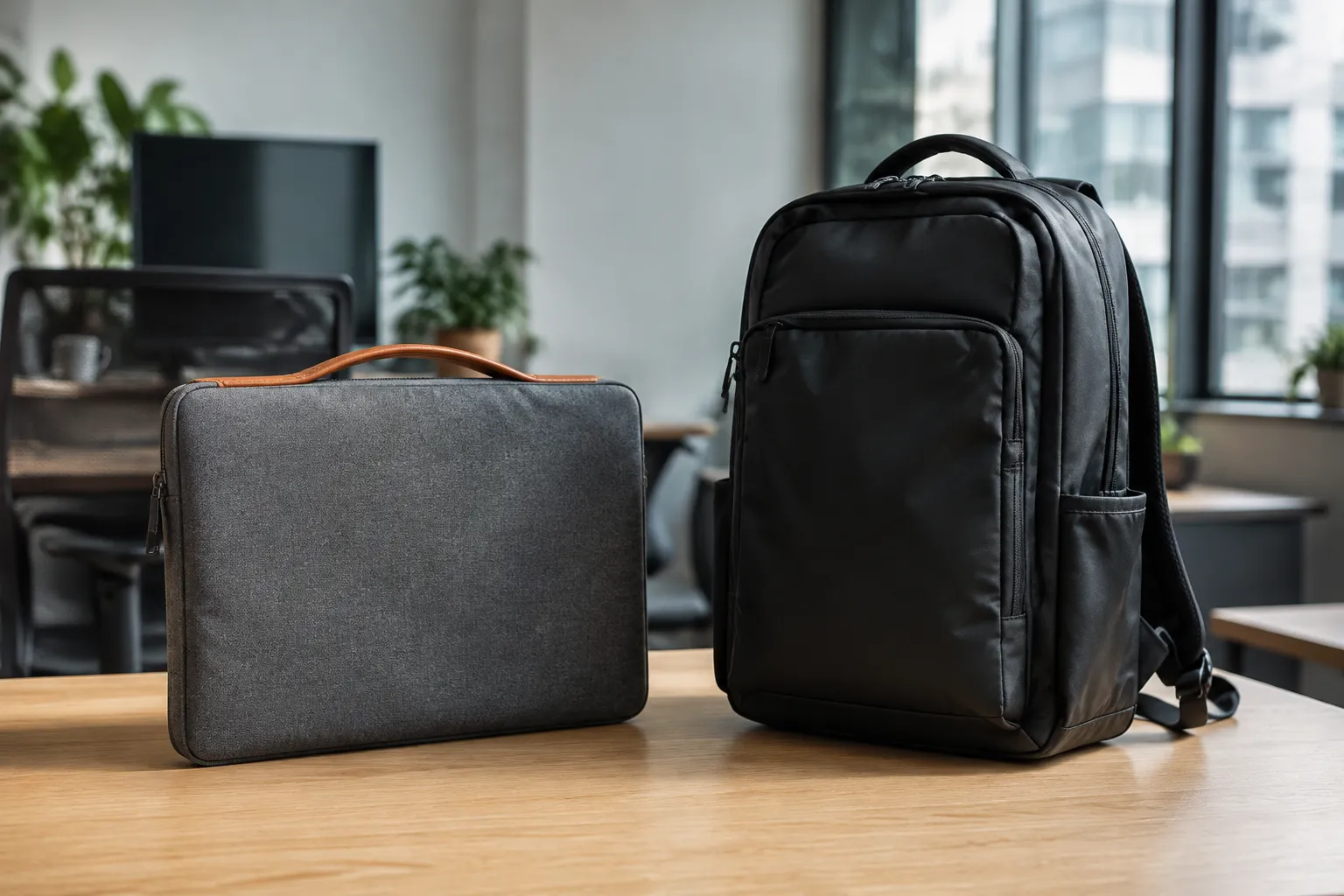
The word sleeve hides a lot. There is the padded envelope style, which is basically a laptop condom with a zipper. There is the folio style, which opens flat and holds papers alongside the machine. And there is the structured briefcase-sleeve hybrid, which has a hard bottom and handles, and is essentially a briefcase that happens to be sized for a laptop.
Each category carries differently. The envelope sleeve is the lightest and the most likely to be carried under an arm, which means it slides off a shoulder constantly and offers zero protection against a knock in a crowded hallway. The folio adds weight distribution but still has no real strap system, so a person ends up clamping it between forearm and ribs like a football. The structured hybrid is the only one that behaves like an actual bag, with a rigid base and handles long enough to hook over a shoulder.
Most advice about sleeves focuses on padding thickness and water resistance, which misses the actual daily experience. The thickness matters less than the friction of the material against a wool coat. The water resistance matters less than whether the zipper catches on a folder corner. A sleeve is a minimal object, so its flaws are proportionally more annoying than the flaws of a larger bag.
The Weight Transfer Problem Nobody Talks About
Here is the physical reality that separates the two options. A backpack distributes load across two shoulders and the hips, assuming the wearer uses the sternum strap. A sleeve on a shoulder hook concentrates the entire load onto one trapezius muscle, and then only if the person uses the short strap. Under an arm, the load goes to the forearm and the grip, which means the shoulder is fine but the hand slowly tires.
For a 1.3 kilogram laptop, the difference is negligible for a twenty minute commute. For a 1.8 kilogram workstation laptop, plus a 300 gram charger, plus a 500 gram notebook, the difference becomes tangible by the third block. The sleeve wearer shifts the bag from one side to the other. The backpack wearer forgets the bag is there. That is the entire ergonomic contest in one observation.
A person who walks more than twenty five minutes each way should default to the backpack on physics alone. That is not a controversial claim. The controversy arrives when the walk is short but the meetings are long, because then the bag is on the body for only fifteen minutes but off the body, sitting on a conference table, for six hours.
What the Sleeve Communicates in a Meeting
When a person slides a laptop sleeve onto a table and pulls the laptop out, the gesture is quick and clean. There is no unzipping of three compartments, no digging for a charger, no soft fabric sound of a backpack being set down. The sleeve sits flat, and it does not take up visual space. This matters more than most people admit, because the first thirty seconds of a meeting are pure subconscious assessment.
The backpack on a conference table creates a different scene. It has to be placed somewhere, often on the floor or on a spare chair, and it tilts or slouches. The person has to bend to retrieve anything. None of this is damning, but it accumulates. A colleague who sees a person pull a laptop from a sleeve sees preparation. A colleague who sees a person wrestle a backpack sees a student, or worse, someone who commutes from far away.
That commute inference is the brutal part. A backpack implies distance traveled, and distance traveled implies a lower tier of housing or a longer train ride. The sleeve implies a short walk from a nearby apartment or a car parked in the building garage. The logic is unspoken and ugly, but it operates in every office with a dress code looser than a suit.
The Shirt Collar Test
Dress code dictates the answer more than any other factor. A person wearing a blazer or a sport coat should never wear a backpack. The straps bunch the jacket shoulders, create an unprofessional ridge at the back, and wrinkle the lapels. A sleeve carried by hand or under the arm preserves the jacket's line completely. For tailored clothing, the sleeve is not an option. It is the only choice.
A person wearing a dress shirt with no jacket faces a subtler problem. The backpack straps press the shirt fabric against the shoulders and can leave visible marks, especially on lighter colors, by the time the wearer sits down. The sleeve avoids this entirely. But the same person wearing a knit polo or a casual button-down will find that the backpack's marks disappear within minutes, and the ergonomic benefit becomes the deciding factor.
Offices that skew toward jeans and sneakers are backpack territory. Offices that skew toward tailoring and visible shoe leather are sleeve territory. The gray zone, where the dress code says casual but the culture says polished, is where people make the wrong choice and feel it all day.
The Rain and the Transit Reality Check
Weather breaks the sleeve argument quickly. A sleeve under an arm offers no protection from rain, and most sleeves are not waterproof anyway, they are water resistant at best. A backpack worn on both shoulders under a coat or an umbrella keeps the laptop drier and keeps both hands free for holding the umbrella or the railing.
Transit adds another layer. On a crowded train, a backpack has to come off the shoulders and go between the feet or on the luggage rack, which creates a moment of vulnerability and awkwardness. A sleeve stays in the hand or under the arm, which makes it easier to move through a crowd but impossible to hold onto when both hands are gripping overhead bars. Cyclists have no contest. The backpack wins by default.
A person who takes a car or a rideshare to work every day is optimizing for the walk from the drop-off point to the door. That walk is short, covered, and free of precipitation. The sleeve works perfectly. A person who takes the subway for forty minutes is optimizing for stability and hands-free movement. The backpack works better, despite the social cost.
The Charger and Cable Dilemma
Laptop sleeves have no secondary storage. This is their single greatest flaw. A person who carries a sleeve must also carry a charger, which means either a second bag or an overstuffed pocket. The padded envelope sleeve with a charger shoved next to the laptop is a recipe for a scratched screen and a bulging silhouette.
The folio style solves this with an extra pocket, but the pocket changes the bag's shape and weight. The structured hybrid handles a charger and a few cables easily, but then it weighs as much as a small backpack and no longer slides under an airline seat gracefully. Every solution to the charger problem pushes the sleeve closer to becoming a briefcase, which defeats the original purpose of carrying something minimal.
The backpack holds a charger, a mouse, a pair of headphones, a snack, an umbrella, and a change of shoes without changing its external dimensions. That capacity is the real advantage, not the ergonomics. A person who needs to carry anything beyond the laptop and a notebook is fighting the sleeve's fundamental design.
A Practical Rule for the Undecided
The cleanest heuristic is to count the items beyond the laptop. Zero to two items, meaning a charger and a phone cable, and the sleeve works. Three or more items, and the day will be full of small compromises that add up to a decision to buy a backpack within six weeks.
But the opposite rule applies to the social dimension. A person who presents to clients, meets external vendors, or sits in rooms where decisions get made about budgets should bias toward the sleeve or the structured hybrid when the meeting count exceeds three in a day. The visual impression is not worth fighting. A person who works in an internal role, writes code, or stays at a desk all day should bias toward the backpack and ignore the optics entirely.
The hybrid option deserves more attention than it gets. A structured sleeve with a top handle, used like a small briefcase for the walk and stashed in a drawer at the desk, offers the best of both worlds. The person arrives looking polished, and the bag disappears until it is time to leave. This requires a drawer or a shelf at the office, which not every workspace provides, but for those who have the space, it eliminates the entire argument.
The Staircase and the Shoulder at 6 PM
The final test happens at the end of the day, not the beginning. The morning commute has fresh energy and a clear destination. The evening commute has fatigue, a drained laptop, and a brain that has been making decisions for nine hours. That is when the carry method reveals its true cost.
A person with a backpack stands up, slips both arms through the straps, and walks out. The weight settles evenly and disappears. A person with a sleeve picks it up, hooks it over one shoulder, feels the strap dig in, adjusts it, and walks out slightly tilted. If the building has a staircase and the train platform is underground, the sleeve wearer feels every single step.
The sleeve wearer arriving home will set the bag down on a chair and not touch it until morning. The backpack wearer will hang it on a hook and forget it exists. Neither person will think about the choice consciously. But the body remembers, and the body votes again the next morning at 8:47, when the same lobby sees the same person walk in with the same bag, committed now to a decision that no article can overturn.