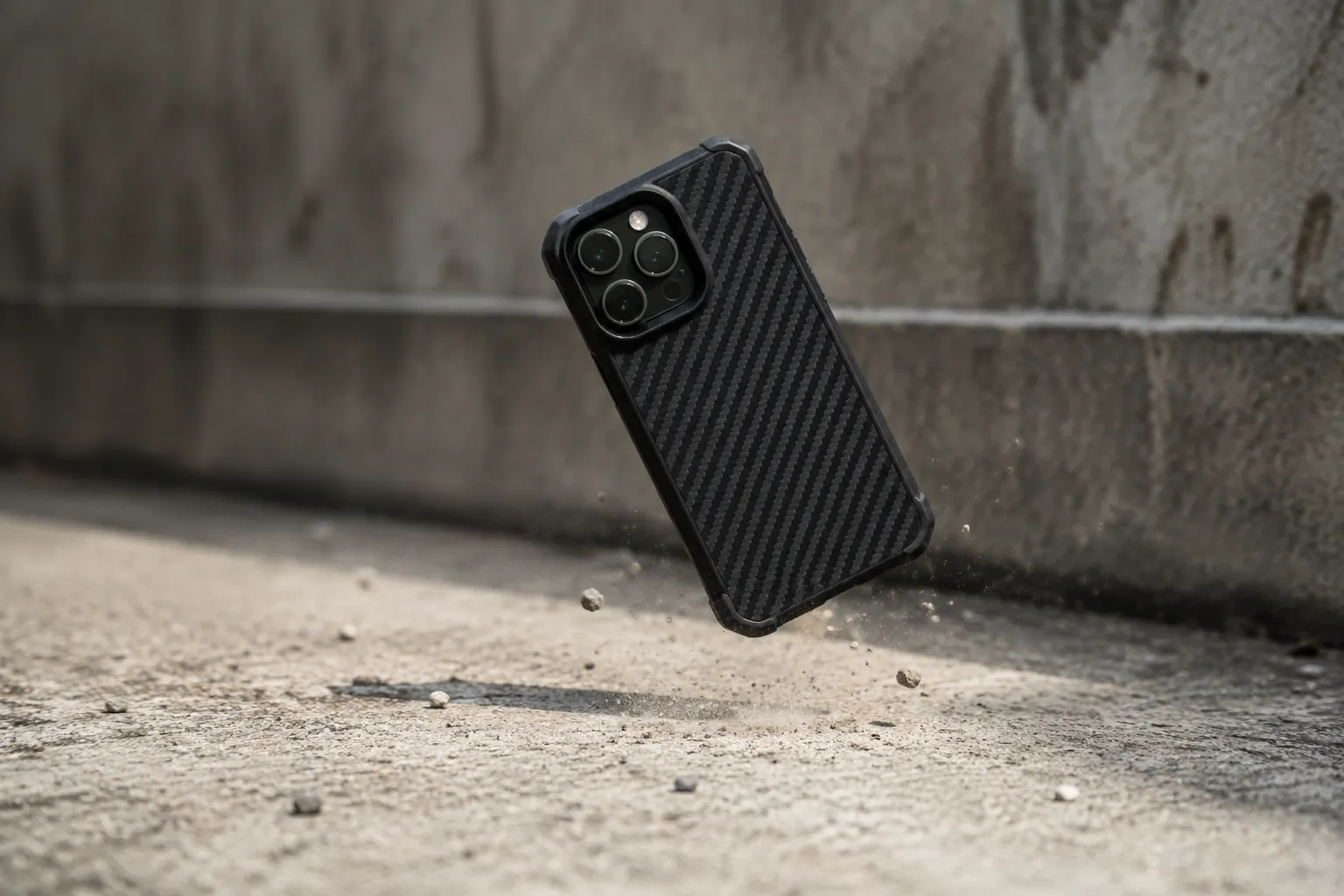
Aramid fiber cases occupy a strange corner of the phone accessory market. They promise the protection of a tank while weighing almost nothing, and they charge a premium for the privilege. The marketing materials show knives scraping across fabric, drops from shoulder height onto concrete, and the phone emerging without a scratch. The reality of how these cases behave when a phone actually hits the ground is more complicated, and it depends on physics that no amount of weave density can override.
The first thing to understand is what aramid fiber actually is. It is the generic name for a class of heat-resistant synthetic fibers, the most famous of which is Kevlar, a DuPont trademark. The material is five times stronger than steel on an equal weight basis. It stops bullets in ballistic vests, reinforces tires, and handles the heat of racing brakes. In the phone case world, it appears as a thin shell, often less than a millimeter thick, bonded over a polycarbonate or thermoplastic frame.
The pitch is simple: this thin layer of aerospace-grade material will protect a phone better than a thick slab of plastic or rubber. The marketing leans hard on the military and industrial pedigree of the fiber. A person sees the words "ballistic-grade" and imagines their phone surviving the same punishment as a soldier's helmet.
That mental image is wrong in ways that matter.
The Difference Between Abrasion and Impact
Drop a phone face-down onto rough asphalt and two things happen at once. The screen hits the ground with a force measured in G-forces, and the case scrapes along the surface. Aramid fiber handles the second part beautifully. The weave is dense, the surface is tough, and it resists tearing and abrasion far better than plastic or leather. In a slide across pavement, the case will scuff before the glass does, and the glass underneath survives because the fiber acts as a sacrificial layer.
But a drop is not a slide. A drop is an impact, and impact protection is about managing energy, not resisting surface wear. When a phone hits concrete, the kinetic energy of the fall has to go somewhere. The case deforms, the frame flexes, the internal components shift. The best protective cases are thick, soft, and crushable. They use materials like silicone, TPU, and air-filled corners that compress over a longer distance, increasing the time over which the deceleration happens. Slower deceleration means lower peak force, and lower peak force means the glass and internal solder joints survive.
Aramid fiber is none of those things. It is thin, hard, and rigid. When a phone in an aramid case lands on a corner, the fiber shell does not compress. It transfers the force almost directly to the frame of the phone. The case protects the back glass from scratches and keeps the exterior pristine, but the energy still travels through to the vulnerable components.
This is the fundamental trade-off that marketing never mentions. Aramid cases are protective against the things that happen to a phone's exterior over time: keys in a pocket, sliding across a table, the constant micro-abrasion of daily carry. They are far less protective against the sudden vertical shock of a real drop.
What the Drop Tests Actually Show
Several independent testers have run controlled drops on aramid cases from major brands, including Pitaka and Latercase. The results follow a consistent pattern. From waist height onto a hard surface, the cases survive with minor scuffs. The phone inside often survives too, but not because of the case. The phone survives because modern flagship devices are built with Gorilla Glass and aluminum or titanium frames that can handle a waist-high drop on their own.
From shoulder height or higher, the results get uglier. In one widely viewed test, a phone in a Pitaka case dropped from six feet onto concrete landed on its corner. The aramid shell cracked at the impact point, which is expected; the fiber is strong, but it is also brittle under point impact. The phone's glass back shattered despite the case being intact around it. The energy had nowhere to go but through the shell into the glass.
Another test dropped the same model phone in a latercase on its face. The screen cracked on the second drop from four feet. The case showed minimal damage. The tester noted that the case protected the phone from scratches and minor scuffs, but offered "little meaningful protection against screen impact."
These results are not anomalies. They are the predictable outcome of the case's design philosophy. The thin profile that makes aramid cases so attractive is exactly what limits their impact protection. There is no room for shock-absorbing material, no air gap, no crush zone. The phone might as well be naked in terms of how much vertical force reaches the frame.
The Pocket Appeal Is Real
None of this means aramid cases are bad products. It means they solve a different problem than the one their advertising implies.
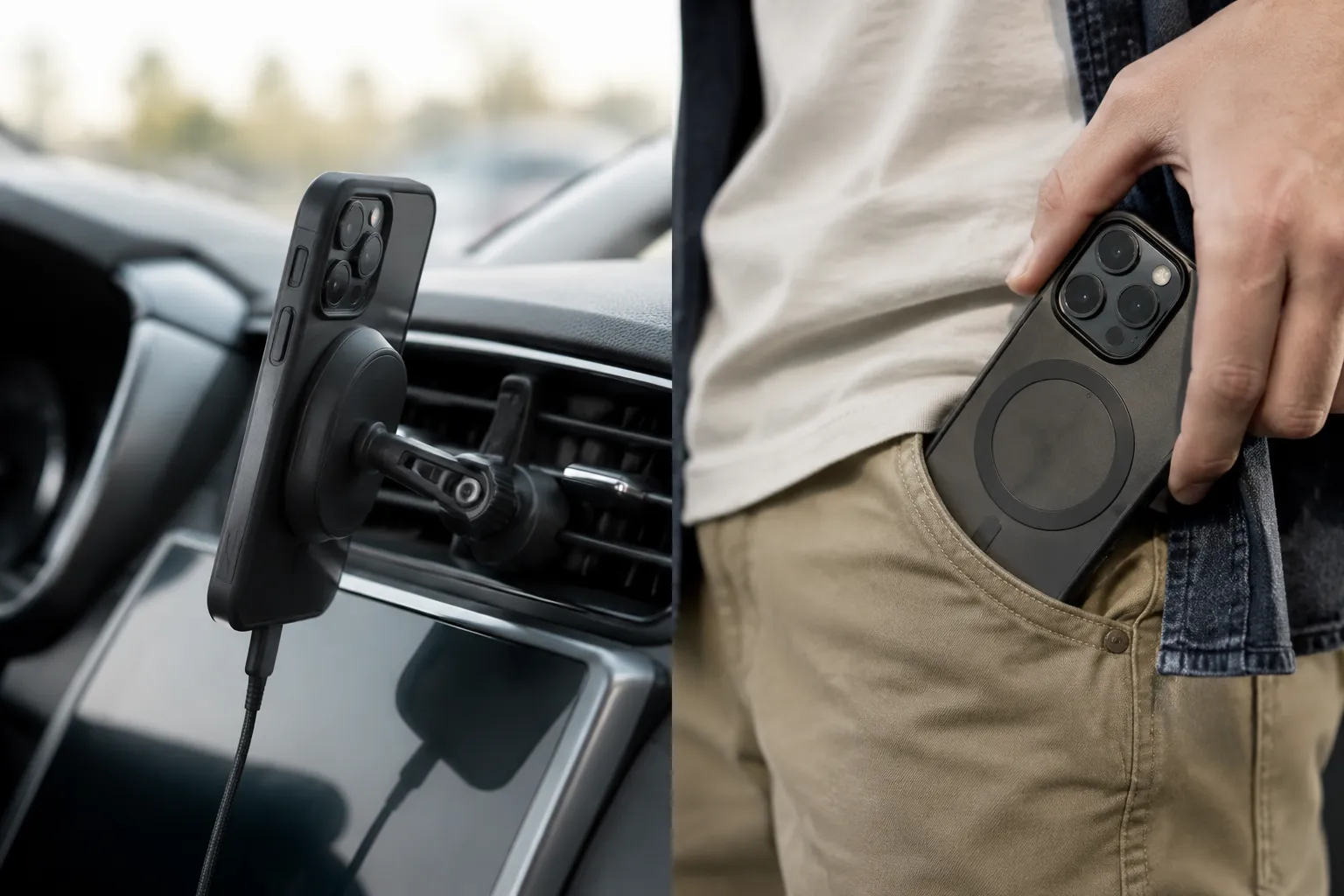
The people who buy these cases are not clumsy drop-prone users. They are people who care about how the phone feels in the hand and in the pocket. A phone with a thick rugged case is a brick. It bulges against a trouser seam, catches on a jacket lining, and adds noticeable weight to every lift out of a bag. The aramid case adds grams, not ounces. It preserves the slim profile of the phone itself and adds a texture that feels dry and secure, like a well-worn tool handle.
There is genuine value in that. A person who drops a phone once a year and keeps it for two years will probably be fine with an aramid case. The case prevents the slow accumulation of scratches and scuffs that make a phone look older than it is. It keeps the back glass pristine for resale. It adds negligible bulk to an already large device.
The people who should avoid aramid cases are the ones who drop phones with alarming regularity. The ones who have cracked a screen in the last twelve months. The ones who use a phone without a case because they hate bulk but keep breaking glass anyway. For those users, aramid is false security dressed in premium materials.
Weight Is Not the Only Metric That Matters
There is a reason rugged case brands like OtterBox and UAG show videos of phones thrown against walls and run over by cars. It is because their cases are thick, soft, and heavy. The weight is the protection. Every gram of polymer between the phone and the ground is a gram absorbing energy that would otherwise transfer to the glass.
The aramid case industry has responded to this criticism by adding shock-absorbing frames to their designs. Pitaka's newer cases include a "bumper" made of a different material, often a softer plastic or a more flexible composite, around the edges. Latercase does something similar with a lip that extends slightly beyond the screen. These additions help with corner drops and screen-first landings, but they compromise the minimalist ethos that made the cases popular in the first place.
And even with a bumper, the protection is not comparable to a dedicated rugged case. A comparison of drop test results across case categories shows a clear hierarchy. Thick two-layer cases with soft inner cores and hard outer shells consistently protect phones from higher drops than thin single-layer cases of any material. Aramid is a single-layer solution. It cannot compete on impact without becoming something it is not.
The marketing department knows this. That is why the advertising focuses on scratch resistance, on the weave pattern, on the heat dissipation of the fiber. It never shows a drop from head height onto a hard corner. It shows the case being scraped with a knife, because that is a test the material passes easily.
The Price of Featherweight Protection
Price is the other uncomfortable fact about aramid cases. A Pitaka case for a flagship phone costs between 60 and 90 dollars. Latercase runs similar. That is two to three times the price of a solid mid-range protective case from Spigen or Ringke, and it buys less drop protection.
What the price buys is material science and manufacturing. Aramid fiber is expensive to produce and difficult to mold into the precise shapes required for a phone shell. The cases are often made by layering sheets of the fiber with resin and curing them under heat and pressure, a process that does not scale as cheaply as injection-molded plastic.
The premium price also buys a certain status. Aramid cases are visibly different from ordinary cases. The distinctive herringbone weave pattern signals that the owner paid attention to the details of their gear. It is the phone accessory equivalent of a carbon fiber watch or a titanium water bottle. The functional benefits are real but modest, and the aesthetic is the actual product.
There is nothing wrong with that, but a buyer should go in with clear eyes. Choosing an aramid case because it looks exceptional and feels excellent in the hand is a rational decision. Choosing one because the marketing says it provides "military-grade drop protection" is a misunderstanding of what the material can do.
A Drop Test With Real Stakes
The most honest assessment comes from an unusual source: the community of people who use their phones for work in harsh environments. Construction site supervisors, field technicians, and outdoor guides have tested aramid cases on real job sites, not in controlled studio conditions. Their consensus is uniform. The cases are fine for daily carry in an office or a coffee shop. They do not survive the kinds of drops that happen when a person is climbing a ladder, hauling equipment, or working on uneven ground.
One field survey of mobile device damage across several industries found that the majority of screen failures happen when a phone is being used one-handed and slips, landing face-down on a hard surface. The drop height is usually between three and five feet, the distance from the hand to the ground. The failure mode is almost always a direct impact on a corner or the screen itself.
These are exactly the conditions where aramid cases underperform. The thin shell does not distribute the force of a corner impact across a wide area. It concentrates it. The result is a cracked back glass or a shattered screen, often with the case itself showing only minor cosmetic damage. The case looks fine, the phone is broken, and the owner is left wondering what went wrong.
What went wrong is that the owner bought a case designed to protect against the wrong threat.
Choosing With Intent
The aramid case debate finally comes down to a single question: what is the phone's life actually going to look like? A device that stays in a pocket, moves between a desk and a car, and gets handled with reasonable care will do fine in a thin aramid shell. The case will keep it looking new and will not interfere with wireless charging or the feel of the device.
A device that gets dropped, knocked off tables, fumbled at the gym, or used in environments with hard floors and sharp edges needs something different. The extra ten millimeters of thickness and the extra fifty grams of weight in a rugged case are not a compromise. They are the price of admission for surviving the accidents that statistics say will happen.
The smart play is an honest assessment of personal history. A person who has never cracked a screen in ten years of smartphone ownership is probably safe with aramid. A person reading this article because they just cracked their third screen in two years and are looking for a lighter way to prevent a fourth should buy a case with actual shock absorption, no matter how ugly it looks.
Aramid fiber is a remarkable material. It stops bullets, protects brake rotors, and makes phone cases that feel like nothing at all. It just does not stop a phone from hitting the ground. That is a job for thickness, softness, and weight, and no amount of weave engineering changes the physics.