Two coils of wire, a slab of silicone, and a question that has quietly driven charger sales for years. The premise of the MagSafe versus Qi debate sounds like a technicality: does the charger have to touch the back of the phone, or can it work through a case? The reality is messier, and it hinges on something most buyers never see. The difference between 15 watts and 7.5 watts matters less than the distance between the coil in the charger and the coil in the phone.
Apple's MagSafe puck is a ring of magnets surrounding a charging coil. The magnets snap the puck into perfect alignment with the phone's internal coil. That alignment is the entire trick. Qi, the open wireless standard, has no such alignment aid. A phone dropped onto a Qi pad can land millimeters off center, which is enough to cut charging speed dramatically or stop it altogether. This is the first reality check: the wattage printed on the box assumes the coils are lined up, and in daily use, they often are not.
The Case Thickness Problem No Spec Sheet Solves
Every millimeter of material between the charger and the phone eats into the power transfer. Wireless charging is inductive, meaning it works through magnetic fields, and magnetic fields weaken with distance. A thin plastic case is one thing. A rugged case with a built-in stand, a battery pack, or a wallet flap is another. The phone's coil sits near the back glass, but the case adds gap, and gap is the enemy.
MagSafe mitigates this in two ways. The magnets do not just align the coils; they also pull the charger flush against the case. That physical contact minimizes air gap. Standard Qi pads cannot pull the phone closer. The phone sits where it sits, and if the case has a raised camera bump, a textured back, or an uneven surface, the pad might not touch the case at all in the spot where the coil lives.
The practical result is a split personality in real-world charging. A naked phone on a MagSafe puck charges at the full 15 watts. The same phone in a thin silicone case still hits near that speed because the magnets compress the layers together. The same phone in a thick OtterBox-style case drops to 7.5 watts or lower, and the charger might heat up enough that the phone throttles the intake further to protect the battery.
Qi-only chargers face a steeper hill. Most Android phones cap out at 10 or 15 watts on Qi pads anyway, and that speed only holds when the phone is centered perfectly. Slide it a few millimeters and the rate falls. Add a case and the rate falls again. Some Qi pads have multiple coils to catch a phone that lands off-center, but those multi-coil pads are often slower at each individual spot than a single-coil pad would be. The phone picks a lane, and the lane is rarely the fastest one.
Testing the 15-Watt Claim on a Real Desk
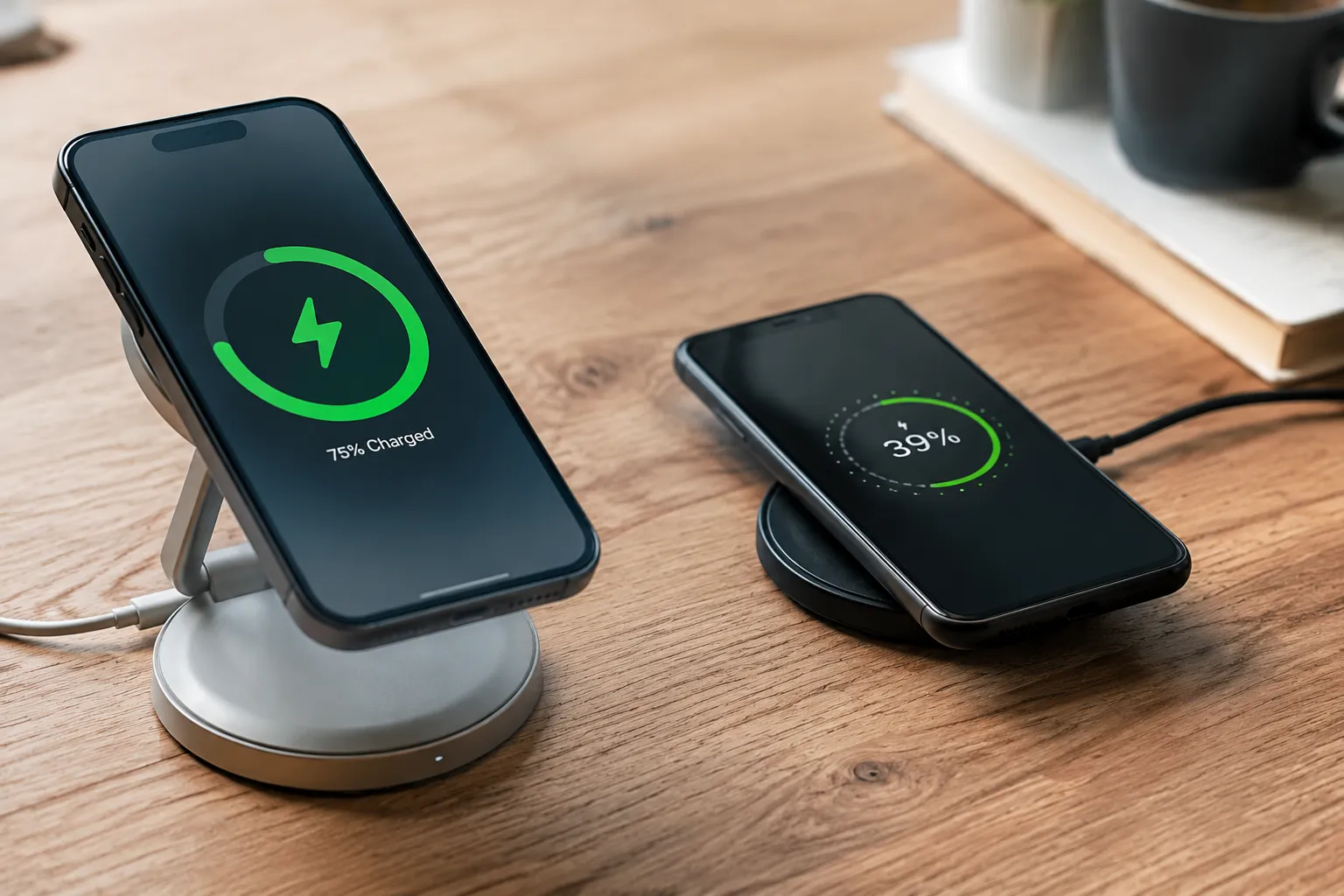
This is where the marketing hits the desk. A person with an iPhone 15, a MagSafe puck, and a basic Qi pad can run a simple test. Plug both into the same 20-watt adapter, put the phone on the charger, and watch the battery percentage after thirty minutes. The MagSafe puck with no case delivers a noticeable jump. The Qi pad with no case, when the phone lands centered, comes close but trails by a few percent.
Put a case on the phone and the gap widens. With a standard 1.5 millimeter plastic case, MagSafe still pulls ahead because the magnets seat the puck tight. The Qi pad loses more because the phone rests on a flat surface and the case adds a fixed gap with no way to close it. With a heavy-duty case, the difference becomes stark. MagSafe drops to the slower Qi-compatible profile, but it still charges. The Qi pad often stops charging entirely if the case pushes the coil out of range, or it charges so slowly that the phone gains a few percent an hour while running navigation or streaming audio.
The thermal issue compounds the problem. Wireless charging generates heat in both the charger and the phone. Cases trap that heat, and iPhones throttle charging speed when the battery temperature climbs. A thick case on a warm day can turn a 15-watt MagSafe charge into a trickle. The charger reports full speed, the screen says it is charging, but the phone is managing temperature and slowing the intake to protect itself.
Why the Magnet Alignment Beats Raw Wattage
The wattage arms race misses the point. A 15-watt charger is only as fast as the actual power transfer, and actual transfer depends on coil position. Qi's open standard allows for 15 watts, but that figure assumes perfect alignment, which requires the user to place the phone with care and hope it does not shift. MagSafe changes the physics of the interaction by making misalignment nearly impossible. The magnet snaps the coil to the coil. The user does not have to aim.
That convenience is the real product. Charging a phone at a desk is rarely a stationary act. People pick the phone up to check a message, set it back down slightly off, pick it up again. With a Qi pad, every pickup and return risks a slow spot. With MagSafe, the phone finds its spot on its own. Over a workday, that consistency adds up to more actual charging time, not because the wattage is higher, but because the phone spends more of its time at the correct position.
The trade-off is the walled garden. MagSafe is Apple's proprietary magnet arrangement, and while the Qi2 standard now includes a magnetic alignment profile that mimics it, the ecosystem is still split. Android phones with magnetic cases can use MagSafe chargers, but the speeds vary. A magnetic Android phone on a MagSafe puck might charge at 15 watts if the manufacturer licensed the profile, or it might fall back to 7.5 watts if not. The magnets align, but the phone's software decides how much power it will accept.
Qi2 Leveled the Field on Paper
Qi2 arrived with a promise to end the confusion. The new standard bakes magnetic alignment into the spec, so any Qi2-certified charger and any Qi2-certified phone should snap together like MagSafe. The standard also opens the door to 15-watt charging for phones that support it, without Apple's licensing fees. On paper, Qi2 makes the MagSafe-versus-Qi question obsolete.
On a desk, the transition is slower. The first generation of Qi2 chargers shipped in late 2023 and early 2024, but the phone support remains thin outside the iPhone. Most Android flagships still use plain Qi with no magnets, and their wireless charging speeds cap at 15 watts or lower. The magnetic cases that exist for Android phones are third-party accessories, and they add bulk without the software integration that iPhones get natively.
The spec war also overlooks the case problem that Qi2 inherits. A Qi2 charger with magnets still depends on the phone being compatible. A phone without the magnetic ring inside will not snap to the charger, and the alignment benefit disappears. Users with older phones or budget models are stuck with plain Qi behavior, which means they are back to eyeballing the coil position and hoping for the best.
The Real-World Charging Logs Look Different
Charging tests in reviews usually happen on a bare phone in a temperature-controlled room. Real charging happens on a nightstand next to a window, in a car mount angled toward the sun, under a stack of mail. Those conditions change the outcome. A phone in direct sunlight on a Qi pad charges slower because the battery heats up and the phone reduces intake. A phone on a MagSafe puck in the same sunlight also slows, but the magnetic mount often holds the phone off the surface, allowing some airflow underneath.
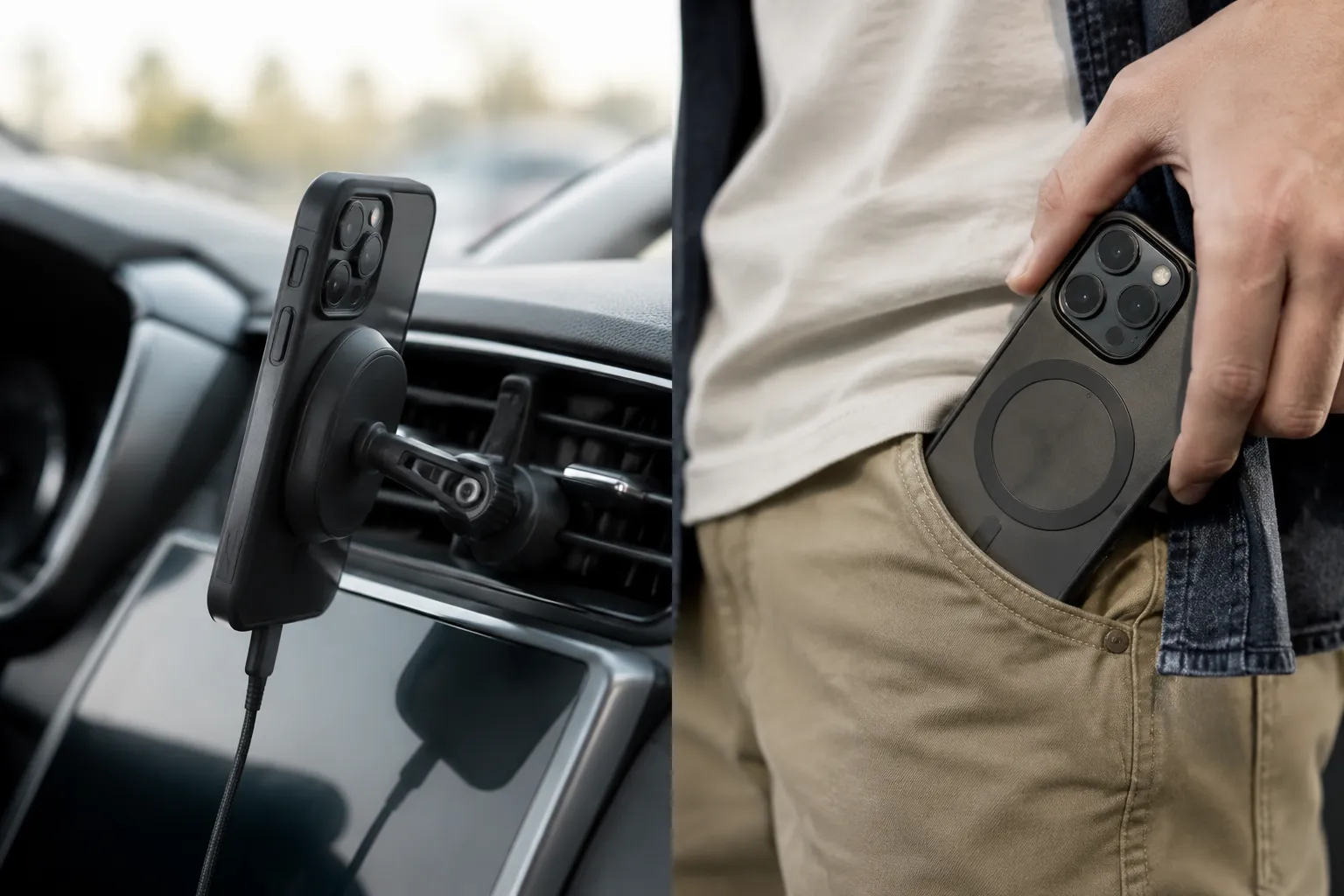
The car scenario favors MagSafe heavily. A Qi pad in a car requires the phone to stay put on a flat surface, and motion shifts it constantly. A MagSafe car mount holds the phone rigid and aligned. The difference is not just speed; it is whether the phone gains charge at all while running GPS and Bluetooth. A 7.5-watt charge with perfect alignment outpaces a 15-watt charge that keeps dropping to 2.5 watts every time the phone slides.
Nightstand charging is the least demanding scenario, but it exposes the standby mode difference. MagSafe's magnets allow the iPhone to sit upright in standby mode, displaying the clock and widgets while charging. Qi pads require the phone to lie flat, which means the screen faces the ceiling and the user cannot see it without picking the phone up. This is a quality-of-life difference, not a speed difference, and it drives many people to MagSafe even when their actual charging needs are modest.
What the Wattage Figures Actually Mean Per Phone
Different phones respond to wireless charging differently. An iPhone 15 charges at 15 watts on MagSafe and 7.5 watts on standard Qi. A Samsung Galaxy S24 charges at 15 watts on Qi with the right charger, but it does not stick to a MagSafe puck without a magnetic case, and even then, it negotiates power through a protocol that may not match the puck's profile. A Google Pixel 8 charges at 18 watts on the Pixel Stand, a proprietary Qi derivative, but only at 12 watts on generic Qi pads and 15 watts on some newer magnetic chargers.
The numbers on the box rarely match the numbers in practice. A charger rated for 15 watts might deliver 9 watts to a phone that negotiates a lower profile. A phone rated for 15 watts might accept only 7.5 from a third-party puck that lacks the proper certification. The only way to know what a specific combination delivers is to test it, and most users do not have the equipment or the patience to measure power draw.
The honest guidance is simple: buy the charger that matches the phone's native standard. An iPhone owner gets the best wireless speed with MagSafe or Qi2. An Android owner gets the best speed with a Qi pad that supports the phone's specific fast-charging profile, and that often means buying a charger from the same brand as the phone. Generic chargers work, but they work at generic speeds.
Case Companies Are the Real Gatekeepers
Case manufacturers have quietly decided how fast wireless charging happens. A case that claims MagSafe compatibility might have a thin magnetic ring on the back, but the material thickness between the ring and the phone varies. Some cases are 1 millimeter thick in the center and 3 millimeters at the edges. Others are uniform but use materials that interfere with the magnetic field more than others. The magnets in the charger have to pull through the case to align with the phone, and if the case is too thick or uses a magnetic shield layer, the pull weakens.
The market responded with a wave of MagSafe-compatible cases that are thin by design. Apple's own silicone and clear cases are consistently thin enough to preserve full speed. Third-party makers like Spigen and OtterBox offer MagSafe versions of their popular cases, but the MagSafe versions are often thinner than the standard versions. Users who buy a rugged case without the MagSafe logo get a case that blocks or slows alignment, and they often blame the charger rather than the case.
This is the core misunderstanding in the whole debate. The charger is rarely the bottleneck. The case is. A person with a top-tier MagSafe puck and a cheap, thick case gets worse results than a person with a basic Qi pad and a thin case, because the thin case allows the basic pad to transfer power efficiently. The marketing focuses on the charger's wattage, but the user's choice of case determines the actual outcome.
The Speed Difference That Actually Shows Up
For most people, the difference between MagSafe and Qi is not a matter of minutes. A full charge from empty on an iPhone 15 takes about two hours on MagSafe and closer to three hours on standard Qi, assuming ideal conditions. In daily use, few people charge from empty. They top off from 40 percent or 60 percent, and the difference shrinks to twenty or thirty minutes.
The meaningful difference is reliability. A Qi pad can fail to charge a phone overnight if the phone shifts, if the case is too thick, or if the pad's coil does not match the phone's coil position. MagSafe removes those variables. The phone clicks into place and charges. A user wakes up to a full battery instead of waking up to a phone at 60 percent and a blinking notification light on a charger that stopped transferring power at 2 a.m.
That scenario, the silent overnight failure, is the reason MagSafe earned its reputation. It is not faster in a way that changes a person's daily routine. It is more dependable in a way that prevents a specific annoyance. The person who charges overnight and leaves in the morning with a full phone does not care about the wattage breakdown. The person who wakes up to a half-charged phone because the Qi pad lost alignment cares very much.
Charging Through the Case Demands a Thickness Budget
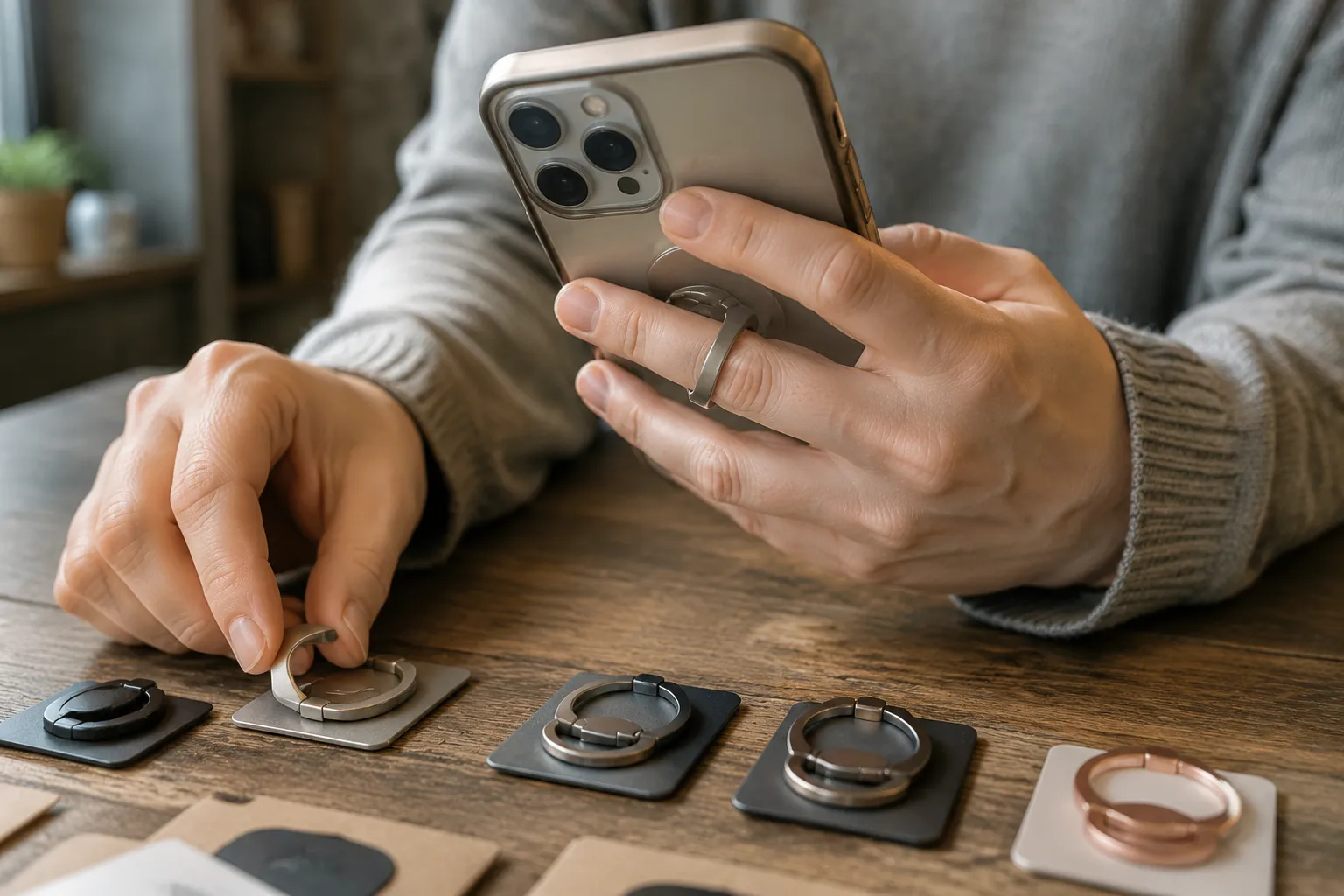
The practical takeaway for anyone shopping today is to treat case thickness as a budget. Every accessory stacked between the phone and the charger spends down that budget. A screen protector does not matter, it sits on the front. A case matters. A popsocket or metal plate on the back matters even more, and a metal plate can disable wireless charging entirely if it sits between the coil and the charger.
MagSafe wins the case test because it can afford to lose a few millimeters and still function. The magnet pulls the charger close, and the 15-watt profile has enough headroom to deliver 7.5 watts through a moderately thick case. Standard Qi has no such headroom. It requires the phone to sit close to the pad, and any case that adds significant gap drops the power to the point where charging becomes a maintenance trickle rather than a refill.
The people who should choose MagSafe are the ones who keep a case on their phone all the time. The people who should choose Qi are the ones who charge naked or with a skin-thin case, and who prefer the freedom of any charger working with any phone. The people who should wait are the ones with older phones, because the Qi2 transition will eventually make most of this debate moot, and dropping money on a proprietary puck today locks them into a standard that is already evolving.
The final word belongs to the coil gap. Every millimeter between the charger and the phone is a millimeter of speed lost, and no amount of marketing wattage recovers it. The best charger in the world cannot beat physics. The best case in the world is the one that gets out of the way.