Three years of daily use finally killed the last phone case that felt worth owning. Not the case itself. The little fabric loop sewn into its bottom edge, the one that clipped to a carabiner and made the phone impossible to lose between the train seat and the station platform, tore clean off during a crowded exit. The phone survived. The convenience did not. That small piece of webbing had quietly changed an entire daily routine, and its absence made every subsequent pocket fumble and bag dig feel like a step backward.
The market for cases with built-in lanyard loops has expanded well beyond the simple fabric tab. There are now cases with integrated card slots that double as anchor points, cases with metal loops that rotate, cases designed specifically to hang around a neck, and cases that treat the loop as an afterthought, a flimsy slit in the plastic that breaks within a month. The difference between a good loop and a bad loop is rarely visible in a product photo. It only becomes apparent after a few weeks of actual commuting, when the loop either proves itself as a reliable third hand or snaps, stretches, or digs into a palm.
The commuter's real problem is not finding a case with a loop. It is finding a loop that survives the specific violence of a daily transit routine. A person does not gently place a phone into a bag while standing still. The phone gets shoved into a coat pocket while holding a coffee, hooked onto a belt loop while juggling a transit card, and swung onto a shoulder while the train lurches. The loop has to take that abuse without tearing, without stretching out of shape, and without making the phone swing like a pendulum into a door frame.
The Difference Between a Strap and a Loop
Most people conflate two separate functions. A lanyard loop is a fixed anchor point built into the case itself, a permanent opening through which a strap, a carabiner, or a finger can pass. A strap is the accessory that attaches to that loop. The case provides the hardware. The user provides the tether. A case with a poorly designed loop will ruin even the best aftermarket strap, while a case with a solid loop can make a simple piece of paracord feel like a deliberate engineering choice.
The material of the loop matters more than its size. Thermoplastic polyurethane, or TPU, is the most common material for flexible loops. It bends, it grips, and it holds its shape. Cheap cases use a loop made of the same hard polycarbonate as the back plate, which looks tidy on a shelf but creates two problems in daily use. Hard plastic loops scrape against whatever they touch, scratching keys, sunglasses, and the finish on a jacket zipper. More critically, hard plastic has no give. A sudden jerk on a hard loop transfers all that force directly to the case's mounting points, which can crack the frame or pop the phone loose from its shell.
Quality loops are either molded from a softer, flexible material or reinforced with a fabric insert. Fabric loops, usually nylon webbing, last longer than any molded plastic because they do not fatigue from repeated bending. The tradeoff is that fabric absorbs moisture, holds odor, and can fray at the edges if the manufacturer did not heat-seal or stitch the ends properly. The best designs use a short fabric loop anchored into a reinforced plastic tunnel that spreads the load across a wider area of the case body.
Loop placement is the second critical factor. A loop on the bottom corner works well for a wrist strap. A loop centered on the bottom edge works better for a neck lanyard because the phone hangs flat against the chest. A loop on the top corner, near the camera, suits people who clip the phone to a bag strap and want it to hang upside down for quick access. There is no universal placement. A commuter who rides a crowded bus and keeps the phone in a coat pocket needs a different anchor point than someone who wears the phone around the neck on a long walk.
The most common mistake in loop placement is putting the anchor on the bottom edge and expecting it to work as a neck lanyard. The phone hangs upside down, the screen faces the body, and every glance requires a full wrist twist to see the display. Some manufacturers angle the loop slightly off-center to compensate, but the geometry only works if the case is thick enough to hold the phone at a natural angle. Thin cases cannot fix this. The loop ends up pulling the phone into an awkward diagonal that makes the whole setup feel unstable.
Cases That Treat the Loop as a Primary Feature
Several case lines have made the lanyard loop a central design element rather than a bolt-on afterthought. The Casetify Impact case, popular in dense urban areas, includes a substantial TPU loop at the bottom corner with a reinforced base that spreads stress across a wider surface. The loop is thick enough to thread a finger through for a secure grip during one-handed typing on a moving train. It is not a delicate slit. It is a functional handle that happens to look like part of the case's cushioning system.
Smartish's Gripmunk line takes a different approach. The case has a flat, recessed loop on the back, positioned low enough that a person's fingers naturally slide through it when holding the phone. That loop is not designed for external straps. It is a finger hold that keeps the phone from slipping during a crowded commute. The company also makes a version with a corner loop for those who want to attach a wrist strap, and the two loops serve completely different purposes. The back loop prevents drops. The corner loop prevents loss. Neither substitutes for the other.
For the neck-lanyard crowd, the Loopy Cases brand has built an entire business around a large, custom-shaped loop on the back that works as a finger anchor for camera use and as a pass-through for a wide strap. The loop is large enough to accommodate a thick woven lanyard without bunching. The case itself is not particularly protective, but it is secure. The phone can hang from the neck for hours without the loop digging into the collarbone because the wide strap distributes the weight across a larger surface.
Urban Armor Gear's Monarch series includes a strap slot on the bottom corner that is reinforced with a metal grommet. This is the rare case where the loop is designed for heavy-duty use, including clipping to a backpack strap with a locking carabiner. The metal reinforcement prevents the stretching and tearing that eventually destroys purely plastic loops. The downside is that the metal adds weight and can scratch the rim of a pocket if the phone is carried without a strap attached.
Quad Lock's cases use a proprietary mounting system that doubles as a lanyard point. The twist-lock mechanism on the back is made of hardened plastic and includes two small slots that accept a standard wrist strap. This is a clever solution for cyclists who already use Quad Lock's bike mounts. The same case that locks onto a handlebar also accepts a lanyard for the walk from the bike rack to the office. The slots are small, though, and they will not accept a thick paracord or a wide nylon strap without significant persuasion.
The Card-Slot Trap
A significant number of cases with lanyard loops also include a card slot on the back. The combination seems practical. A commuter can carry a transit card and a phone in one hand, attached to a wrist strap, and never fumble for either. The reality is less elegant. Card slots add thickness. A case with a back slot and a lanyard loop is often twice as thick as a slim case, which makes it harder to slide into a tight jeans pocket and more likely to snag on the edge of a bag compartment.
The card slot also changes how the loop behaves. Cards in the back slot stiffen the entire case, reducing its flexibility and making the loop pull against a harder surface. The added weight of two or three cards makes the phone heavier, which puts more strain on the loop and the strap. A person who hangs a card-carrying phone around the neck will feel the difference within an hour. The strap digs in more. The phone swings harder. The convenience of having a transit card attached is real, but it comes at the cost of comfort.
Some manufacturers have addressed this by integrating a small pull-tab card slot into the lanyard loop itself. The loop extends into a fabric tab that pulls out a single card. This is a clever design when it works. The card stays secure because it is held by friction and a small lip. The problem is that these pull-tab mechanisms are fiddly. The tab can be hard to grip with gloves on. The card can stick if the interior is not smooth. And the mechanism adds moving parts that fail over time, a poor trade for a case that is supposed to simplify a commute.
The better move for most commuters is to keep the phone case simple and carry the transit card separately. A dedicated card holder on a lanyard, worn around the neck or clipped to a bag, is cheaper, lighter, and easier to replace than a compromised phone case. The phone case should focus on protecting the phone and providing a reliable anchor point. Trying to make it do everything else usually results in a product that does none of it well.
Testing a Loop Before Buying
A person cannot tell if a loop is well-built from a product page. The render looks perfect. The marketing copy promises durability. The only reliable test happens in hand, and there are three quick checks that expose most weak designs.
First, pull the loop sideways with moderate force. A good loop flexes and returns to its original position. A bad loop stretches permanently or shows white stress marks at the base, a sign that the plastic is reaching its breaking point. Second, check the loop's attachment point from the inside of the case. If the loop is molded as part of the outer shell, look for a corresponding ridge on the inside. A smooth interior means the loop is anchored to the outer layer only, which can separate from the inner layer under repeated stress. Third, thread a thin strap through the loop and give it a sharp tug. The strap should slide easily. A loop that binds or pinches the strap will make every attachment and release a frustrating experience.
The thickness of the loop opening matters more than most people expect. A loop that is just wide enough for a standard wrist strap will not accommodate a thicker lanyard or a carabiner. A person should decide what kind of tether they plan to use before choosing a case. Buying a case with a loop that only fits a skinny cord, then discovering the need for a wider strap, means buying a second case.
One useful trick is to bring the actual strap or carabiner to the store when testing a case. Most phone shops allow handling display models. Threading the real strap through the real loop on a display unit reveals fit issues immediately. A loop that looks generous in a photo can be impossibly tight in practice. The few seconds spent testing in a shop save the cost of a case that does not work with existing accessories.
The Strap Is Half the Equation
A superb loop paired with a bad strap still fails. The strap market is crowded with options that look good and perform poorly. Woven nylon straps with cheap metal clips are the worst offenders. The nylon frays at the edges where it rubs against the clip. The clips themselves, often stamped from thin metal, bend open under load and drop the phone. A simple dropped phone is bad enough. A dropped phone with a loud clatter on a quiet train is a special kind of humiliation.
For daily commuter use, a strap made of tubular nylon or a similar closed-weave material holds up best. The closed weave resists fraying and lies flat against the body. Paracord is a decent budget option because it is strong and cheap, but it is also slippery and can work loose from a loop that does not have a tight fit. Leather straps look refined and age well, but they stretch with moisture and can crack in extreme cold. The fabric wristbands popularized by accessory brands are comfortable and washable, though they often use plastic buckles that eventually crack.
The connection method between the strap and the loop matters as much as the strap material. A lobster claw clip is the standard because it is easy to attach and release. The small ones are weak. The large ones are bulky. A better option for permanent attachment is a simple split ring, the kind used on keychains. A split ring never accidentally opens, and it threads through any loop larger than a few millimeters. The tradeoff is that removing the phone from the strap requires unthreading the ring, a two-second job that becomes annoying when done three times a day.
Magnetic connectors, which have become popular on premium lanyards, offer the best of both worlds. The magnet clicks the phone to the strap with enough force to hold its weight but releases with a sharp tug. The risk is that the magnet also attracts metal objects. A phone hanging from a magnetic connector will pick up loose coins, keys, and steel paperclips from a bag or desk. For most commuters, the convenience outweighs the occasional metallic attachment. For those who work around fine metal shavings or electronic components, magnetic connectors are a hazard.
The Cold-Weather Factor
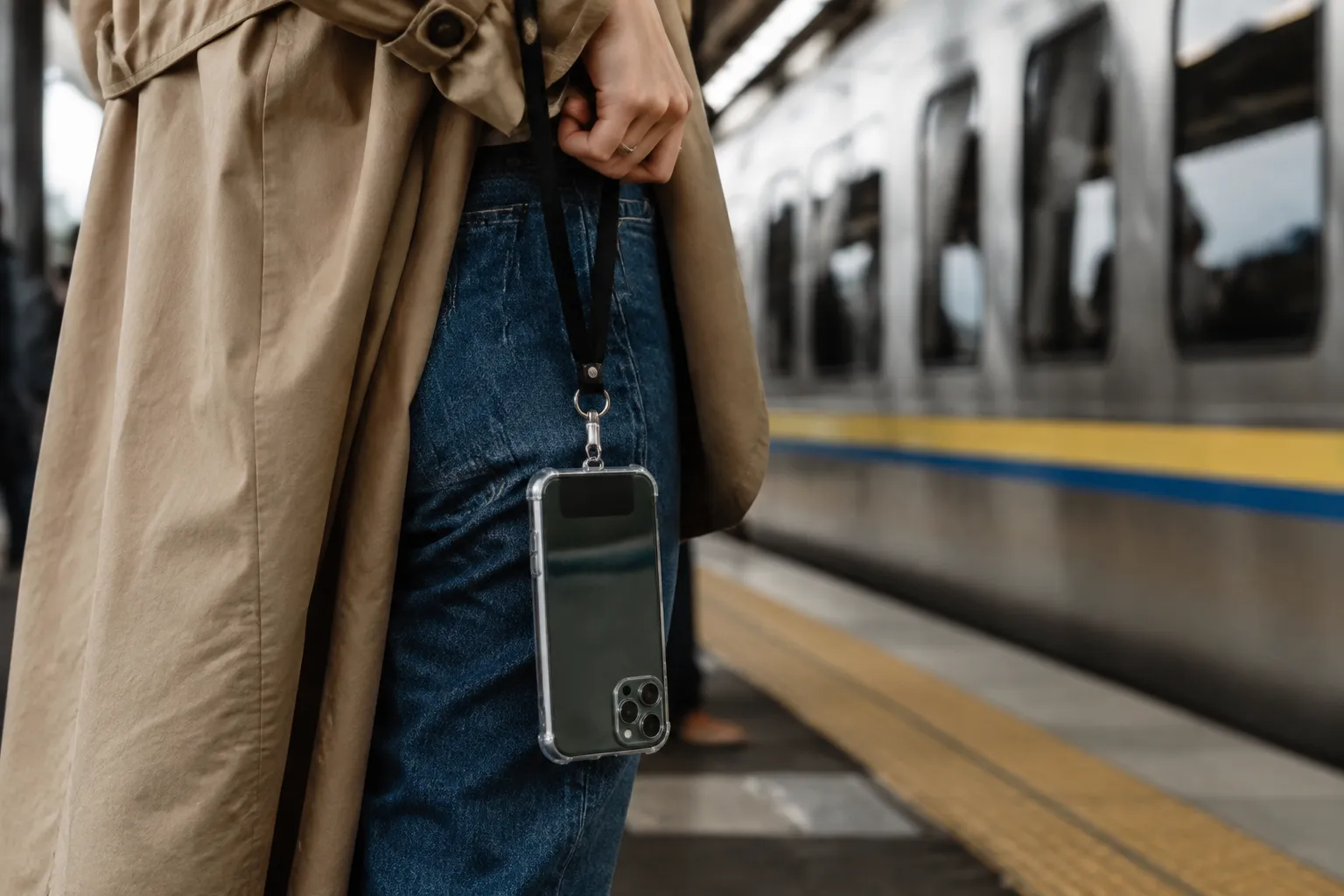
Winter commuting changes the calculus entirely. Gloves make a bare phone case nearly impossible to grip securely. The lanyard loop becomes not a convenience but a necessity, the only reliable way to keep hold of a phone when fingers are wrapped in wool or synthetic insulation. A phone on a wrist strap can be used without removing gloves, because the strap keeps the phone from falling when the gloved grip slips.
Cold also affects the materials. TPU loops stiffen significantly in freezing temperatures. A loop that flexes easily at room temperature can become rigid and brittle at minus ten degrees Celsius. The case shell itself becomes more likely to crack on impact. Fabric loops are unaffected by cold and remain the better choice for winter commuters. The fabric does not stiffen, does not become brittle, and retains its flexibility even when wet from snow.
Wet conditions reveal another weakness in cheap loops. Water seeps into the gap between the loop and the case shell. If the loop is purely cosmetic, molded into the outer surface, that water sits against the phone's back panel. Repeated wet-dry cycles can weaken adhesives in some cases, particularly those with a separate inner liner. Cases with a sealed loop channel, where the loop passes through the case structure rather than sitting on top of it, resist water ingress far better.
A person who commutes in a rainy city should also consider how the loop interacts with wet clothing. A phone hanging from a neck lanyard under a coat will trap moisture against the chest. The fabric loop will absorb that moisture and stay damp for hours. A plastic or TPU loop sheds water and dries quickly. For heavy rain climates, the material of the loop is a comfort issue as much as a durability issue.
When the Loop Is the Whole Point
Some commuters do not want a case at all. They want a holster that happens to protect the phone. For these people, the loop is not an accessory. It is the primary interface with the phone. The case exists to give the loop a solid anchor. This category includes runners, cyclists, and anyone who needs both hands free while keeping the phone accessible.
Armband cases with integrated lanyard loops are a strange hybrid. They strap around the bicep and include a small loop on the outer edge. The loop is meant for a secondary safety tether, but it also serves as a pull tab for removing the phone from the armband. The dual function is clever. The loop adds a fingerhold that makes one-handed extraction much easier. This is a case where the loop solves a problem the manufacturer did not explicitly design for, and the result is a product that feels more refined than its specs suggest.
For cyclists who do not want an armband, a stem-mounted phone holder with a lanyard loop provides a backup if the mount fails. The loop connects to a short leash that wraps around the handlebar. If the mount pops loose on a bumpy road, the leash catches the phone before it hits the pavement. This is a niche use, but it demonstrates the broader principle: a loop is only as good as the system around it. A person should think about the whole carry system, not just the case.
The lanyard loop also changes how a phone is retrieved. A phone in a pocket without a loop requires a reach, a grip, and a pull. A phone with a loop attached to a wrist strap requires only a flick of the wrist to bring the phone into the hand. This difference is measured in fractions of a second, but on a crowded platform where the doors are closing, fractions of a second matter. The loop transforms the phone from an object that must be fished out of a pocket into an extension of the hand that is always available.
The lost art of the phone leash deserves a revival. Before the smartphone era, phones clipped to belts and hung from lanyards as a matter of course. The device was a tool, not a fashion statement. Somewhere in the last fifteen years, the industry decided that phones should be sleek and pocket-ready, and the lanyard loop became a niche feature rather than a standard one. The commuters who kept the habit know something that the smooth-case crowd has forgotten: a phone that is tethered is a phone that is never lost, never dropped, and never left behind on a seat.
Choosing a case with a built-in lanyard loop is not about style. It is about building a system that survives contact with the real world. The loop that seems like a minor detail on a product page becomes the difference between fumbling for a phone in a dark coat pocket and having it firmly in hand the moment the train doors open. A good loop disappears into the routine. It is only noticed when it is missing, and by then, the lesson has already been learned.