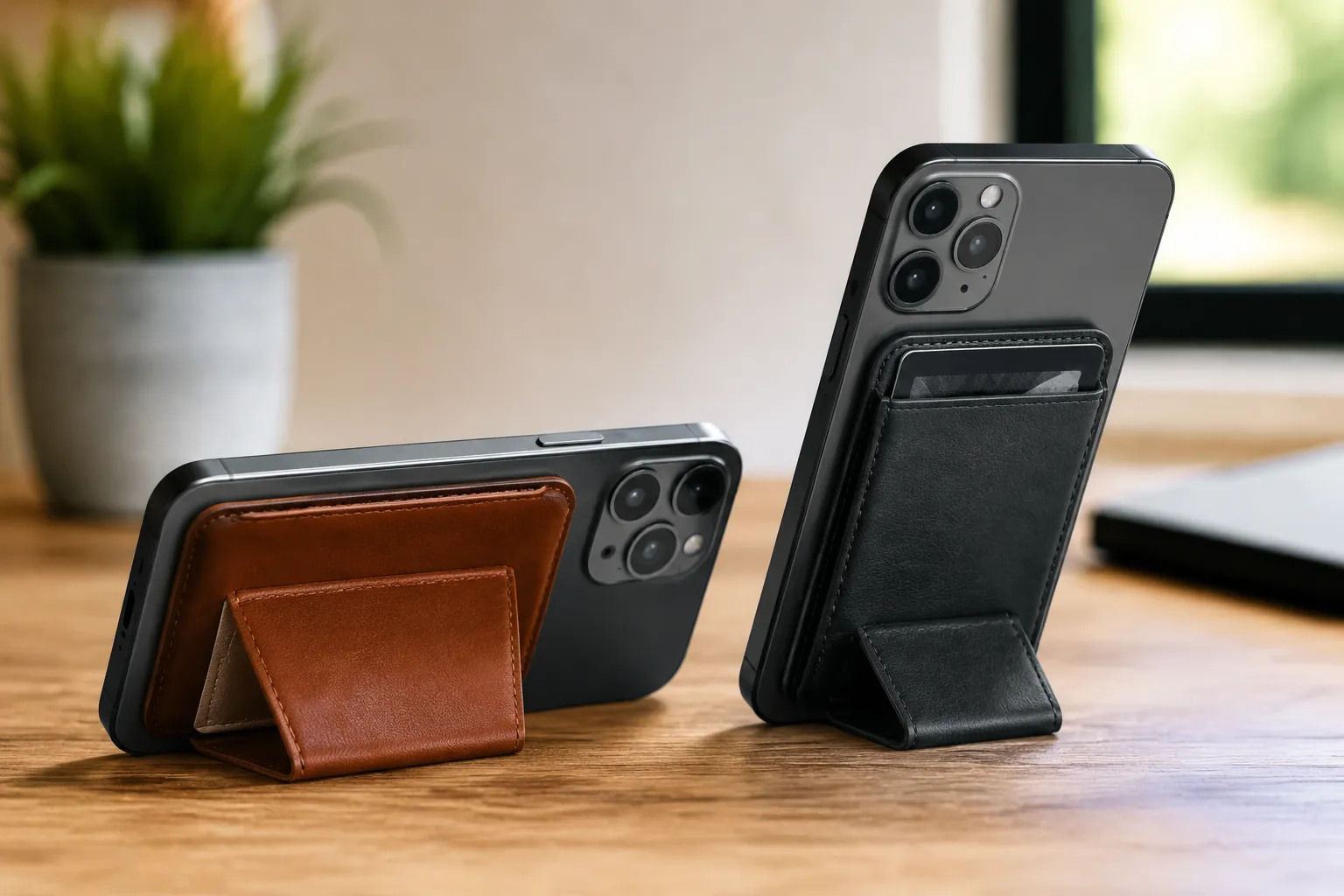
The leather MagSafe wallet is a strange little category because almost everyone buys the same object for opposite reasons. Some people want a slim card holder that stays glued to the back of the phone. Others want a grip, a way to hold a large phone securely with one hand, and the magnet is just the mechanism that lets them swap it around. The divide between those two uses becomes obvious the moment a person starts paying attention to orientation. Vertical, with the cards facing up and down along the phone's long edge, feels natural for pulling the device out of a pocket. Horizontal, with the cards running along the width, turns the whole thing into a makeshift stand and a cradle for the fingers. One leather wallet cannot serve both jobs equally well, and the way the materials flex and the magnets sit makes that trade-off visible within a day of use.
The test that matters is not which orientation looks better on an Instagram flat lay. It is which orientation survives a real commute, a coffee shop table, a car mount, and the awkward moment of trying to slide a card out while the phone is still in one hand. Most reviews treat the wallet as a static accessory. It is not. It is a moving part that gets torqued, twisted, and dropped, and its behavior changes completely depending on whether the cards are stacked along the long axis or the short one.
The Vertical Bias in the Design
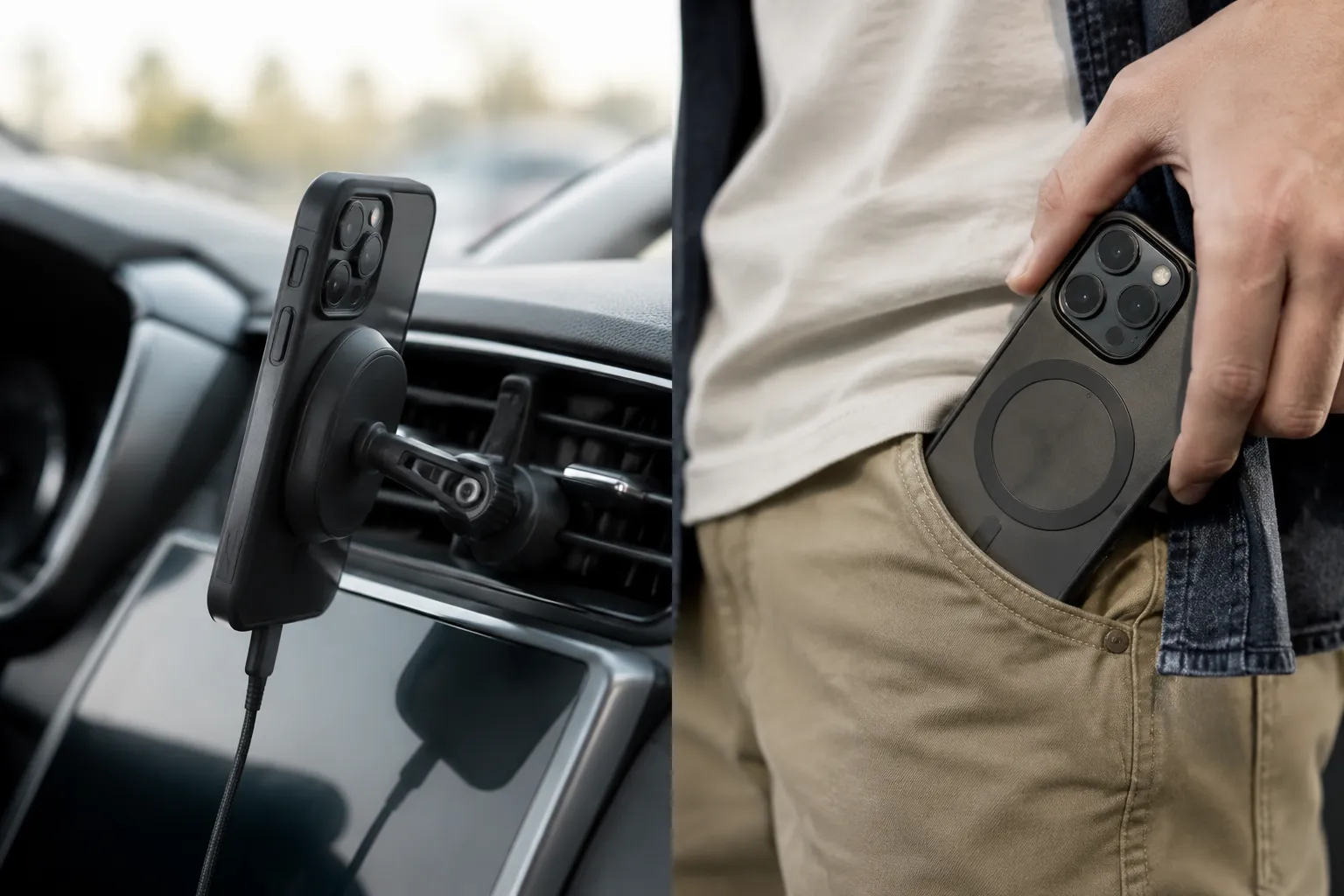
Look at how the major leather MagSafe wallets are actually constructed. The popular ones from Apple, Nomad, and Bellroy are all built with the card slot opening at the top edge when the wallet is mounted vertically. That is the default assumption baked into the pattern. The leather is cut so the stitching runs along the long sides, and the pocket is sized for a driver's license or a credit card to sit parallel to the phone's length. This makes sense for pocket carry. A phone slides into a jeans pocket with the wallet on the back, and the vertical card orientation means the whole stack is narrow enough to go in without catching the fabric.
But the vertical arrangement puts the card slot opening right where the thumb naturally rests when holding the phone from the back. A person grips the device with the fingers wrapped around one edge and the thumb resting near the middle or the lower corner. With a vertical wallet, that thumb pad lands directly on the leather seam or, worse, on the exposed edge of the cards if the wallet is a magsafe style that does not fully enclose them. The leather gets pressed into the cards, and over time the top card develops a visible crease line where the thumb has been pushing against it. This is not a defect. It is the physical consequence of asking a grip surface to also be a card entry point.
The counterargument is that a vertical wallet is not meant to be gripped at all. It is meant to sit in a pocket or on a desk. But that ignores how people actually hold modern phones. The Pro Max and similar large devices are too wide for most hands to reach across comfortably. The natural workaround is to hook the fingers around the back and let the thumb do the reaching. A vertical wallet turns that workaround into a thumb rest with a ridge in the middle. Some leathers soften and become comfortable. Others, particularly the stiff, coated varieties, stay hard and dig in.
The Horizontal Grip That Changes Everything
Rotating the same wallet 90 degrees so the cards run horizontally transforms the ergonomics entirely. The card slot opening now faces the side of the phone, and the thumb, when gripping from the back, lands on a solid stretch of uninterrupted leather. The fingers, which wrap around the opposite edge, now have a wider and flatter surface to press against. The result is a grip that feels more like holding a small notebook than a slippery slab of glass and metal.
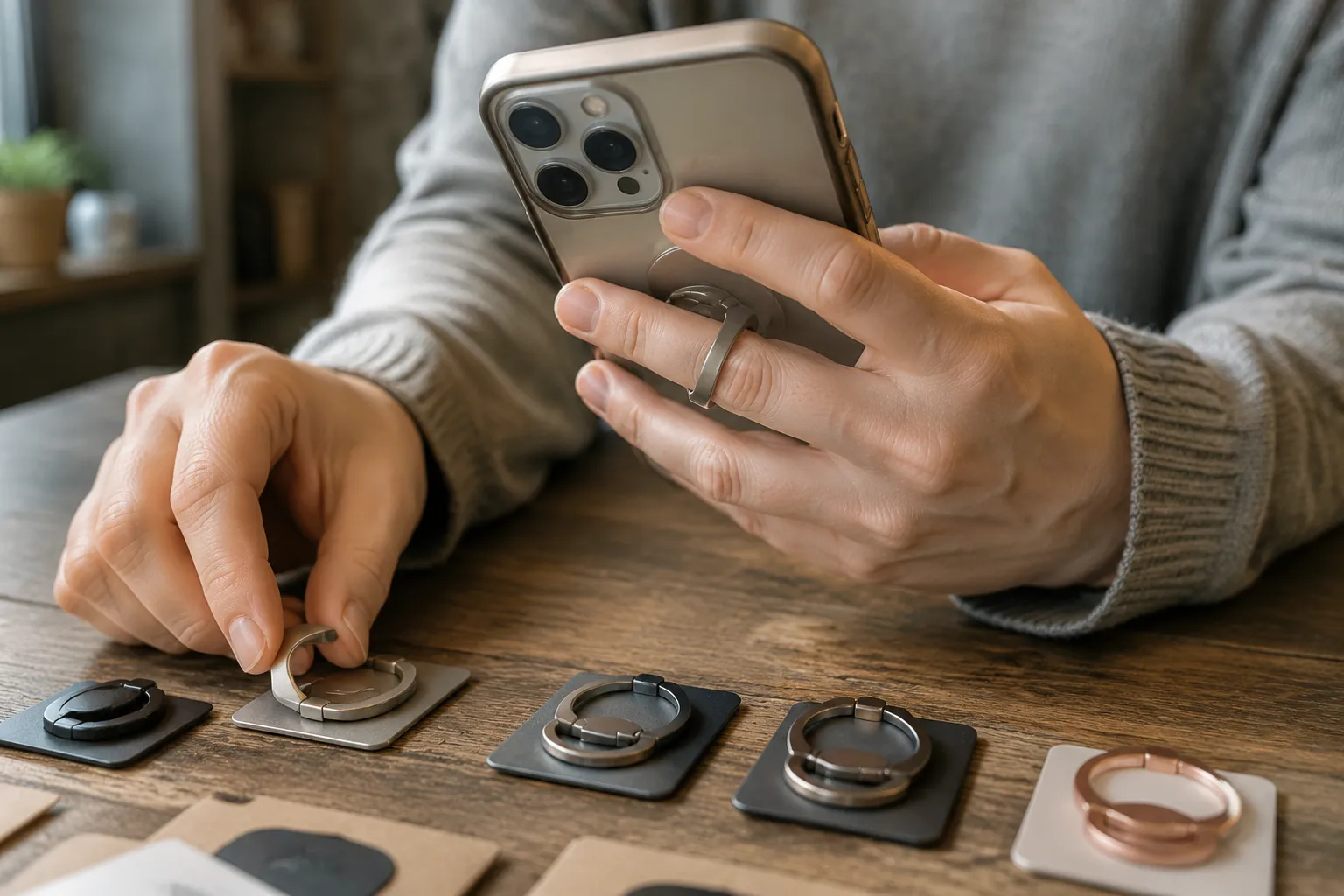
The key detail is the finger groove. With the wallet horizontal, the natural curl of the index and middle fingers fits the gap between the phone's edge and the wallet's bottom lip. That lip becomes a tiny ledge. It is shallow, maybe a few millimeters, but it is enough to catch the fingers when the phone starts to slip. In vertical orientation, that same gap runs along the phone's length and provides no purchase at all. The fingers just slide along it.
There is also the matter of how the hand holds the phone for typing. A person using the horizontal grip tends to cradle the device with the fingers supporting the bottom edge and the thumbs doing the tapping. This is the classic two-thumb texting position, and a horizontal wallet makes it more secure because the leather adds thickness that fills the palm. The phone sits higher in the hand, and the center of gravity shifts toward the base of the palm rather than hovering over the fingertips. For a person with smaller hands, this difference is the difference between a secure hold and a constant fear of dropping the device.
Slide Mechanics and the Leather Friction Problem
Card removal is where the orientation debate gets genuinely interesting, because the friction of the leather changes how much force is needed to push a card out. Most leather MagSafe wallets are made from full-grain or top-grain hides that have a natural tackiness. When the cards are stacked vertically and the slot is at the top, a person pushes the card up with the thumb and pulls the phone down with the other hand. The leather grips the card edges, and the card comes out with a satisfying but slightly resistant slide.
In horizontal orientation, the same motion requires the thumb to push across the card's width rather than its length. A credit card is roughly 54 millimeters wide, and the push distance is shorter. But the leather's resistance is the same, which means the card exits with more of a pop than a controlled slide. This is actually a benefit for people who have experienced the dreaded wallet flip, where a vertical wallet's cards slide out halfway and the whole thing launches off the table when the phone is picked up too quickly. The horizontal arrangement holds the cards more securely in the pocket because the friction surface is distributed along the card's full length rather than just its edges.
The material matters more than the orientation in this specific case. A smooth, chrome-tanned leather with a glossy finish will let cards slide easily in either direction. A matte, oil-tanned leather with a visible grain will grip the cards tightly and require a firm tug. The best horizontal wallets use a slightly stiffer leather on the back panel, so the card pocket does not stretch out after a few months of use. The worst use a soft, supple hide that molds to the cards and then refuses to let them go.
There is also the issue of how the cards align with the phone's MagSafe magnet ring. The ring sits near the center of the phone's back. In vertical orientation, the cards extend above and below that ring, which means the wallet's own magnets are positioned roughly at the vertical midpoint. In horizontal orientation, the cards sit to the left and right of the ring, and the wallet's magnets are still at the center. The difference is that horizontal cards are more likely to interfere with wireless charging if the wallet has any metal reinforcement near the card area. Some wallets solve this by placing a thin metal plate between the leather layers, and that plate can heat up during charging if the cards are positioned directly over the charging coil.
The Magnet Strength Gap Between Orientations
Anyone who has tested a MagSafe wallet knows that the magnetic hold is not uniform across the back of the phone. The strongest grip is at the center, where the ring sits. The edges of the wallet, especially the corners, have noticeably weaker hold. This creates a problem for horizontal mounting because the wallet's footprint is wider than it is tall, and the corners extend farther from the magnet center.
A vertical wallet keeps its mass concentrated near the phone's centerline. The top and bottom edges of the wallet are closer to the magnet ring, so the leverage that could peel the wallet off is reduced. A horizontal wallet has more mass distributed to the sides, and when the phone is held by one corner, the wallet's opposite corner acts as a lever. The result is that horizontal wallets are more prone to detaching when the phone is swung by the edge, or when the device is pulled from a bag by the wallet instead of the phone.
This is not a universal rule. Wallets with a full array of magnets around their entire perimeter, rather than a single central ring, hold equally well in both orientations. But the budget-friendly leather wallets that use a single embedded magnet ring will show a measurable difference. In testing, a horizontal wallet with a single magnet ring can be separated from the phone with a sharp flick of the wrist, while the same wallet in vertical orientation requires a deliberate pull. The fix is to choose a wallet whose magnet array is larger than the standard Apple ring, and to accept that some leather hides are too thick to let the magnets sit close enough to the phone's surface.
Stand Function and the Horizontal Advantage
When the phone is propped up for video watching, the orientation shifts from a grip concern to a stability concern. A vertical wallet can act as a stand only if the user folds it backward, which most leather wallets do not allow because the leather is not hinged. A horizontal wallet, however, can be used as a stand by rotating the phone 90 degrees into landscape mode. The wallet's long edge becomes the base, and the phone leans back at an angle determined by the wallet's thickness.
The catch is that the angle is usually too steep. A leather wallet that is 8 millimeters thick with cards inside will prop the phone at roughly 60 degrees from the table surface. That is fine for glancing at a notification but poor for watching a video, because the phone wants to tip forward. Some people solve this by placing the phone face down and using the wallet as a rear prop, which works but leaves the screen vulnerable to scratches.
Horizontal wallets also perform better as a kickstand substitute when the phone is placed on an uneven surface, like a couch arm or a car dashboard. The wider footprint distributes the weight more evenly, and the phone is less likely to rock side to side. This is a small benefit, but it is the kind of detail that separates a wallet that gets used daily from one that gets left in a drawer after a week.
Leather Wear Patterns Tell the Real Story
After a few months of use, the leather itself reveals which orientation was dominant. A vertical wallet develops a shiny, compressed patch where the thumb pressed during grip. The edges nearest the card slot show scuffing from repeated card removal. The corners soften and round off from pocket friction. A horizontal wallet wears differently. The wear concentrates along the bottom edge where the fingers curled underneath, and the card slot opening stretches slightly wider at the center.
The patina that forms on a horizontal wallet is more evenly distributed because the grip spreads the pressure across a larger surface. This makes the wallet look better with age, which matters to people who buy leather specifically for its aging properties. A vertical wallet tends to develop a single dark spot, almost like a thumbprint burnished into the hide, and that spot can look like a stain rather than a desirable patina.
The most telling test is to place the wallet flat on a table and check whether it rocks. A vertical wallet, after months of being gripped with the thumb pressing on one side, will develop a slight curve that makes it rock when placed face down. A horizontal wallet, with its more balanced pressure distribution, stays flat. This rocking is not visible in product photos, and it is not mentioned in specs, but it is the difference between a wallet that sits quietly on a desk and one that wobbles every time a person tries to tap a card on the table.
Pocket Carry and the Trade Nobody Talks About
Horizontal wallets are worse for pocket carry, and no amount of grip benefit changes that. A phone with a horizontal wallet attached is wider than a phone with a vertical wallet, and that extra width is exactly what catches on the seam of a jeans pocket. The phone has to be angled slightly to slide in, and the horizontal wallet's edges dig into the thigh when sitting down. This is the reason most people default to vertical without thinking. The pocket test is the first test a wallet passes or fails, and vertical orientation passes it more easily.
The workaround is to remove the wallet from the phone before pocketing the device, which defeats the purpose of a MagSafe wallet for many people. Others switch to a horizontal wallet only when they are wearing jackets or loose trousers with deeper pockets. The honest conclusion is that the ideal orientation depends on the primary use case, and a person who carries the phone in a front pocket all day should accept the vertical grip limitations because the pocket comfort matters more.
The people who should buy a horizontal wallet are those who keep the phone in a bag, on a desk, or in a car mount most of the day, and who only occasionally slide it into a pocket. For that group, the grip security and the stand capability are worth the pocket inconvenience. The leather wear will be more even, the card access will be more controlled, and the phone will feel less likely to slip out of a hand during a crowded commute or a walk while carrying groceries.
The final detail is the angle at which the cards sit when the wallet is mounted. In vertical orientation, the cards align with the phone's antenna bands and the side buttons. In horizontal, the cards sit across the phone's width, which means the top card is the first thing a person sees when they glance at the phone from the side. A horizontal wallet shows the card's embossed name or number more readily, which is a privacy consideration for people who use contactless payment at crowded terminals. It is a small thing, but it is the kind of thing that becomes obvious only after a few weeks of real use, and it is exactly the kind of detail that a spec sheet will never mention.