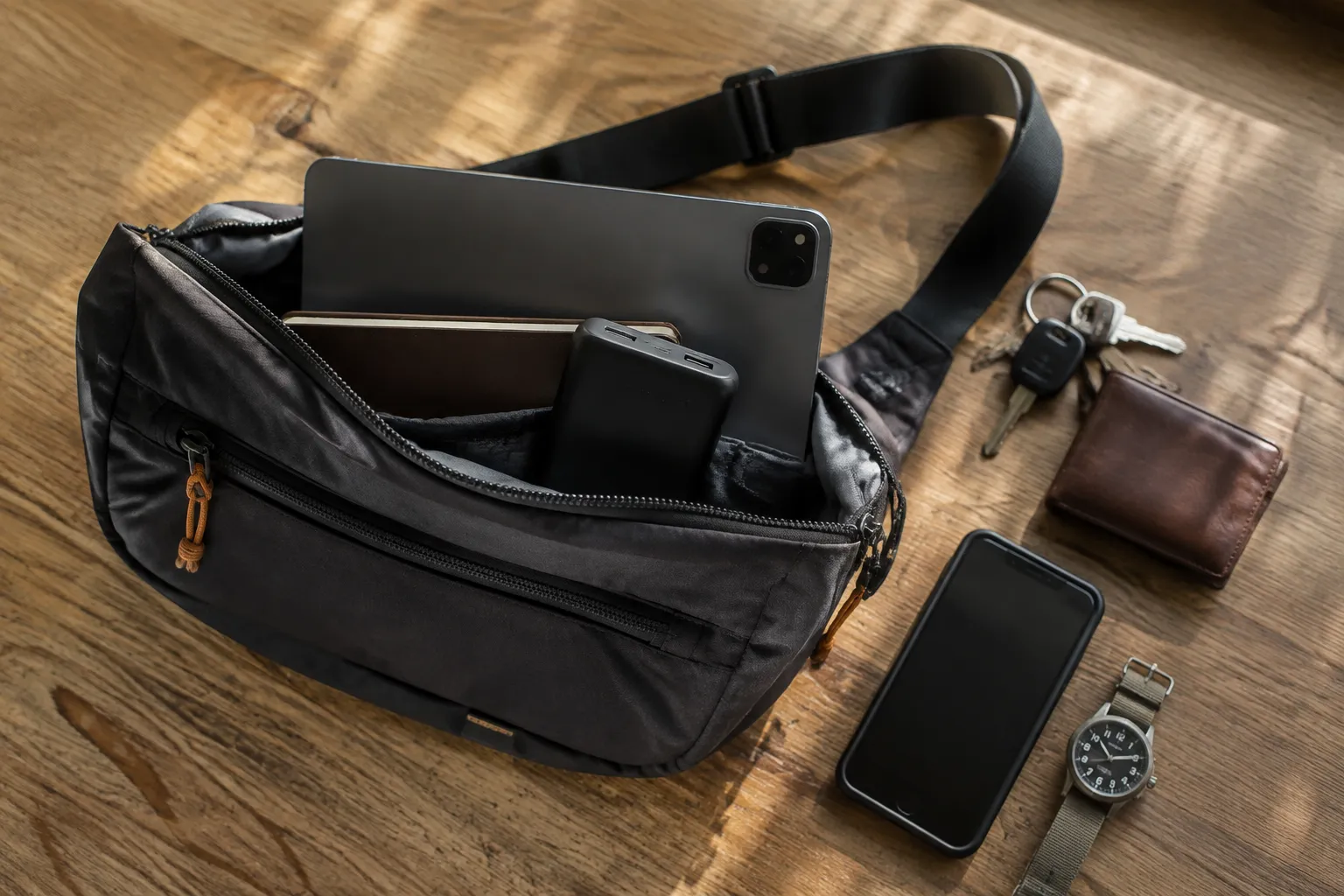
The most honest thing to say about the EDC sling is that it solves a problem most people refuse to admit they have. A person carries a phone, keys, a wallet, and then adds a tablet and a battery brick, and suddenly the jacket pockets bulge like a possum stuffed with avocados. Backpacks feel like overkill for a trip to the coffee shop. Briefcases announce that the wearer is going to a meeting, not to a bookstore. The sling sits in between those options, and for the last few years it has become the default answer for the person who wants both hands free and the ability to actually find a cable without excavating a 25-liter cavern.
The market has responded with hundreds of options, most of them indistinguishable nylon rectangles with a buckle. Sorting through them requires a clear sense of what a tablet-carrying sling actually needs to do. A 10-inch tablet changes the geometry of a bag completely. It is not a phone pocket with extra room. It is a flat, rigid slab that demands a dedicated space, usually against the back panel, and it forces the rest of the contents to work around it. That single constraint filters out more than half of the slings on the market.
Why the Tablet Changes the Math
A sling built for a phone can be 3 liters and feel spacious. A tablet adds roughly a liter of volume just for the device itself, and then the carry system needs padding on at least one side so the screen does not meet a concrete floor through a thin layer of Cordura. The practical minimum for a tablet-capable sling lands around 6 liters. Below that, the bag becomes a tight envelope where every additional item requires a fight with the zipper.
The other shift is weight distribution. A phone sling sits happily at 1.5 pounds loaded. Add a tablet at 1.1 pounds, a 10,000 mAh power bank at half a pound, and the usual assortment of pens, cables, and a small pouch, and the total climbs toward 4 pounds. That weight concentrates on one shoulder, so the strap width and the presence of a stabilizer strap matter in a way they simply do not on a lighter bag. A one-inch strap digging into a shoulder for a 40-minute commute turns a clever carry system into a nagging irritation.
The wearer also needs to accept the cross-body position. Worn on one shoulder like a messenger bag, a loaded sling will slide off within a block. The whole design assumes a diagonal strap across the chest, with the bag resting at the lower back or the front hip. People who hate that feeling, who find any strap across the torso claustrophobic, should stop reading here and buy a small backpack instead. There is no sling design that fixes this.
The Aer City Sling 3: For the Minimalist Who Lied
Aer makes some of the best urban carry gear in the business, and the City Sling 3 is the bag that people buy when they insist they only carry a phone, then realize they want to add an iPad mini. The 3.5-liter capacity sounds small, but the internal organization is so well executed that it punches above its volume. The main compartment opens wide, the back pocket fits an iPad mini snugly, and the front organization panel keeps smaller items from becoming a jumble.
The catch is that the City Sling 3 will not fit a full-size iPad or a 10-inch Android tablet. Anyone who tries to force one in will find the zipper straining and the bag losing its clean silhouette. The design assumes a small tablet or a large phone, not a serious slab. For a person who carries an iPad mini and a power bank and wants to feel like they are carrying almost nothing, this bag is close to perfect. The 1680D Cordura exterior feels tough without looking tactical, and the strap uses a nice webbing that does not twist.
What pushes the Aer ahead of comparable small slings is the attention to how a person actually moves through a city. The strap has a quick-release buckle that does not require a contortionist to operate. The back panel is padded with a foam that breathes enough for a summer walk. The zippers are smooth, which sounds trivial until a person has fought with a cheap zipper while standing in a crowded train doorway. At 110 dollars, it is not cheap, but it is the bag that feels like it will last a decade.
The Moment When 6 Liters Becomes the Right Call
Somewhere between carrying a tablet and carrying a tablet plus a light jacket or a water bottle, the capacity question stops being about preference and becomes about physics. The 6-liter class exists for exactly this threshold. The best example of this category is the Alpaka Metro Sling Pro, which manages to fit a full 11-inch iPad Pro in its main compartment while still looking like a bag for a night out rather than a bag for a hike.
The Metro Sling Pro uses a clever two-compartment layout. The rear compartment holds the tablet flat against the back, protected by a foam pad. The front compartment expands slightly to take a power bank, a small camera, or a paperback. The external straps on the sides let a person lash a jacket or a tripod, which turns the bag from a simple sling into a genuinely versatile day carry. The X-Pac fabric option adds a subtle sailcloth texture that stands out from the sea of black nylon.
The trade-off appears in the strap hardware. The buckle mechanism works fine, but the adjuster tab can dig into a shoulder blade for a person with a shorter torso. The bag also has a tendency to swing forward when the wearer bends down to tie a shoe, which is a common sling annoyance at this size. None of these issues are dealbreakers, but they keep the Metro Sling Pro from being a flawless recommendation. At 89 dollars, it offers the best balance of tablet capacity and everyday manners in the category.
The Bellroy Venture Sling: The Price of Polished Looks
Bellroy builds bags that look like they belong in a design studio rather than a luggage rack, and the Venture Sling 10L carries that aesthetic into the tablet category. The 10-liter capacity is generous enough for an iPad Air, a mechanical keyboard, and a power bank, with room left for a light layer. The recycled fabric has a soft, almost suede-like hand that resists the stiff, crinkly feel of most technical materials. The magnetic buckle closes with a satisfying click and releases with one hand.
The styling costs something in function. The Venture Sling 10L has no external water bottle pocket, which feels like an oversight for a bag this size. The main compartment opens with a single large zipper that runs around three sides, but the lack of internal organization means small items drift to the bottom. A person who wants to carry a tablet, a power bank, and a handful of cables will need to add pouches to keep things sorted. The bag looks beautiful hanging on a hook, but it does not reward a chaotic packer.
That said, the 10L size is the sweet spot for a person who wants to carry a full tablet setup without moving to a backpack. The extra volume absorbs the randomness of daily life, a scarf in winter, a snack for a long meeting, a paperback picked up on a whim. The strap is wide and comfortable, and the bag stays put on the back. At 179 dollars, it is the most expensive option here, and the price buys a refined look that works from a client meeting to a brewery patio without missing a beat.
How the Strap System Changes Everything
Most people evaluate a sling by its pockets and zippers, but the strap system determines whether the bag gets worn at all. The 5-liter class of bags works fine with a simple webbing strap and a single adjustment point. Once the load passes 3.5 pounds, the strap needs to distribute weight across the shoulder and upper back, and the bag needs to resist sliding forward. Two design features matter above all others.
The first is a stabilizer strap. This is a thin secondary strap that connects the main strap to the bottom of the bag, creating a triangle that holds the bag against the body. Without it, a heavy sling swings forward whenever the wearer leans over or moves quickly. The Aer and Alpaka bags both offer a stabilizer option, while the Bellroy Venture Sling 10L uses a curved strap design that reduces the need for one. The stabilizer adds a bit of faff every time the bag goes on, but the stability gain for a tablet load is substantial.
The second feature is the strap material itself. A slippery nylon strap slides across a winter coat and requires constant readjustment. A strap with a rubberized inner surface, or one made of a grippy seatbelt-style webbing, stays put through a long walk. The difference becomes obvious on a rainy day when a person is wearing a slick shell jacket. The bag that felt secure on a cotton t-shirt suddenly wants to migrate toward the elbow.
The Code of Conduct for Power Bank Placement
A power bank introduces a problem that most sling designers ignore: it is a dense, heavy brick that wants to be accessible without occupying the space a tablet needs. The right placement is a dedicated front compartment or a stretch mesh pocket on the inside, where the bank can sit flat against the outer wall. A 10,000 mAh bank, particularly one with a built-in cable, fits perfectly in a slim pocket no more than an inch deep.
The wrong placement is at the bottom of the main compartment, where it slides around and presses against the tablet. The cables also need a home. A person who carries a power bank without a cable is carrying a paperweight. The best slings include a small elastic loop or a dedicated pocket for a coiled cable, so the whole charging kit stays together. The Alpaka Metro Sling Pro excels at this, with a front pocket that swallows a 6,000 mAh bank and a 6-inch cable without bulging.
A final note on power bank size: a 20,000 mAh bank is too heavy for a sling. The weight concentration turns the bag into a pendulum that swings with each step. A 10,000 mAh bank provides two full phone charges and a partial tablet charge, which covers a full day out. Anyone who needs more than that should be carrying a backpack and a different lifestyle.
The Fixture That Holds the Daily Grind
Beyond the tablet and the power bank, the sling has to absorb the miscellaneous objects that define a real day. A pen, a small notebook, a lip balm, a set of earbuds, a passport or a transit card, a snack that got crushed at the bottom of a backpack and now needs a safer home. The bags that handle these items gracefully share a common trait: they use the full depth of the bag rather than just the front panel.
The Aer City Sling 3 has a clever internal layout that uses vertical dividers to create separate channels for pens, cables, and a phone. This prevents the classic sling failure mode where a person unzips the bag and every small item avalanches toward the opening. The Bellroy Venture Sling 10L, with its cavernous main compartment, actually struggles with this problem. Small items drift to the bottom and require a full rummage to retrieve. The solution is a separate tech pouch, which adds another object to remember, or accepting that the bag works best for people who carry few small items.
A note on the transit card or key fob. The best slings include a quick-access pocket on the top edge or the strap itself. Reaching into a main compartment for a transit card while standing at a fare gate is a minor annoyance that repeats twice a day. A dedicated pocket cuts the motion down to a single zip and a single grab. The Alpaka has this pocket. The Bellroy does not. A small detail that becomes a daily verdict.
The Rain and the Real World
No sling survives a downpour without some help, but the material choice determines whether the contents survive a drizzle. The X-Pac fabric used in the Alpaka and the coated Cordura in the Aer both shed water well enough for a walk between subway stops. The zippers matter just as much as the shell. A standard zipper, even a water-resistant one, will leak under sustained rain. The AquaGuard-style zippers used in higher-end bags create a tight seal that keeps moisture out, but they also run stiffer and require two hands to zip smoothly.
The practical advice is to carry a small stuff sack or a Ziploc for the tablet on days when the forecast looks threatening. The tablet is the one item that cannot dry out in a few minutes. A damp notebook still works. A damp iPad screen develops spots. A person who commutes in a rainy city should prioritize a bag with a covered zipper track or an external flap over the main opening, which is a feature more common on the Aer bags than the others.
The last consideration is what happens when the bag is not on the body. A sling that cannot stand upright on its own becomes a floppy puddle on a restaurant floor or a train seat. The Aer and the Bellroy both have enough structure to stand when packed. The Alpaka, with its softer side panels, requires a lean against a wall. This sounds trivial until a person tries to retrieve a tablet while holding a coffee and balancing on a moving train.
The Verdict Splits by Daily Distance
The right sling depends on the distance a person actually covers. For a short hop from a car to a cafe, where the bag sits on a passenger seat for most of the day, the Bellroy Venture Sling 10L offers the most style and the most forgiveness. For a commute that involves walking, trains, and a crowded transfer station, the Alpaka Metro Sling Pro earns its keep with better weight distribution and easier access to the essentials. For the person who carries an iPad mini and refuses to admit that they are carrying anything at all, the Aer City Sling 3 is the leanest option that does not force compromises.
The bags all share a common weakness that no manufacturer has fully solved. The tablet, once placed in its protective pocket, is not accessible without removing the bag and setting it down. A person cannot unzip a sling one-handed while standing and pull out an iPad to check a map. The form factor simply does not allow it. Anyone who needs that level of access should buy a backpack with a side zipper and move on with their life.
The sling earns its place for the person who wants the tablet close at hand without announcing its presence. It carries the tools of a digital life in a compact package that disappears under an arm or rests against a hip, and it does so without turning the wearer into a pack mule. The trade-off is accepting the awkwardness of a full stop when the tablet needs to come out. For many people, that moment of pause is a small price for a carry system that works with the rhythm of the day rather than against it.