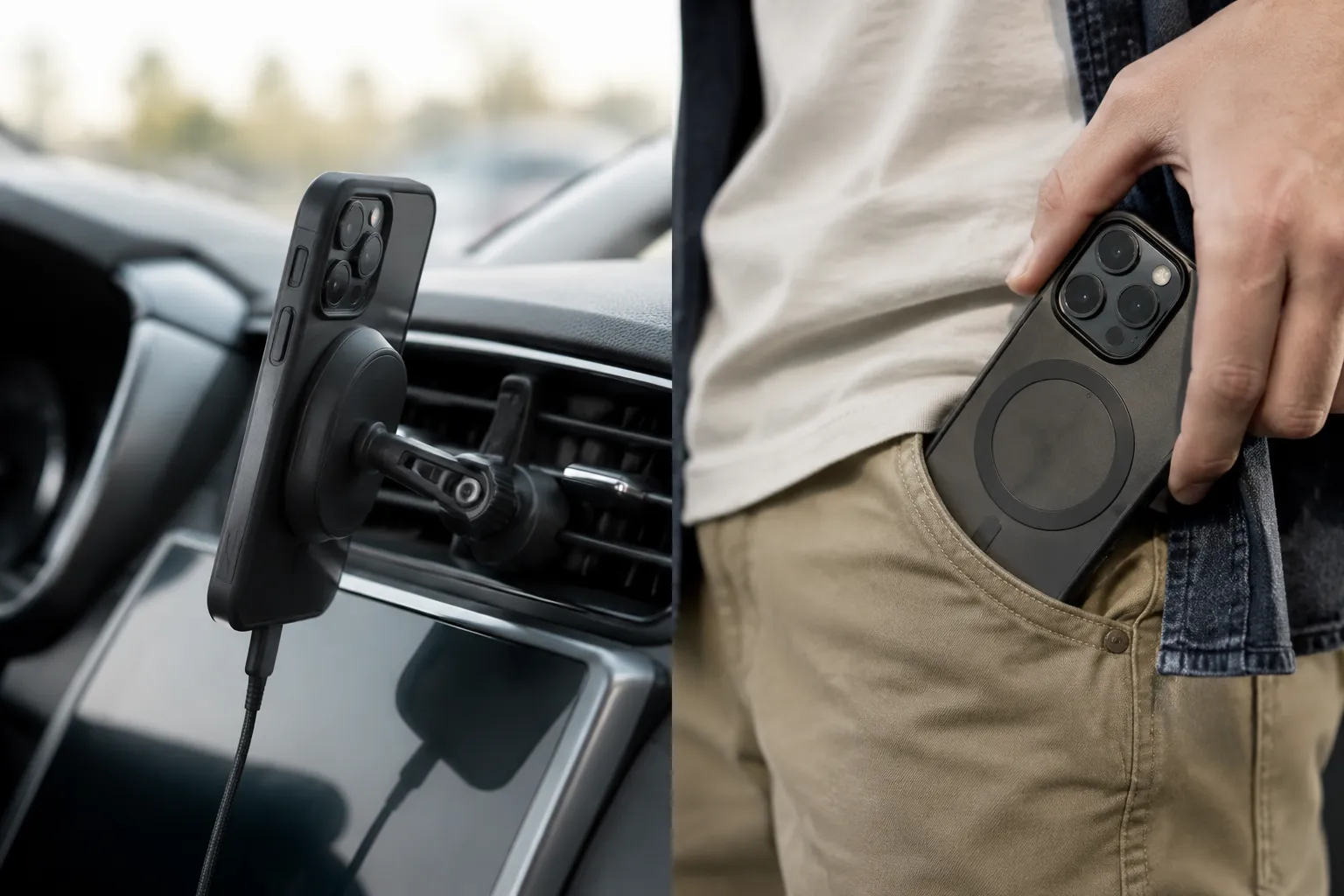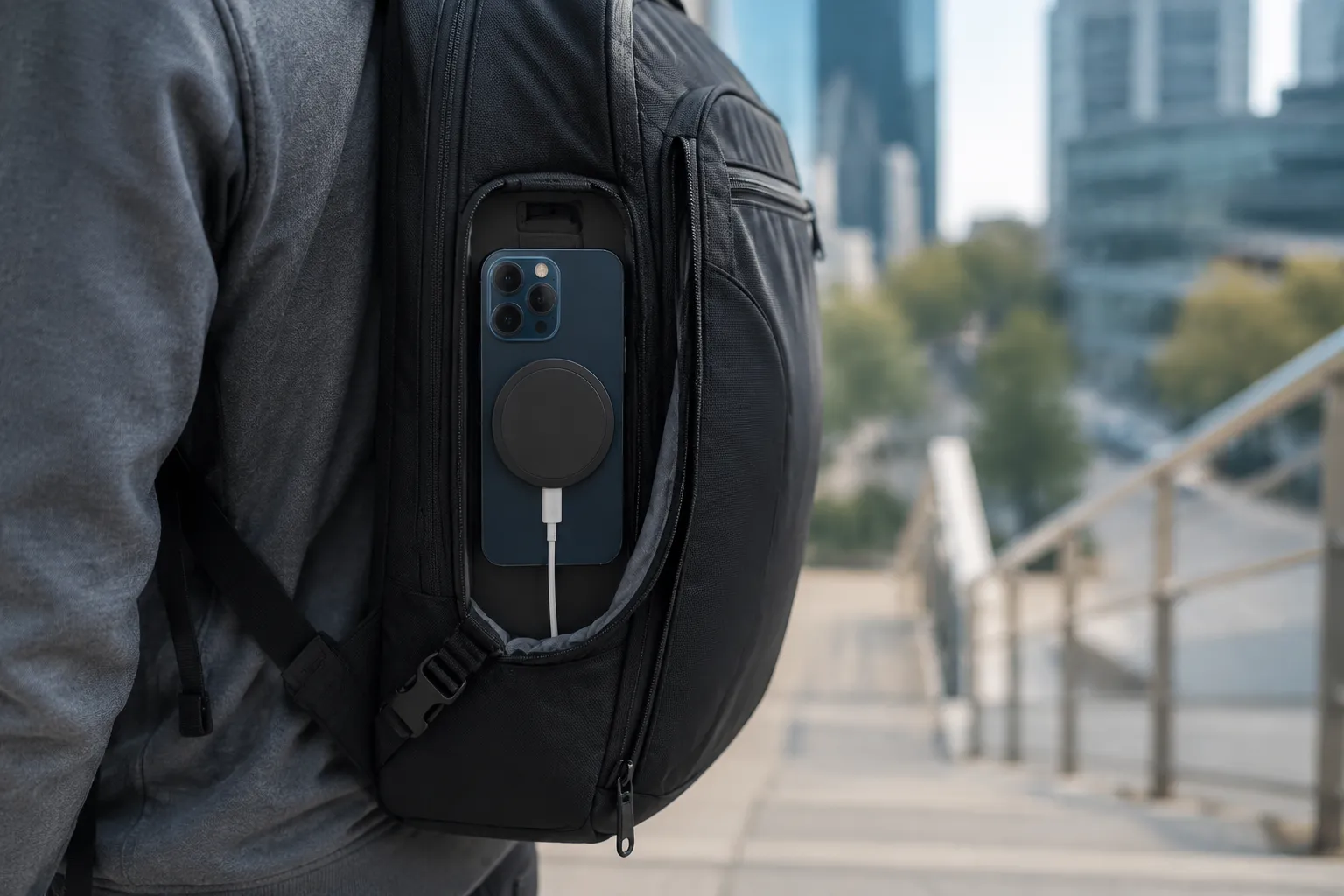
The first time most people see a backpack with a built-in MagSafe charging pocket, the reaction is usually the same. It is a slow squint, followed by a silent question about whether they are looking at a solution to a problem they have never actually had. There is a genuine tension baked into the category. A backpack is supposed to be a simple thing. A bag that charges a phone while a person walks through an airport feels less like an upgrade and more like a gadget looking for a reason to exist.
Then the suitcase gets tossed into an overhead bin, the hand finds the pocket for the hundredth time, and the battery sits at 12 percent again. The discomfort of being permanently tethered to a wall outlet is real enough that companies have started sewing inductive charging coils into fabric. The result is a category that is still finding its footing, where the difference between a thoughtful piece of carry gear and a marketing gimmick comes down to the mundane physics of alignment, heat, and zipper placement.
The core promise is straightforward. Drop a phone into a designated slot, and a coil hidden beneath the lining tops up the battery through the same magnetic snap that Apple built into the back of modern iPhones. No cables, no hunting for a port, no forgetting the power bank at the hotel. The phone just sits there and gains charge while a person walks, rides a train, or stands in a line. It sounds almost too clean to be true, and in many implementations, it is.
The Magnet Is the Easy Part
Qi wireless charging has existed in bags for years, mostly as a failed experiment. The early versions were loose pads sewn into the bottom of a pocket. A phone slid around during transit, drifted off the coil, and the charging stopped within fifteen minutes. The whole exercise became an exercise in frustration, and the bags quietly disappeared from catalogs.
MagSafe changed the math because it introduced a physical anchor. The magnetic ring in the phone snaps to a matching ring in the bag, which locks the phone into the exact position over the coil. The alignment problem that killed earlier efforts simply vanished. A person does not need to fiddle with the phone to find the sweet spot. The magnets do the work, and the charging stays consistent even when the bag swings against a hip or gets dropped on a seat.
That is the part the marketing material gets right. The magnets are not a gimmick. They solve a genuine engineering problem that has plagued inductive charging since the technology left the charging pad and tried to move into the real world. The phone stays put, the coil stays aligned, and the power flows.
The harder question is what happens around that magnetic snap. A backpack is not a static surface. It flexes, bends, gets stuffed full, and gets thrown around. The pocket that holds the phone needs to keep the phone pressed against the coil even when the bag is packed to the gills. That requires a rigid backing plate, a snug fit, or some combination of both. Many bags skip this detail and rely on the magnet alone, which works fine until the bag is full and the fabric bulges outward, pulling the phone away from the coil.
Why the Heat Matters More Than the Wattage
Wireless charging generates heat. That is a simple fact of the technology. The coil in the phone and the coil in the bag both warm up during transfer, and heat is the enemy of battery health. A phone that charges wirelessly in a closed pocket, surrounded by insulation and other gear, runs warmer than a phone charging on an open desk. The difference is not enormous, but it is measurable, and over a year of daily charging, it can shave real lifespan off a battery.
Some manufacturers address this with breathable mesh or ventilation channels in the charging pocket. Others do not. The ones that do not are selling a product that slowly degrades the very device it claims to protect. A person buying a bag with a built-in charger is usually the kind of person who cares about battery health, since they are already carrying a phone that costs over a thousand dollars. Selling them a pocket that cooks that battery is a strange form of self-sabotage.
The output wattage matters less than the heat management. Most of these bags charge at 7.5 or 15 watts, which is fine for topping up over the course of a commute. A full charge from empty is not the use case. The use case is a slow, steady trickle that keeps the phone from dying during a long day. At those speeds, the heat is manageable if the pocket is designed properly. The problem is that many bags are designed by people who understand magnets and coils but have never thought about thermal dynamics.
There is also the question of what happens when the phone is not the only thing in the pocket. A charging pocket that is also the designated phone slot needs to be exactly the right size. Too loose, and the phone slides around. Too tight, and a phone with a thick case will not fit at all. The best designs use a stretchy side panel or a soft interior that accommodates the slight size differences between phone models while still holding the device firmly against the coil.
The Battery Question Nobody Asks
Here is the structural problem that most reviews gloss over. The charging pocket is powered by something. Either the bag has an internal battery pack, which adds weight and creates a fire risk, or the pocket is wired to an external battery that the user must supply. The second option is more common, and it creates an odd dependency.
A person buys a bag with a built-in charging pocket, then discovers they still need to carry a separate battery pack and plug it into a cable that dangles somewhere inside the bag. The convenience of wireless charging is undermined by the inconvenience of managing a wired connection to a brick that sits at the bottom of the main compartment. It works, but it feels less like the future and more like a workaround.
The integrated battery option solves that problem but introduces its own. Batteries add weight. A battery with enough capacity to charge a phone twice adds roughly a pound, and it takes up space that could hold a jacket or a laptop charger. The bag becomes heavier and less flexible, and the user must remember to charge the bag itself. A backpack that needs to be plugged in is a strange regression for people who bought it to escape the tyranny of cables.
There is a middle path. Some bags pair the charging pocket with a pass-through cable that connects to the user's own battery pack, but keep the battery in a separate compartment with a short, organized cable. This arrangement keeps the weight optional. The user can carry the battery when they need it and leave it at home when they do not. The charging pocket remains functional regardless, since it can also draw power from a USB port on a laptop or a wall adapter when the bag is at rest.
Where the Bag Lives Matters
The placement of the charging pocket is not a cosmetic detail. It determines whether the feature gets used or ignored. A pocket on the outside of the bag is convenient but exposed to theft and weather. A pocket inside the main compartment is safer but requires opening the bag and digging around. A pocket on the side, accessible without opening the main flap, offers a balance that works well for commuters.
The best implementation this category has produced places the charging pocket on the top of the bag, just behind the handle. The phone slides in horizontally, snaps to the magnet, and charges while the bag sits on the floor of a train or hangs from a shoulder. Access is fast because the pocket is not buried. The phone is also close to the center of gravity, which keeps the bag balanced when it is slung over one shoulder.
The worst implementations hide the pocket at the bottom of the main compartment, in the same space that holds a laptop charger and a pair of gym shoes. The phone gets crushed, the coil gets misaligned, and the charging stops. A person who has to unzip the main compartment, move two other items, and press the phone into a slot will stop bothering after the third day. The feature becomes dead weight that adds cost without adding utility.
The other placement variable is which side the pocket faces. A pocket on the back panel, pressed against the wearer's body, benefits from consistent pressure and warmth. It also puts the phone in a spot where it is hard to reach without removing the bag. A pocket on the front panel is easier to access but catches the worst of the bumps and jostles of daily life. There is no perfect answer, but the designers who put the pocket in an awkward spot are the ones shipping products that end up in a drawer.
What the Case Does to the Equation
MagSafe charging depends on the magnetic ring in the phone. A thick case can interfere with that ring, either by physically separating the phone from the coil or by blocking the magnetic field. Apple's own cases work well because they contain the magnets needed to maintain the snap. Third-party cases are hit or miss.
This creates a compatibility trap. A person buys a bag with a charging pocket, then discovers their rugged case, the one with the built-in kickstand and the card slot, is too thick to allow a reliable connection. The phone slides in, the magnet does not catch, and the charging is intermittent at best. The solution is to remove the case every time, which defeats the purpose of wireless charging in the first place.
The manufacturers of these bags are aware of the issue. Some include a slim MagSafe-compatible case in the box, which is a clever way to control the variables. Others design the pocket with a soft, compressible interior that accommodates a wider range of case thicknesses. The best approach is to test the bag with the actual phone and case that will be used daily. A bag that works with a bare iPhone may not work with the same phone wrapped in a protective shell.
There is also the issue of phones that do not have MagSafe at all. Android devices and older iPhones lack the magnetic ring, so they will not snap into place. They will charge if they happen to land on the coil, but they will slide around and lose alignment within minutes. A bag with a MagSafe pocket is effectively an iPhone accessory, and anyone buying one for a different phone is setting themselves up for disappointment.
The Real Cost of Convenience
These bags cost more. A standard backpack with similar materials and construction might sell for 80 dollars. The same bag with a MagSafe charging pocket jumps to 150 or 200. The price difference is not entirely markup. The coil, the magnet assembly, the wiring, and the reinforced backing all add to the bill of materials. The question is whether the added cost is justified by the added utility.
For a daily commuter who spends an hour or more on a train each day, the charging pocket pays for itself in the elimination of one specific anxiety: the low-battery warning at the wrong moment. The phone gains a meaningful amount of charge during the commute, which means the person arrives at work with a fuller battery and does not need to hunt for an outlet at lunch. That convenience has real value, even if it is hard to quantify.
For someone who drives everywhere and spends most of the day at a desk, the charging pocket is a solution to a problem that does not exist. The car has a charger. The desk has a charger. The bag is an expensive redundancy that adds weight and provides nothing except a feature that sounds impressive in a spec sheet.
The category also suffers from a quality split. Established bag makers who added wireless charging as an afterthought tend to produce mediocre implementations with weak magnets and poor alignment. Smaller startups that built the charging system from the ground up often produce better charging but worse bags, with thin straps, cheap zippers, and insufficient padding. Finding a bag that excels at both is harder than it should be, and the market has not yet consolidated around a clear winner.
The Durability Question That Time Will Answer
A charging coil is a piece of electronics embedded in a flexible object that gets bent, compressed, and dropped. The long-term reliability of these bags is unknown. A traditional backpack can last a decade or more. A bag with a charging pocket has a seam where the wiring runs, a connector that can corrode, and a coil that can crack if the backing plate flexes too far.
The manufacturers offer warranties, but warranties do not help when the bag fails a year later and the company has moved on to a newer model. The consumer is left with a bag that still carries a laptop perfectly fine but no longer charges a phone, and the premium paid for the charging feature is gone.
This is the argument for buying a bag where the charging pocket is a modular addition rather than a permanent fixture. Some companies sell removable charging inserts that attach to standard bags with a clip or a strap. When the insert dies, the bag lives on. When the tech improves, the user buys a new insert instead of a whole new bag. It is a less elegant solution, but it is a more honest one.
There is real innovation here. A few bags have begun experimenting with pass-through charging that works even when the bag is folded flat, using flexible printed coils that can bend without breaking. Others have integrated the charging pocket into a removable pouch that also serves as a travel organizer, so the electronics stay protected when the bag goes through an airline's baggage system. These are genuine attempts to solve the durability problem, and they deserve credit for treating the electronics as a component rather than a gimmick.
A Good Bag Charges Twice
What the best bags in this category understand is that the charging pocket is not the reason to buy the bag. It is a bonus on top of a bag that would be worth owning anyway. The harness fits well. The materials resist wear. The organization makes sense. The charging pocket is a feature that adds value on a good day and does not ruin the bag on a bad day.
The worst bags in the category invert that relationship. The charging is the entire pitch, and everything else suffers. The straps dig into the shoulders. The main compartment has no structure. The zippers catch and jam. These bags are sold on a single feature and fail on everything else, which means the charging pocket gets used for a month before the whole bag gets retired.
The right way to evaluate one of these bags is to ignore the charging entirely. Judge it the way any backpack should be judged. Does it carry a laptop securely? Does it survive a rainy commute? Does it hold the gear a person actually needs? If the bag fails those tests, the charging pocket is irrelevant. If the bag passes, the charging pocket becomes a quiet upgrade that shows up exactly once a day, when the phone comes out of the pocket with more battery than it had going in.
That single moment is the whole value proposition. The phone slides into the pocket, the magnets click, and the walk from the train to the office adds ten percent instead of losing five. No one notices it happening. No one has to do anything. The bag just works, and the battery lasts until the evening. That is the quiet promise of the category, and it is a promise that only the bags built on solid foundations will keep.