Counterfeit Apple accessories used to be a shrug. A fake Lightning cable might stop working after a month, and the buyer would roll their eyes, order another, and move on. The stakes were low because the technology was dumb. MagSafe changed that math. A charger is no longer a passive wire that moves electrons from a wall plug to a battery. It is a coil array, a magnet alignment system, and a communication protocol that negotiates power delivery with the phone. When a counterfeit gets that communication wrong, the failure mode is not a slow trickle. It can be heat, and heat in a lithium-ion device is the one thing nobody should gamble on.
The market is flooded with fakes that look convincing at arm's length. Some of them come in convincing Apple packaging, complete with the pull tabs and the plastic film. The good news is that the physical and electronic tells have not caught up with the packaging counterfeiters. A person who knows what to look for can spot the difference in under a minute, without opening the box, and with zero technical equipment. Here are the five checks that matter.
The weight tells the story first
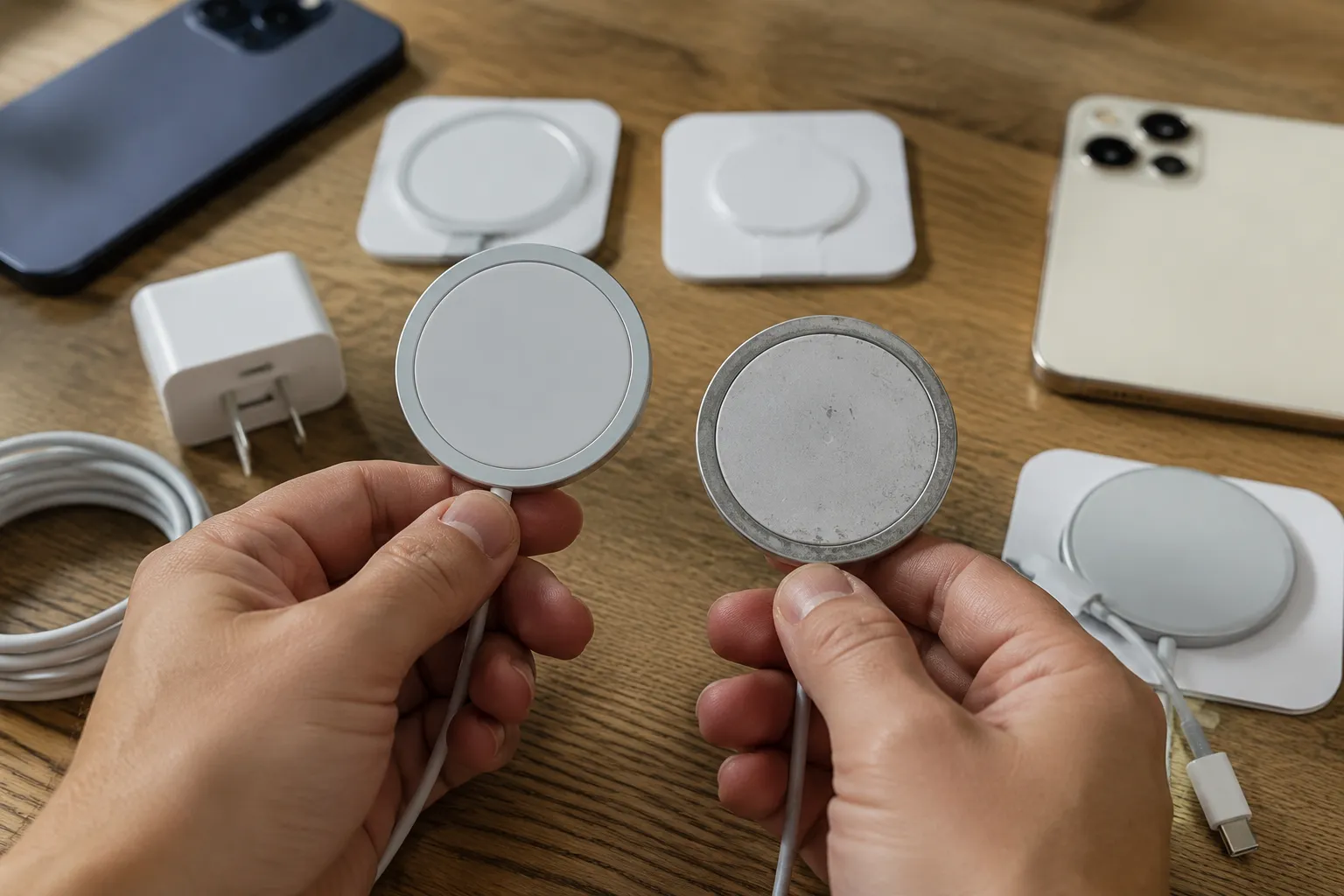
An authentic Apple MagSafe charger has a distinct heft. The aluminum body is machined from a solid block, and the internal components include a substantial magnet array and a shielding plate. Pick up a genuine unit and it feels dense, almost cold at first touch. A counterfeit feels hollow by comparison, like a plastic toy with a metal skin painted on.
The difference is not subtle once a person has held both, but most buyers have only ever held one. A useful trick is to compare the charger against a known object of similar size. An Apple MagSafe charger weighs 107 grams. A counterfeit often comes in around 70 to 80 grams. That 30 gram gap is the difference between a solid aluminum block and a thin shell.
There is a reason the weight gap exists. Apple uses a unibody aluminum construction that requires a specific milling process. Counterfeiters use die-cast zinc or thin aluminum sheet because the tooling is cheaper. The weight difference is not cosmetic. It reflects a genuine difference in thermal management. A solid block of aluminum acts as a heat sink, drawing heat away from the coil and the phone. A thin shell traps heat exactly where it should not be trapped.
The lightning connector is a precision part
Apple does not manufacture a single piece of the MagSafe charger's cabling casually. The connector that plugs into the wall adapter is machined to tolerances that counterfeiters rarely match. The surest visual test is the seam where the connector meets the cable. On an authentic unit, that seam is nearly invisible. The transition is smooth, with no gap and no ridge. On a fake, the seam is often a visible line where two plastic halves meet, and the plastic itself feels slightly softer, almost tacky.
The pins inside the connector are another tell. Apple's connectors have gold-plated pins that sit flush with the surrounding surface. Counterfeit connectors often have pins that sit slightly recessed or protrude unevenly. This is not a cosmetic issue. The pin depth affects the quality of the electrical connection. A poorly seated pin can create resistance, and resistance creates heat.
The cable itself deserves scrutiny. Apple's cable has a woven nylon exterior that is surprisingly stiff near the connector and becomes more flexible toward the charger head. Counterfeit cables often use a braided material that looks similar but feels slicker, like a shoelace rather than a technical fabric. The giveaway is the stiffness gradient. Genuine Apple cables have a hard plastic strain relief at both ends. Fakes often skip this, leaving the cable to bend sharply at the connector, which is the first place a cable fails.
The serial number check that actually works
The classic advice is to check the serial number on Apple's website. That advice is outdated. Counterfeiters now generate serial numbers that pass Apple's online verification because they harvest real serial numbers from genuine units and print them on thousands of fakes. The verification page will say the serial number is valid because it is valid, just not for the unit in a person's hand.
A more reliable check is the serial number's physical format. Apple prints serial numbers on MagSafe chargers in a specific font with specific spacing. The text is laser-etched, meaning it is slightly recessed and has a matte finish. Counterfeiters use ink printing or a cheaper laser that produces a raised or glossy mark. Run a fingernail gently across the text. If the nail catches on the characters, it is a fake. Genuine laser etching is flush with the surface.
The serial number's location also matters. On a genuine MagSafe charger, the serial number is printed on the flat face opposite the charging surface, near the cable exit. The text is small but legible without magnification. On many fakes, the serial number is either missing entirely or printed on the side edge of the charger, where it is easier to stamp during assembly. A charger with no serial number at all is an automatic reject, regardless of how good the packaging looks.
The phone knows before the person does
The most decisive test happens the moment the charger touches an iPhone. Apple's MagSafe protocol includes a handshake between the charger and the phone. The phone sends a query, and the charger must respond with the correct identification data. Genuine chargers respond instantly. Counterfeit chargers often respond incorrectly, with a delay, or not at all.
The observable result is the charging animation. When a genuine MagSafe charger connects, the iPhone displays a full-screen animation with a glowing ring that expands and contracts. The animation appears within a second of contact. A fake charger either fails to trigger the animation entirely, triggering only the standard battery icon, or shows a delayed, glitchy version of the animation. Some fakes show the animation but at a lower resolution, with visible pixelation around the ring's edge.
Beyond the animation, the charging speed reveals the truth. Genuine MagSafe chargers deliver up to 15 watts to iPhone models that support it. Most counterfeit chargers cap out at 5 or 7.5 watts because the counterfeit coil array cannot handle higher power without overheating. A simple test is to note the time. If a phone at 20 percent battery gains less than 15 percent in thirty minutes, the charger is not delivering MagSafe speeds, regardless of what the box claims.
The phone's temperature during charging is another signal. A genuine MagSafe charger running at full speed will make the phone noticeably warm, but not hot. A counterfeit running at reduced speed still produces more heat because the coil alignment is imprecise. If the phone or the charger itself becomes uncomfortable to hold after ten minutes, that excess heat is the signature of an inefficient coil design, and it is the reason these products fail.
The box has a texture counterfeiters ignore
Apple's retail packaging has a specific tactile quality that is difficult to replicate. The box for the MagSafe charger is small, white, and covered in a matte finish that feels almost like fine paper. Counterfeiters often use a glossier stock because it is cheaper and more forgiving of printing imperfections. The difference is visible under direct light. A genuine box reflects light diffusely, with no hotspots. A counterfeit box produces a visible glare.
The print quality on the box is a more reliable tell. Apple uses a multi-pass printing process that produces text with razor-sharp edges. Counterfeit boxes often show slight text blur, particularly around the small legal text on the back panel. This is not a matter of eyesight. A person can photograph the back of the box with a smartphone and zoom in on the text. If the characters appear to have soft edges or a slight halo, the box is fake.
The pull tab on the side of the box is another detail. Apple's pull tab is a thin, perforated strip that removes cleanly, leaving a straight edge. Counterfeit boxes often have pull tabs that tear unevenly or leave a jagged edge. This is a small detail, but counterfeiters consistently miss it because it requires a precise die-cut tool that adds cost to the packaging line.
The price is the last warning, not the first
A Magsafe charger priced at 15 dollars is obviously fake. A MagSafe charger priced at 35 dollars, slightly below Apple's 39 dollar retail price, is the dangerous one. The counterfeit market has learned that pricing too low triggers suspicion. The current generation of fakes sits within 10 percent of Apple's price, relying on the buyer's assumption that a small discount signals a legitimate deal rather than a counterfeit product.
This is why the physical checks matter more than the price. A person who buys a 35 dollar charger and checks the weight, the connector, the serial number, the charging animation, and the box texture will catch the fake every time. A person who relies on price alone will lose that bet. The counterfeiters have already priced in the psychology.
There is one more test that takes longer but produces an unambiguous result. Apple's MagSafe chargers receive firmware updates. When a genuine charger is connected to an iPhone, the phone can push a firmware update to the charger silently in the background. This update process is visible in the Settings app under General, About, and Apple MagSafe Charger. A counterfeit charger does not have this settings entry at all because it lacks the microcontroller and flash memory required to accept a firmware update. If that settings page does not exist, the charger is not communicating with the phone as a genuine Apple accessory, and no visual inspection is needed.
The counterfeit market will eventually adapt. Firmware updates can be faked, and packaging can be refined. But the physical constraints remain. A charger that dissipates heat properly costs money. A coil array that aligns precisely costs money. A connector that seats perfectly costs money. The counterfeiters are cutting those corners today, and the five checks above expose exactly where they cut. The charger that passes all five checks is worth the full retail price. The one that fails any single check is worth nothing, because a charger that cannot manage heat or communicate properly is not a charger at all. It is a liability with a cable attached.