Apple sells MagSafe chargers in five different wattages, three different form factors, and two colorways that exist only to match a specific iPhone finish. The accessory market around the technology has spawned hundreds of third-party mounts, battery packs, car holders, and dock stands, many of which solve problems that did not exist until the solution arrived. The whole ecosystem has become a parody of itself, a tangle of magnets and coils that turns a simple charging standard into a collecting hobby.
Strip it all away, and the honest list of MagSafe accessories that improve daily life fits on one hand. The rest is convenience theater.
The one thing MagSafe actually fixed
Every iPhone since the 12 has shipped with a cable that plugs into a Lightning or USB-C port. Every one of those ports has eventually failed, loosened, or collected enough pocket lint to stop charging entirely. MagSafe did not invent wireless charging, but it solved the specific failure mode of the charging port by making the port optional for the nightly top-up.
The magnetic alignment is the feature that matters. A standard Qi pad requires the phone to be placed precisely, and a nightstand fumble at 2 a.m. usually means waking up to a 40 percent battery. The magnets snap the coil into the exact right position every time, and the phone charges at full speed without any cable management. That is the entire value proposition, and it is a genuine one.
Everything else built on top of the magnets is a product looking for a reason to exist.
Skip the battery packs unless travel is weekly
The MagSafe battery pack category is the most seductive trap in the ecosystem. Apple's own unit costs around a hundred dollars, snaps to the back of the phone, and delivers roughly a full charge of extra life. It feels like a magic trick the first time it clicks on. It also turns a slim phone into a brick with a bulge, runs warm in a pocket, and charges slower than the phone drains during heavy navigation use.
A person who commutes by train, reaches the office by 9 a.m., and plugs in at a desk does not need one. The pack adds weight for the entire day to solve a problem that a wall outlet near the desk already solved. The honest use case is the person flying multiple times a month, spending full days in museums or trade show halls, or otherwise moving through spaces where an outlet is a myth.
For that traveler, the pack earns its place. For everyone else, it is a hundred dollars of anxiety that lives in a drawer and gets charged once a month out of guilt.
Desktop stands are where the system earns its keep
One MagSafe accessory genuinely changes how a desk works: the angled charging stand. Belkin, Anker, and Apple all make versions, and they share the same core design. A weighted base holds a puck at roughly a 20 degree angle, and the phone drops onto it sideways or upright. Face ID unlocks at a glance, notifications are readable without picking up the device, and the phone charges while it sits.
The stand converts the phone from a pocket computer into a small desktop monitor for the eight hours a person sits in front of it. Calendar alerts appear without a reach. A video call comes in and the phone is already propped at eye level. The simple act of angling the screen transforms the charging spot into a notification hub that does not demand attention.
This is the accessory that makes the case for MagSafe as a daily driver rather than a travel convenience. It is also the one that most people already own in a cheaper form: a rubber wedge that holds the phone at an angle while a cable plugs into the Lightning port. The MagSafe version removes the cable from the interaction entirely. The phone just lands on the magnets, and the port stays untouched for weeks at a time.
The desk stand justifies the whole standard on its own.
The car mount that does not fall off in summer
Car mounts existed long before MagSafe, and most were awful. The vent clip versions snapped plastic fins, the suction cup versions dropped phones on hot dashboards, and the CD slot versions required owning a car with a CD slot. Every one of them demanded two hands, a twisting motion, and a prayer that the phone stayed put over a pothole.
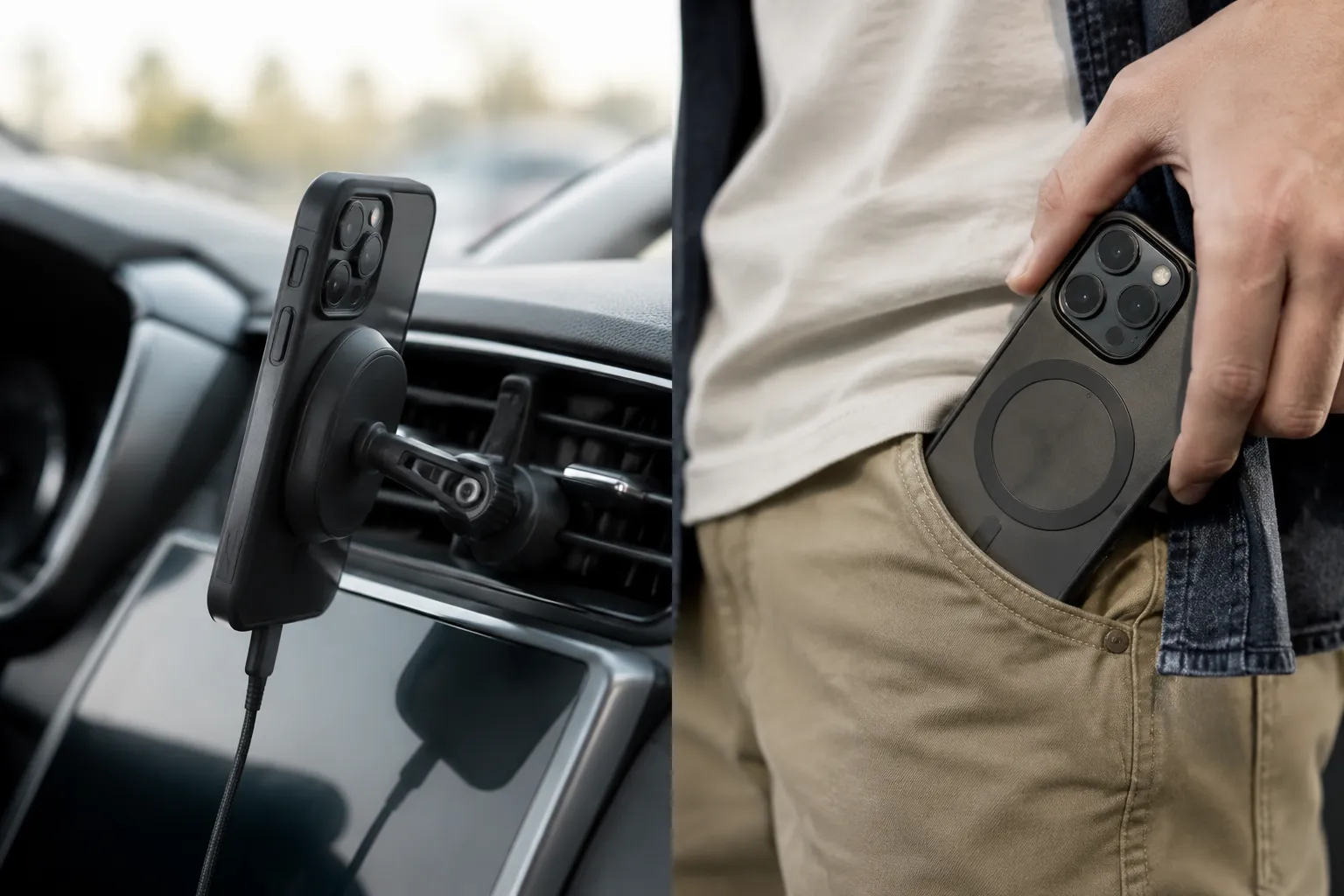
MagSafe changed the car mount into a one-handed operation. The phone gets close, the magnets catch, and the device locks into place with an audible click. A person can do it without looking, which matters more than any spec sheet. The Belkin and Anker car mounts use a vent clip or a dashboard adhesive base, and both hold firmly enough for daily driving.
The summer heat test is the divider. A cheap magnetic mount with a weak magnet will let the phone slide down a vent after an hour of direct sun, because the adhesive softens and the phone's weight eventually wins. The MagSafe spec requires a specific magnet array, and the phone side of the connection is always the strong half of the pair. A mount that meets the spec holds the phone through heat, vibration, and the occasional aggressive gear change.
For navigation-heavy driving, the car mount is the second accessory that earns real daily use. It replaces the phone holder that every person already owns but hates, and it does the job better without adding bulk.
The battery pack that lives on the bedside table
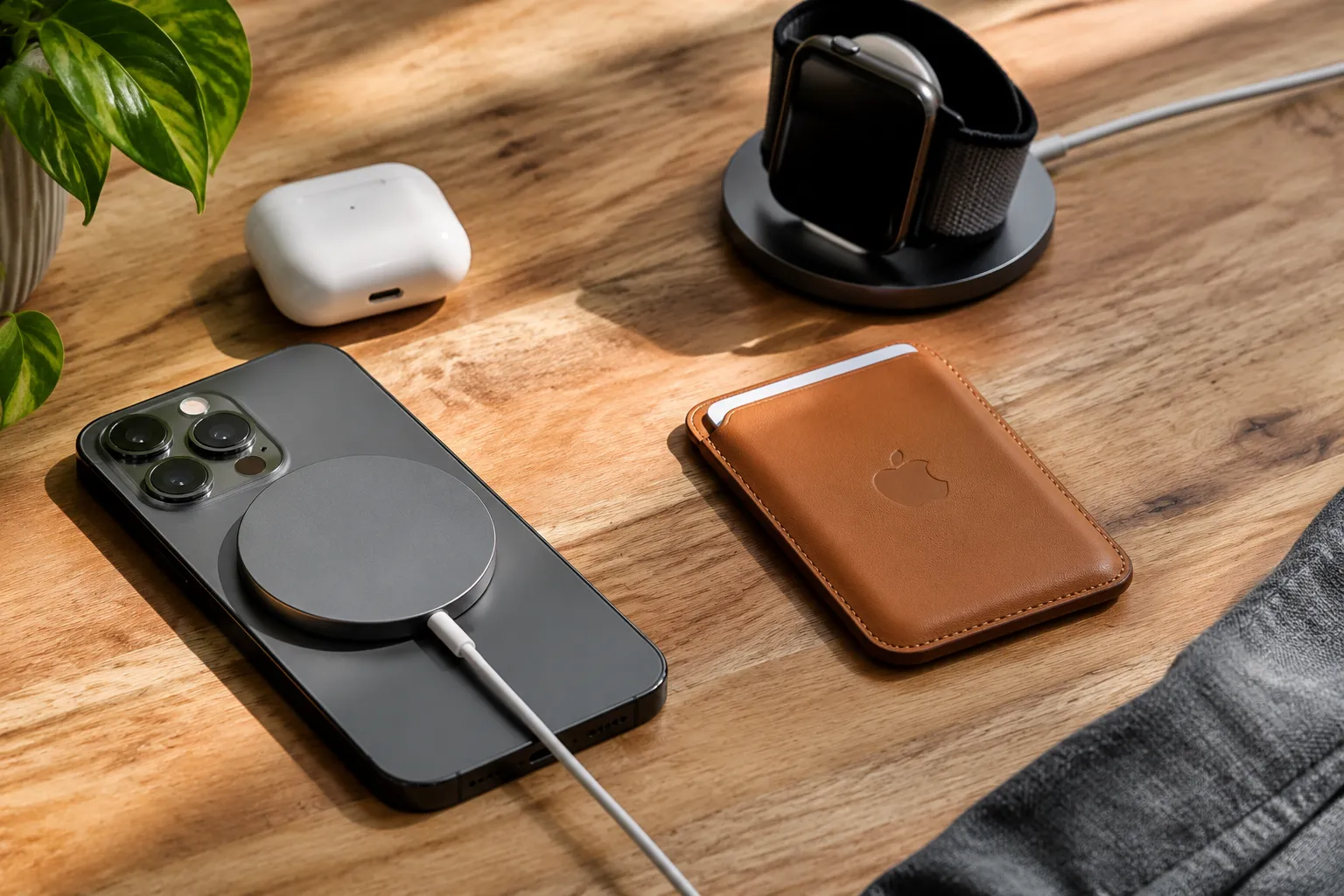
Apple's MagSafe charger puck, the plain circular disc that plugs into a wall adapter, gets dismissed as the default option that came in the box. It deserves more credit than the accessory market gives it. The puck is small enough to travel in a glasses case, powerful enough to charge an iPhone at 15 watts, and dead simple to use with any USB-C adapter that puts out 20 watts or more.
The puck becomes the bedside charger for most people. It sits flat on a nightstand, the phone drops onto it by feel in the dark, and the alignment is guaranteed by the magnets. The cable is short and tangle-free by design, which means the whole setup fits in a corner of a small table without becoming an eyesore.
It is also the most honest travel charger. A person packs the puck, a wall adapter, and a cable, and the whole kit weighs less than a single third-party MagSafe battery pack. The phone charges at full speed overnight in any hotel room, and the setup works with any USB-C adapter found in a borrowed office or an airport lounge.
The puck is the accessory that most people already own and do not realize they own. It is the baseline. Everything else has to beat it on convenience, and very little does.
The pop socket style grip that breaks the phone habit
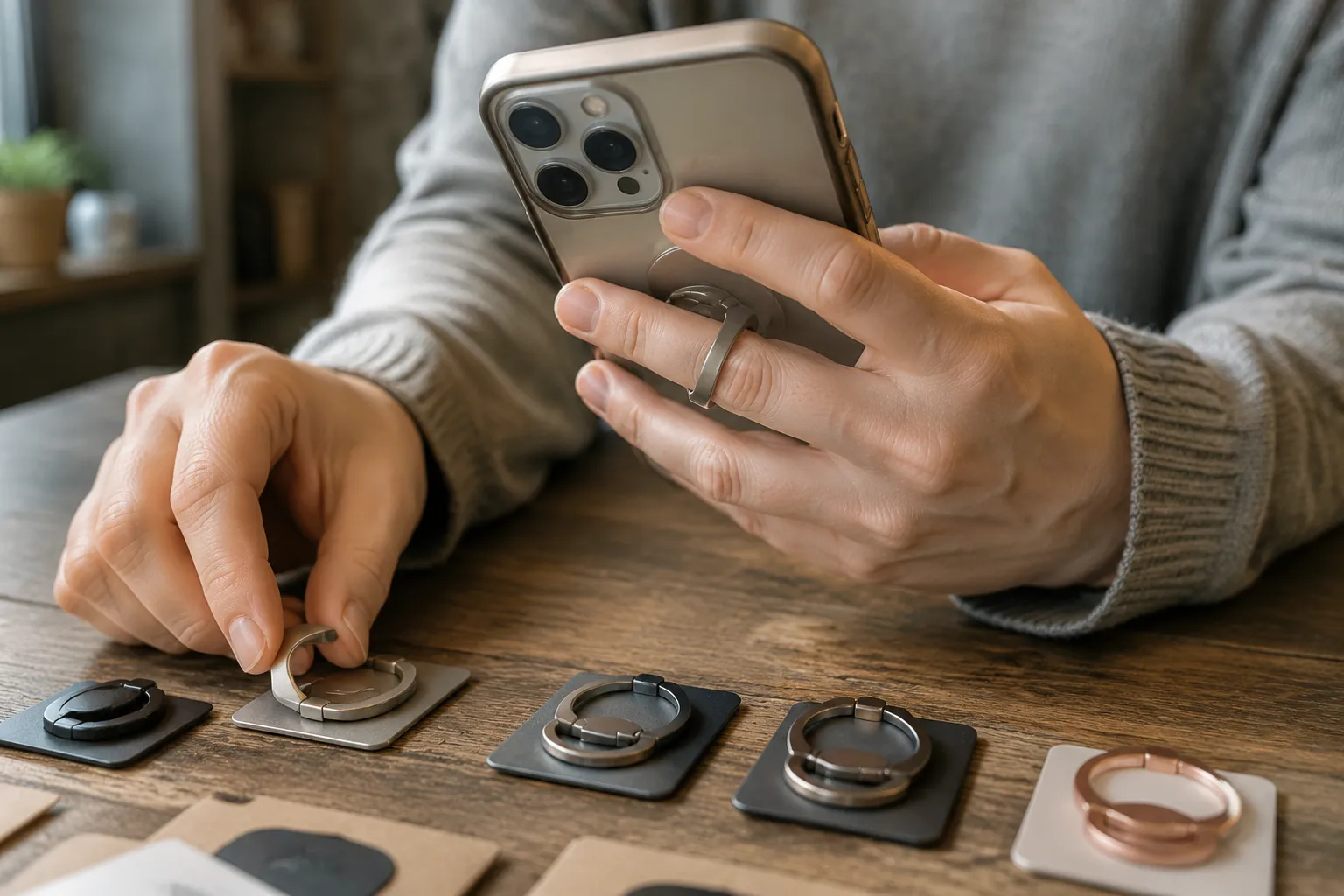
The MagSafe-compatible grip, whether from PopSockets or a dozen generic brands, is the accessory that looks like a gimmick and turns out to be the one that prevents dropped phones. A small round disc with a collapsible stand or a finger loop attaches magnetically to the back of the phone. It adds almost no bulk, and it gives a hand something to hold onto beyond the slippery glass and aluminum sandwich.
The grip matters because phone cases have become worse over time. The thin clear cases that people buy to show off the phone color offer almost no grip, and the phone slides out of a hand during a one-handed scroll more often than anyone admits. A grip on the back changes the physics. The fingers wrap around the loop or the stand, and the phone stays put even during a thumb-heavy texting session.
The magnetic attachment is the key feature. Older grips glued to the case stayed in one position forever. The MagSafe version comes off when the phone goes on the desk stand or in a car mount, and goes back on when the phone returns to a hand. One grip serves every use case without compromise.
It is also the cheapest accessory on this list, often under 20 dollars, which makes it the lowest-risk purchase in the entire ecosystem. A person can try one for a week and decide it is not for them without much financial regret.
The wallet that forces a real decision
Apple's MagSafe wallet, and its many imitators, is the most divisive accessory in the lineup. It holds two or three cards, snaps to the back of the phone, and works with Find My to alert the owner when it gets separated. It also gets in the way of wireless charging unless it is removed first, and it adds a lump to the back of a phone that many people find intolerable.
The wallet earns its place for a specific person: the one who carries a phone, a house key, and a driver's license, and nothing else. That person can leave a full wallet at home and run errands with the phone in one hand and the key in the other. The magnet holds firmly enough for a jeans pocket, and the whole setup disappears into a jacket.
It fails for the person who carries cash, multiple cards, transit passes, or a work ID. The two or three card limit is real, and the wallet becomes a negotiation every time a card needs to be swapped. The friction of removing and reattaching the wallet every time the phone needs to charge on a stand cancels out the convenience.
This is the one accessory on the list that most people should buy only after a week of honest self-assessment about what actually lives in a pocket. It is not a default purchase. It is a lifestyle fit.
What to ignore completely
The accessory market pushes a long tail of products that fail the daily use test. The MagSafe ring light for selfies works only for the rare person filming vertical video daily. The MagSafe keyboard stand holds an iPad at an angle that makes typing awkward. The MagSafe watch charger, a small puck that charges an Apple Watch, duplicates a feature already built into most Apple Watch boxes. The MagSafe duffel bag with a built-in charger pocket solves a problem that a regular bag and a battery pack solves for less money.
The pattern is clear. Any accessory that requires the phone to be picked up and repositioned to work, or that adds bulk to a bag without adding a new capability, is not earning its place. The honest MagSafe ecosystem is a small one because the technology solves one problem well: it makes wireless charging reliable and convenient. It does not turn an iPhone into a camera rig, a workstation, or a travel organizer.
The people who try to build a full MagSafe lifestyle end up with a drawer of plastic discs and magnetic mounts that worked once during the initial setup and then became clutter. The people who buy the desk stand, the car mount, the puck, and possibly the grip end up with a phone that charges effortlessly in every location they actually spend time.
The four accessory test
A useful filter exists for anyone standing in an Apple Store or scrolling through Amazon reviews. Ask whether the accessory makes the phone easier to charge, easier to hold, or easier to see. If it does none of those three things, it is decoration. The desk stand makes the phone easier to see and charge. The car mount makes it easier to see while driving. The puck makes it easier to charge anywhere. The grip makes it easier to hold.
A fourth question catches the outliers. Does the accessory replace something that was already in the bag or on the desk? The wallet replaces a full wallet for the minimal carry person. The battery pack replaces a wall charger for the traveler. Everything else adds to the pile rather than subtracting from it.
The MagSafe ecosystem is best treated as a small set of tools that each do one job without ceremony. The phone drops onto a stand at the desk, snaps into a mount in the car, lands on a puck at the bedside, and clicks into a grip when it goes into a hand. Four touchpoints cover every hour of a typical day, and the phone never needs a cable plugged into its port.
That is the whole argument. The standard works best when it disappears into the background of daily motion, and the accessories that support that disappearance are the only ones worth owning. The rest are just magnets looking for a surface to stick to.