Crossbody phone straps occupy a strange place in the accessory world. They are small enough to seem trivial, yet they change how a person moves through a day more than almost any other item carried. The strap itself is rarely the problem. The problem is always the length. A strap that hangs too low turns every step into a hip-bump against the phone. A strap that sits too high turns the whole setup into a necklace that feels like a leash. Getting the length right matters more than the material, the hardware, or the brand, and it is the part most people get wrong on the first try.
The core tension is that a crossbody strap has to serve two different postures at once. When a person stands still, the phone should rest somewhere comfortable, usually around the lower ribs or upper hip. When that same person bends forward to pick up a bag, tie a shoe, or lean over a stroller, the strap needs enough slack to keep the phone from swinging up into the chin or smacking a knee. Most adjustability ranges try to split the difference, and most of them fail at one end or the other.
Where the Phone Should Actually Sit
The natural resting point for a crossbody phone is somewhere between the bottom of the sternum and the top of the hip bone. That zone keeps the phone accessible without making it a constant visual presence. Any higher and the phone starts to feel like a bib. Any lower and it drifts into the territory where it swings when the wearer walks, especially on stairs or uneven ground.
For most adults, that translates to a strap length between 110 and 130 centimeters, measured from clip to clip. A person on the shorter side, roughly 155 centimeters tall, usually needs around 105 to 115. A taller person, around 180 centimeters, lands closer to 125 to 140. These numbers assume the strap is worn diagonally across the torso, with the phone resting on the opposite hip from the shoulder it crosses.
The mistake most buyers make is treating the strap like a necklace. They adjust it so the phone sits at the center of the chest, which looks tidy in a mirror selfie but becomes miserable within an hour. The phone bounces with every step, the strap digs into the neck on one side, and the whole arrangement feels like it is slowly strangling the wearer. The crossbody point is not the chest. The crossbody point is the side.
Testing this requires nothing more than a quick bend at the waist. With the phone at the desired resting spot, the wearer should lean forward as if tying a shoe. The phone should slide up the torso slightly, not swing violently. If it whips toward the face, the strap is too short. If it hangs down near the knees while standing, the strap is too long. The bend test reveals the real problem with most fixed-length straps: they solve one posture and ignore the other.
The Adjustable Range That Actually Works
Adjustable straps advertise ranges that sound generous but rarely cover the useful span. A strap that adjusts from 90 to 120 centimeters sounds flexible. In practice, the 90-centimeter setting is useless for almost any adult, and the 120-centimeter top end leaves taller wearers with the phone bouncing at mid-thigh. The sweet spot for an adjustable strap is a range that starts around 100 centimeters and extends past 135. That range accommodates a petite person who wants a snug fit and a tall person who needs the extra drop.
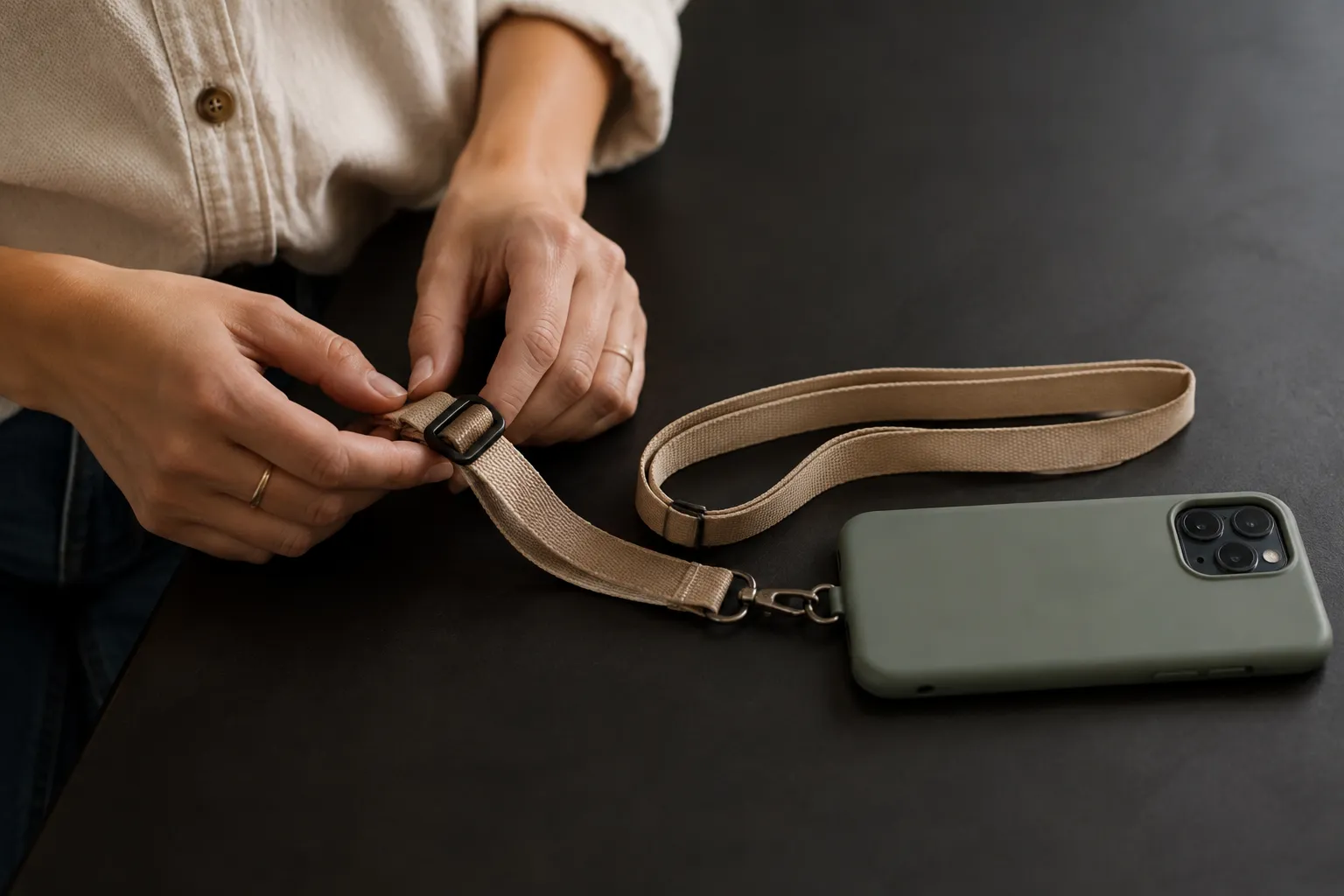
The adjustment mechanism matters as much as the range. Sliders that grip the strap with friction tend to slip over time, especially with smooth nylon or polyester webbing. The phone is not heavy, but it shifts enough during a day of walking that a loose slider can drift several centimeters without notice. Metal buckle adjusters hold better but add bulk. The best systems use a cam buckle or a pinch clasp that locks the strap in place with positive pressure, not just friction.
One detail that gets overlooked is where the adjustment hardware lands on the body. A slider that sits at the collarbone creates a pressure point under a jacket or coat. A slider that sits at the hip digs into the waistband. The wearer should put on the strap, find the right length, and then check where the adjustment hardware falls. If it lands on a bony spot, the strap will become annoying within an hour, regardless of how perfectly the phone sits.
The Fixed-Length Trap
Fixed-length straps are sold as a minimalist solution, and they appeal to people who hate fiddling with hardware. The problem is that a fixed length is a bet on a single body type and a single style of dress. The same strap that sits perfectly over a thin cotton t-shirt will sit too high over a puffy winter coat, which adds three to five centimeters of thickness across the chest and shoulders. Conversely, a strap set for a heavy coat will hang too loose in summer clothing.
Seasonal clothing is the great enemy of the fixed-length strap. A person who wears layers in winter and thin shirts in summer needs two different lengths, or needs to accept that the phone will sit in the wrong place for half the year. Some manufacturers try to solve this by offering fixed straps in multiple lengths, but that just pushes the decision back to the buyer, who now has to guess which length matches their torso and their wardrobe.
The better approach for a first purchase is to buy an adjustable strap, set it to the correct length, and then leave it alone. The adjustability is not for constant fiddling. It is for the few moments when the strap needs to change: switching from a t-shirt to a coat, or passing the strap to someone else for a quick carry. Treating the adjuster as a one-time setup tool rather than a constant companion keeps the strap simple without locking in a single-season length.
How Strap Width Changes the Feel
Width plays a larger role in perceived comfort than most people expect. A thin strap, around 6 to 10 millimeters, feels nearly invisible under clothing but concentrates the phone's weight into a narrow band on the shoulder. For a phone, which weighs less than 250 grams, this is rarely a real problem, but it becomes noticeable during a full day of walking. The narrow strap also tends to slip off rounded shoulders more easily.
A wider strap, around 20 to 25 millimeters, distributes the weight and stays put on the shoulder. The tradeoff is visibility. A wide strap reads as a deliberate fashion choice, closer to a bag strap than a phone accessory. It also tends to bunch or twist if the material is stiff. The ideal for most people sits around 12 to 15 millimeters, wide enough to stay in place and spread the load, narrow enough to disappear under a jacket.
The material changes the length equation too. A stretchy strap, usually a knit or elastic weave, needs to be set shorter than a static one because it elongates under load. A person who sets a stretchy strap at 120 centimeters will find the phone hanging at 125 or 130 once the weight of the phone pulls the material taut. Leather straps stretch slightly over time and then hold. Nylon and polyester webbing do not stretch at all, which makes them the most predictable for dialing in an exact length.
The Swivel Hardware Question
The connection points at each end of the strap deserve more scrutiny than they get. A phone case with a lanyard hole or a metal loop requires a clip that rotates freely. If the clip is rigid, the strap twists every time the phone is picked up and put down, and the twist accumulates until the whole strap is a spiral. Swivel clips, which rotate 360 degrees at the attachment point, prevent this by letting the phone spin without transferring that motion to the strap.
Swivels add a small amount of bulk and a small amount of noise, but the alternative is a strap that needs constant untwisting. For a phone that gets pulled out of a pocket dozens of times a day, the swivel is not a luxury. It is the difference between a strap that works and a strap that fights the wearer all day.
The clip itself also affects usable length. A clip that attaches to the side of a phone case adds nothing to the strap dimension, while a lanyard loop that sits at the bottom corner of the case changes the geometry of how the phone hangs. A bottom-corner attachment makes the phone tilt at an angle, which can cause it to swing more during walking. A side or top attachment keeps the phone hanging more vertically. The strap length needs to account for these attachment points, since a phone hanging at an angle effectively takes up more vertical space.
Reading the Signs of a Wrong Length
The body gives clear signals when a strap length is wrong, and most people ignore them. Soreness at the base of the neck on the strap side usually means the strap is too short, pulling the shoulder up into a slight shrug. A phone that keeps sliding around to the front means the strap is too loose, letting the weight swing forward with each step. A phone that hits door frames and counter edges means the strap is too long, allowing the phone to dangle at the exact height of most obstacles.
There is also the chafing signal. A strap that constantly rubs against the side of the neck or the collarbone is either too short or too wide for the wearer's frame. Slightly lowering the phone by lengthening the strap can move the contact point off the bone and onto the softer muscle of the shoulder, which eliminates most chafing without any other change.
The most common error is setting the strap while standing in front of a mirror. Mirrors distort the actual drop because people tend to adjust based on how the strap looks rather than how it feels. The better method is to set the strap while walking, with the phone in place, paying attention to where the phone rests when the arm is relaxed at the side. The phone should brush lightly against the hip or hang just above it. That is the length that feels natural for hours, not the length that looks balanced in a reflection.
A Shortcut for First-Time Setup
For someone setting up a strap for the first time, there is a practical starting point that removes most of the guesswork. With the strap worn diagonally, the wearer should reach across the body with the opposite hand and grab the phone. If the phone is easy to grasp without leaning or stretching, the strap is in the right zone. If the reach requires a full arm extension or a shift of the torso, the strap needs to be shortened. If the phone is already at the wrist when the arm is relaxed, the strap needs to be lengthened.
This reach test works across body types because it uses the wearer's own proportions as the reference. A long-armed person gets a naturally different result than a short-armed person, which is exactly the right outcome. The strap should fit the person, not a generic size chart.
After the reach test, the wearer should do the bend test from earlier and then spend five minutes walking around, including a set of stairs if available. These two checks catch the most common errors and take less time than a single return shipping cycle. The alternative is ordering a strap, trying it once, deciding it feels wrong, and ordering a different one, a cycle that wastes more time than a careful setup ever will.
When Length Is a Matter of Security
Length also affects how well the strap protects the phone from theft and drops. A phone that hangs at mid-thigh is easy for a passerby to grab or knock. A phone that rests against the ribs is closer to the body's center and much harder to reach. In a crowd, the difference matters. The same logic applies to drops: a shorter strap keeps the phone closer to the torso, which means fewer accidental swings into walls and railings. The phone is the most exposed when it hangs lowest, which is the opposite of where most people set their straps for comfort.
The secure length is usually five to eight centimeters shorter than the comfortable length. That gap matters for someone navigating a busy market or a packed transit station. Many people compromise by keeping the strap at the comfortable length and holding the phone in a hand when the crowd thickens, which defeats the purpose of a hands-free strap. Setting the strap slightly shorter in advance provides the security without requiring constant awareness of the phone's position.
A strap that rides high enough to rest against the lower ribs also keeps the phone from swinging when the wearer rides a bicycle or climbs stairs. The physical restraint of a shorter strap reduces the phone's momentum, which makes the whole setup feel more planted. People who ride bikes with a crossbody strap almost always prefer a shorter length for this reason, even if the standing posture is slightly less comfortable.
The final consideration is the person who shares their strap with a partner or a friend. A single adjustable strap can serve two people if its range spans both of their lengths, but the adjustment becomes a regular ritual rather than a one-time setup. For shared use, a quick-release buckle in the middle of the strap makes length changes faster, since the wearer can adjust one side of the strap without pulling the whole thing over the head. This adds a small piece of hardware at the sternum, but it turns the strap from a personal item into a flexible tool. Most people will never need that feature. The ones who do will find it worth the extra bulk.