The travel bag industry solved the cord problem years ago, and then spent the next ten years pretending it had not. Every "tech organizer" on the market ships with the same trio of elastic loops and a mesh pocket, as if the only cable that exists is a one-meter Lightning cord that never tangles. Then Apple introduced MagSafe, and suddenly the calculus changed. A charger that snaps to the back of a phone with magnets is a different physical object than a cable you plug in. It is thicker. It is round. It wants to sit flat against something. And the bags people actually carry have not caught up.
The problem is not finding a bag that holds a MagSafe charger. The problem is finding a bag that treats the charger like what it is: a puck that needs to stay accessible, stay flat, and stay put when the bag gets tossed into an overhead bin. Most organizers treat it like a small book, which means it slides around, flips over, and ends up tangled in the same three cables it was supposed to tame.
This piece is about the specific bags and internal systems that actually work with the MagSafe ecosystem, and the design decisions that make them work.
The Magnetic Problem in a Zippered World
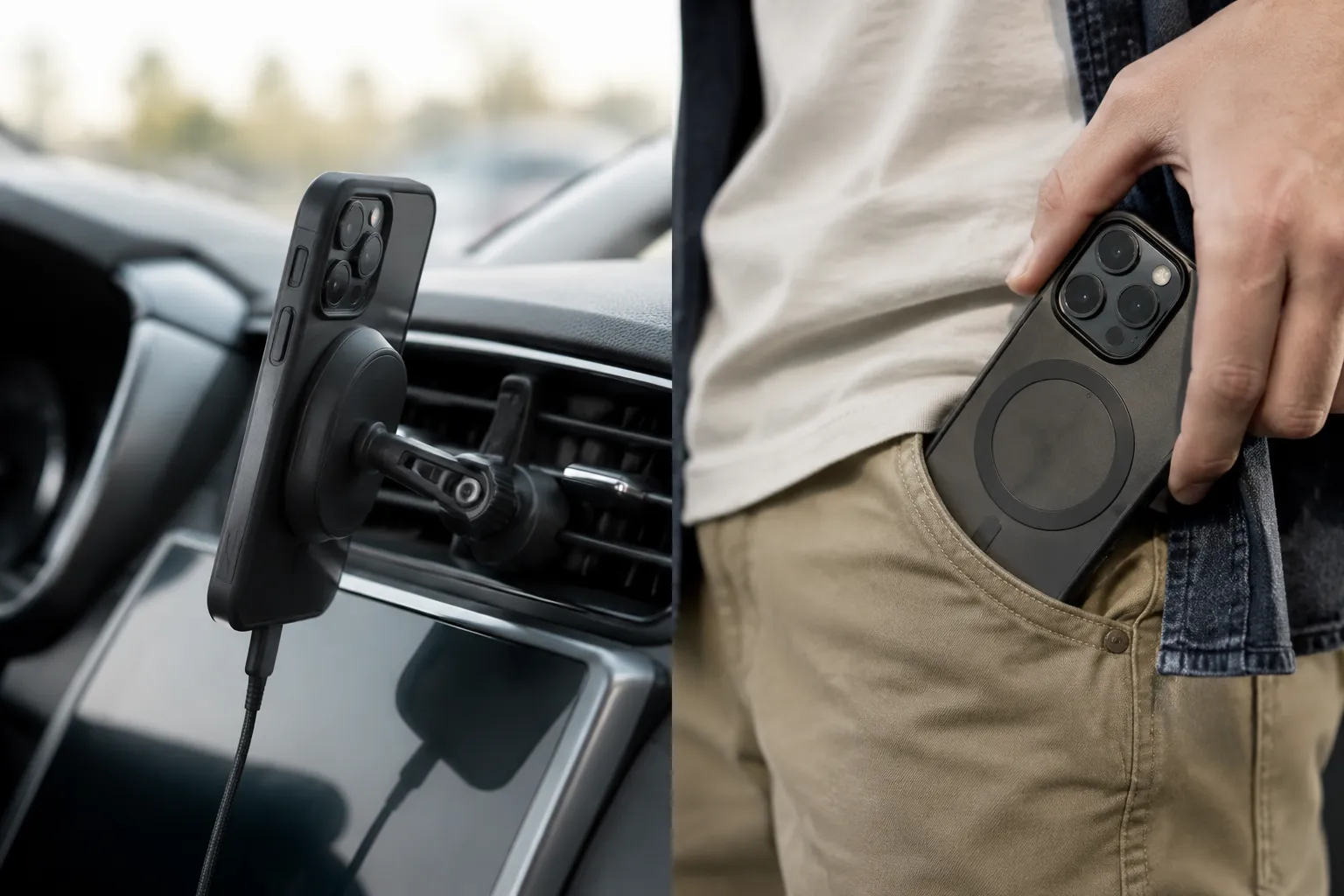
MagSafe changed the physical profile of charging gear in a way that most bag designers have not registered. A traditional wall charger is a block. A cable is a line. A MagSafe charger is a disc, roughly 60 mm across and about as thick as three stacked credit cards. It has a cable coming out of one side at an angle, and that cable is the problem. The puck wants to lie flat. The cable wants to bend upward. Put it in a standard flat pocket and the puck flips on its edge, the cable kinks, and the whole thing becomes a lump that presses into a laptop or a Kindle.
The other issue is the magnet itself. A MagSafe puck is a magnet, and magnets behave badly around other magnets, metal zippers, and the magnetic clasps some bags use for their main compartments. A person who throws a loose MagSafe charger into a pocket lined with a magnetic closure will find the charger stuck to the flap at an awkward angle, pulling the closure open or fighting the user's hand every time the bag is opened. This is not a hypothetical. It happens within a week of owning the charger.
The bags that work are the ones that treat the charger as a magnetic object with a fragile cable, not as a generic slab of electronics.
What a MagSafe Charger Actually Needs From a Bag
Before naming specific bags, it helps to list the physical requirements. A MagSafe charger needs a pocket that is slightly larger than the puck but not so large that the puck slides around. It needs the cable to exit the pocket at a clean angle, not folded back on itself. It needs the pocket material to be soft enough not to scratch the aluminum or the glass back of the puck, but firm enough to hold its shape.
The charger also needs to be reachable without unpacking half the bag. The whole point of MagSafe is that a person can grab the phone, snap it to the charger, and set the whole assembly down on a nightstand or a desk. If the charger is buried at the bottom of a main compartment under a rain shell and a paperback, the convenience evaporates. A dedicated pocket, near the top or in a quick-access panel, is not a luxury. It is the feature that makes the charger usable on the road.
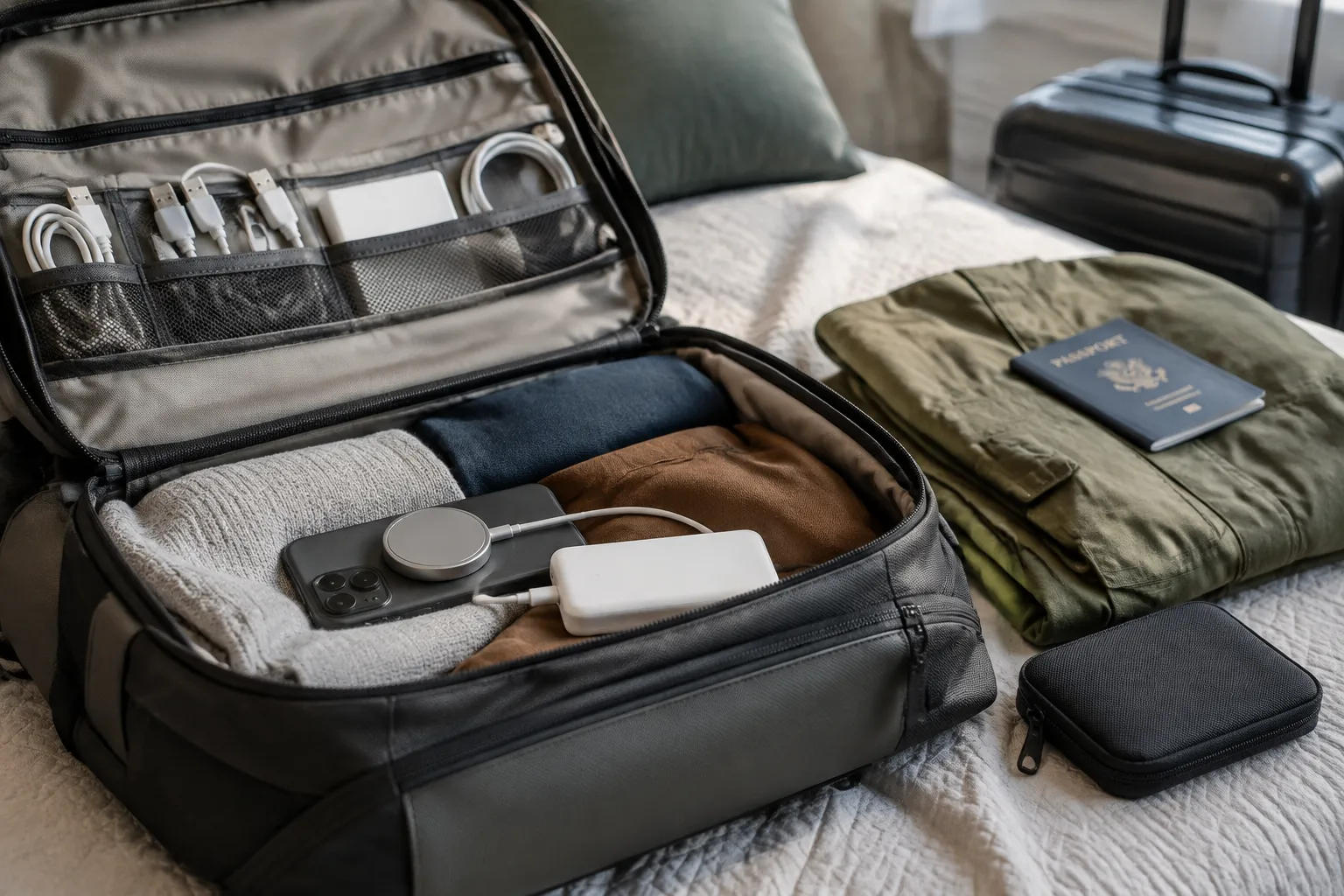
Finally, the bag needs a place for the power bank. A MagSafe charger without a battery is just a longer way to reach a wall outlet. The best travel setups pair the puck with a power bank that supports passthrough charging, so a person can plug the bank into the wall at night, attach the phone to the puck, and have both devices topped up by morning. That means the bag needs two dedicated spaces that sit near each other: one for the puck, one for the bank, and a way to route a short cable between them without creating a bird's nest.
The Internal Organizer That Gets It Right
The most consistent solution is not a single bag but an internal panel. The Tom Bihn Freudian Slip, which has been around for years as a general organizer, works because its elastic pockets are sized for real objects, not for imaginary ones. The large vertical pocket on the left side is almost exactly the right width for a MagSafe puck, and the cable can be coiled into the adjacent smaller pocket, which keeps the kink away from the connector.
The Freudian Slip has a fatal flaw for this use case, though. It is designed to live inside another bag, which means the user has to pull the whole panel out to get to the charger. That works fine in a backpack on a hotel room desk, but it fails in the middle of an airport terminal when the phone is at 12 percent and the charger is somewhere in the depths of a duffel.
A better internal solution is the Aer Cable Kit 2, which is a standalone pouch that can be dropped into any bag. Its main compartment has a pair of elastic loops that hold a MagSafe puck vertically, with the cable routed through a pass-through slot at the bottom. This is the first time a major organizer brand seemed to understand that the cable comes out of the puck at an angle and needs a channel, not just a loop. The puck sits upright, the cable runs straight down, and the whole assembly takes up less than half the volume of the pouch.
The tradeoff is that the Cable Kit 2 is a pouch, not a pocket. It has to be unzipped to access the charger. But because it is small, it can live in an exterior quick-access compartment of a backpack, which closes the gap between "buried" and "reachable."
Backpacks With a Dedicated Charger Seat
A few backpack manufacturers have started building charger-specific storage into their bags, and the results are uneven. The Nomatic Travel Pack, now in its second version, has a dedicated electronics pocket on the front panel with a single elastic strap that is sized for a power bank. The strap is too narrow for a MagSafe puck, so the puck has to go in a secondary pocket, which puts it out of reach of the power bank's output port. The result is a bag that stores the components but makes them inconvenient to connect.
The Peak Design Everyday Backpack handles the problem differently, and better. Its internal FlexFold dividers are magnetic, which sounds like a disaster for a MagSafe puck until a person realizes the dividers' magnets are weak and buried in the shell. A MagSafe puck placed on the shelf between two dividers sits flat and stays put, because the dividers' fabric has a high-friction texture. The cable can be routed along the side channel of the bag, which is intended for water bottles but works perfectly for a coiled charging cable. The main drawback is price. The 20-liter version costs well over two hundred dollars, and the divider system requires a small learning curve.
The most surprising entry in this category is the Osprey Daylite Tote Pack, a budget bag that costs less than a third of the Peak Design. Its front pocket has a flat, unpadded sleeve that runs the full height of the bag. A MagSafe puck drops into the sleeve and rests at the bottom, and the cable can be tucked alongside it. The sleeve has no elastic and no divider, so the puck slides if the bag is carried loosely. But for a person who packs the bag tight, the sleeve keeps the charger flat against the back panel, protected from the rest of the contents. It is a crude solution, but it works, and it costs almost nothing.
The Sling Bag Problem: Small Pockets, Big Pucks
Sling bags are the fastest-growing category in travel gear, and they are also the worst fit for MagSafe. A typical 4-to-6-liter sling has one main compartment and one flat front pocket. The flat pocket is usually too shallow for a MagSafe puck standing on edge, and too narrow for the puck to lie flat. The main compartment is too deep, which means the puck sinks to the bottom and becomes a lump under everything else.
The one sling that solves this is the Alpaka Elements Tech Sling Max, which is larger than most at 9 liters. Its internal organization includes a dedicated padded tablet sleeve, and behind that sleeve is a channel that runs the full width of the bag. A MagSafe puck fits snugly in this channel with the cable routed out the side. The channel keeps the puck pressed against the back panel, so it stays flat and does not interfere with the main compartment. The sling also has an external magnetic buckle on its strap, which is far enough from the internal contents that it does not tug at the puck. Alpaka clearly tested this bag with a MagSafe charger, and it shows.
The lesson from the sling category is that volume does not equal usability. A 9-liter sling works because its internal layout was designed around the dimensions of real charging gear, not because it is big. A person could buy a 12-liter sling from another brand and still find the puck flopping around, because the interior is a single open space.
Power Banks and the Passthrough Problem
A bag can have the perfect puck pocket and still fail if it does not accommodate the power bank. The Anker MagGo power bank, which is one of the most popular MagSafe-compatible batteries, is roughly the same footprint as the puck but twice as thick. It does not fit in most pockets designed for the charger itself. It needs a pocket with a bit of depth, and it needs to sit near the puck so the cable between them is short.
The practical solution is a bag with a two-tier electronics section. The Aer Travel Pack 3 has a front compartment with three flat pockets stacked vertically. The bottom pocket fits the MagGo bank perfectly, with the cable exiting upward. The middle pocket holds the MagSafe puck flat. The top pocket holds a wall charger. This layout allows a person to leave everything in place and simply plug the bank into the wall at night, then snap the phone to the puck in the morning. Nothing has to be moved.
This is the configuration that most bag designers miss. They build one deep pocket for "electronics" and expect the user to sort it out. The bags that work have separate, sized pockets for each component, arranged in the order a person actually uses them: bank at the bottom, puck in the middle, phone on top.
Hard Cases and the Overpacking Trap
There is a subset of travelers who do not want their charging gear in a bag at all. They want a hard case that goes into a backpack's main compartment or a carry-on. The WaterField Designs Magnetic Charger Case is one of the few products designed specifically for a MagSafe puck. It has a molded interior that holds the puck flat, a small pocket for a cable, and a magnetic closure that keeps the case shut without adding a zipper.
The case works, but it introduces a new problem. It adds bulk to what is already a chunky charging setup. A MagSafe puck, a 10,000 mAh power bank, and a wall charger already take up about as much volume as a paperback novel. Put them in a hard case and the assembly becomes a brick. The case is worth carrying only if the alternative is a soft pouch that offers no protection from the other contents of a bag.
For most travelers, the better move is to skip the hard case and choose a bag with a padded, dedicated pocket. The padding provides enough protection for the puck's glass back, and the lack of a case means the whole setup is one less object to fumble with at security.
What Works at the Airport, Not Just the Hotel
The true test of a bag's MagSafe compatibility happens in an airport terminal, not in a hotel room. A person standing at a gate with a dying phone needs to reach the power bank and the puck without sitting down, without emptying the bag, and without taking their eyes off the departure board.
The bags that pass this test share one trait: the charging gear lives in a pocket that opens toward the user while the bag is worn on the chest or shoulder. The Aer City Sling Pro, a 6-liter bag, has a front pocket that opens vertically. A MagSafe puck can be stored flat against the back wall of this pocket, and a slim power bank like the Anker Nano can sit in the same pocket beside it. The pocket's zipper runs along the top edge, so a person can open it with one hand, pull out the puck, and snap the phone to it in under five seconds.
The Peak Design Everyday Sling, now in its third version, fails this test. Its main compartment opens away from the body, which means a person has to swing the bag around to the front, unzip the top, and reach over the divider to find the puck. It is doable, but it takes both hands and a moment of attention. In a crowded terminal, that moment is exactly when a person gets bumped or has to step aside.
This is the detail that separates good design from great design in this category. A bag can hold all the gear, protect it, and organize it, and still fail because it forces the user to stop moving to access it. The charger is only useful if it can come out at the moment it is needed.
The Cable Routing Question That Nobody Answers
Every bag review mentions cable management, and almost no bag actually solves it. The issue is that a coiled cable takes up space in three dimensions, while bag pockets are designed in two. A cable coiled into a circle has a diameter of about 60 mm and a thickness of about 20 mm. It does not sit flat in a shallow pocket. It bulges.
The best solution this author has found is not a bag feature but a cable accessory. The Nomad Base One cable, which is a woven USB-C to USB-C cord, coils into a tight spiral and holds its shape better than most. When coiled, it forms a flat disc that can be stacked on top of a power bank. Bags with a dedicated cable pocket, like the Bellroy Tech Kit, handle this disc well because the pocket is round and slightly deeper at the center.
For the MagSafe puck's own cable, which is permanently attached and cannot be removed, the routing matters more. The puck's cable is about one meter long and has a USB-C connector on the end. Most bags assume the user will coil the cable around the puck, which is wrong. Coiling the cable around the puck makes the assembly a cylinder, which rolls. The correct method is to fold the cable in half twice, creating a short bundle that lies flat next to the puck. Only a few bags have pockets wide enough for this flat bundle.
The Tom Bihn Side Effect is one of them. Its main compartment is a single open space about 180 mm wide and 120 mm tall. A MagSafe puck with a folded cable fits along the bottom, and a power bank sits on top. It is not a dedicated organizer, but its dimensions happen to match the flat-bundle method perfectly.
The Verdict on the Standard Travel Setup
After testing more than a dozen bags and organizers with a MagSafe puck, a MagGo power bank, and a standard wall charger, a clear pattern emerged. The bags that work are not the ones with the most pockets. They are the ones with pockets sized to the actual dimensions of the gear, arranged in the order the gear is used, and positioned so the charger can be reached without stopping.
The Aer Travel Pack 3 and the Alpaka Elements Tech Sling Max are the two bags that get all three things right. They are not the most expensive bags in their categories, and they are not the most beautiful. They simply have interiors designed by someone who has held a MagSafe charger, tried to put it in a pocket, and gotten annoyed when it did not fit.
For a person who wants a single bag that handles both the airport and the hotel room, the Travel Pack 3's front compartment is the closest thing to a purpose-built MagSafe solution on the market. For a person who wants a lighter kit, the Sling Max covers the essentials in a package that fits under an airplane seat and works as a day bag at the destination.
The rest of the market is still catching up. Until then, a person traveling with MagSafe should measure their charger, measure their power bank, and read the internal dimensions of a bag before buying, because the photos on a product page will not show whether the puck sits flat or flops around. The bags that work are the ones that treat a 60 mm disc with a cable coming out of it as a specific object with specific needs, not as a generic piece of electronics to be stuffed into whatever pocket is empty.