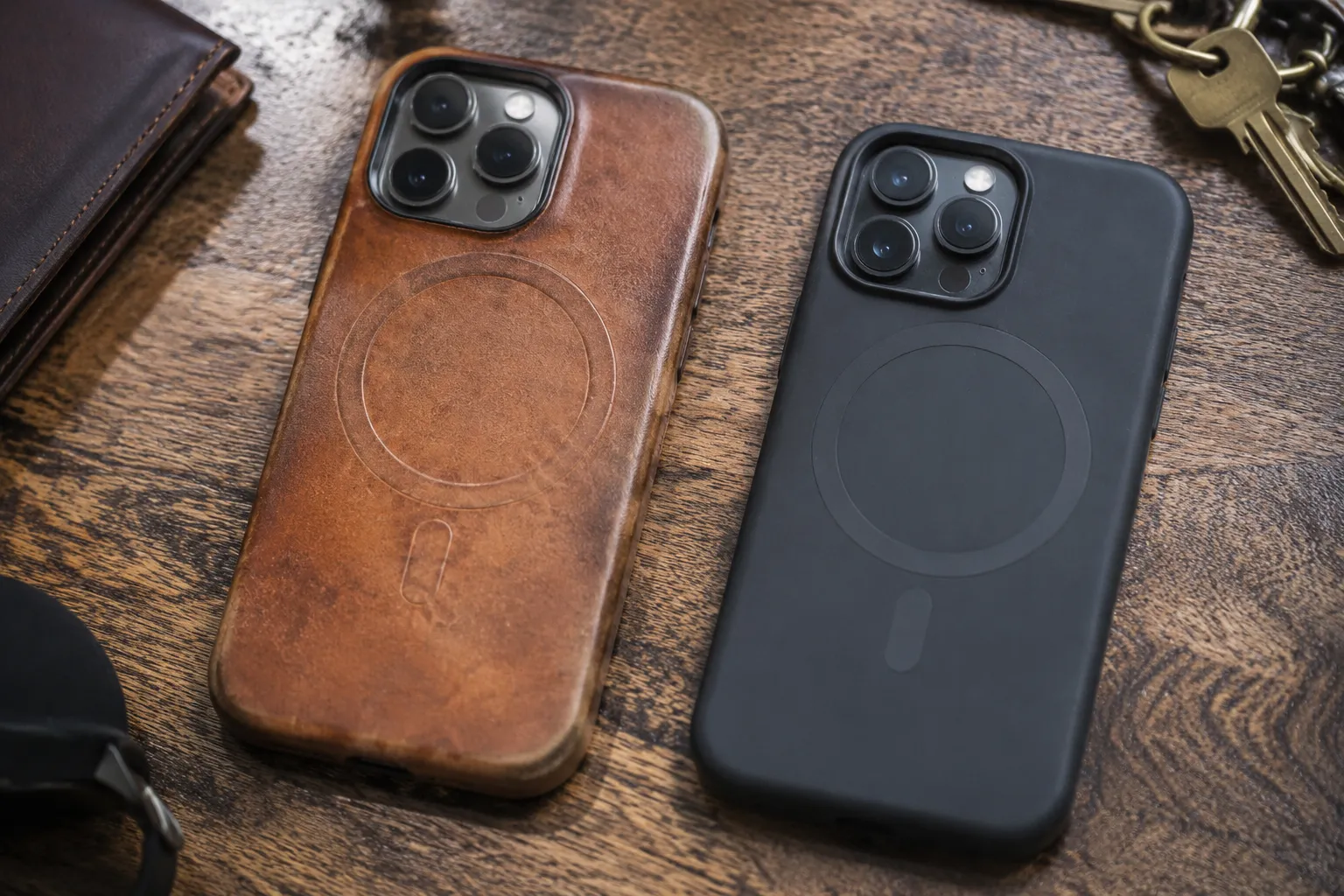
Six months is the honest test period for a phone case, the point where the initial gloss has worn off and the object has settled into whatever it will become. The leather MagSafe case and the silicone MagSafe case start as completely different propositions, and they end as completely different objects. One of them looks better with age. The other one starts to look like a problem.
The leather case arrives with the scent of a new wallet and a surface that feels almost suede-like in its dryness. The silicone case arrives with a rubbery cling and a satisfying click when it seats against the back glass. Both feel premium in the Apple Store under bright lights. Six months of pockets, drops, coffee shop tables, and summer heat change that calculus entirely.
The core difference comes down to how each material handles friction, moisture, and time. Leather is a natural material that records every interaction. Silicone is a synthetic material designed to resist those same interactions. One documents the wear. The other tries to ignore it, and fails.
The Leather Case Develops a Patina Instead of a Stain
The Apple leather MagSafe case uses a specially tanned and coated leather that darkens with handling. Fresh out of the box, the saddle brown color is almost orange, bright enough to draw comments. After a week in a jeans pocket, the edges begin to darken where the denim rubs against the material. After a month, the back develops a subtle sheen where the palm rests during one-handed use.
This is the aging process working as intended. The leather absorbs oils from the skin, and those oils darken the material in a gradient that mirrors exactly how the phone is held. Right-handed users see more darkening on the right edge. Left-handed users see the opposite. The corners take on a deeper tone from repeated drops onto tables and countertops.
Scratches on leather do not look like damage. A scrape across the back of the case shows up as a lighter mark against the darker patina, and over the next few weeks, that mark gradually blends back into the surrounding tone as the leather continues to absorb oils. The case is effectively self-healing in a cosmetic sense, not because the material repairs itself, but because the entire surface keeps changing color anyway. A scratch is just a spot that has not caught up yet.
The leather case also develops a tactile quality that improves with age. New leather has a slight tackiness, a resistance against the palm that makes one-handed reach across the screen feel slightly sticky. After months of use, that surface polishes into something smoother, almost like worn saddle leather. The phone slides in and out of pockets more easily, and the grip in the hand becomes more secure because the material has molded slightly to the contours of the fingers.
The Silicone Case Starts Collecting Evidence Against Itself
The silicone MagSafe case has a different trajectory. Fresh silicone has a soft-touch coating that feels almost like smooth rubber, pleasant to hold and with excellent grip. The material attracts lint and dust in the pocket during the first week, but that is a minor annoyance that wipes away easily. The real problems begin around the two-month mark.
The first visible deterioration appears at the corners. Silicone is soft, and every time the case slides across a table or gets set down with any force, the material compresses and rubs against the surface. Over weeks of this treatment, the corners develop a shiny, polished appearance where the soft-touch coating has worn away, exposing the smoother silicone underneath. This shiny patch spreads slowly, eventually reaching around the edges of the case.
The back of the silicone case develops a different kind of wear. The soft-touch coating breaks down from the combination of hand oils and friction, creating a smooth, almost glossy patch in the center where the palm rests. This patch does not look like patina. It looks like wear, the same way an old TV remote starts to look shiny in the places where the thumbs have rubbed for years. The surrounding material remains matte, creating a visible contrast between used and unused sections.
Drops leave permanent marks on silicone. A drop onto concrete creates an abrasion that removes the soft-touch coating entirely, leaving a lighter, rougher patch that collects dirt and darkens unevenly. The material does not absorb the impact gracefully. It gouges. A leather case takes the same drop and shows a scrape that eventually blends into the patina. The silicone case shows a scar that stays visible for the rest of its life.
MagSafe Magnet Strength Changes in Opposite Directions
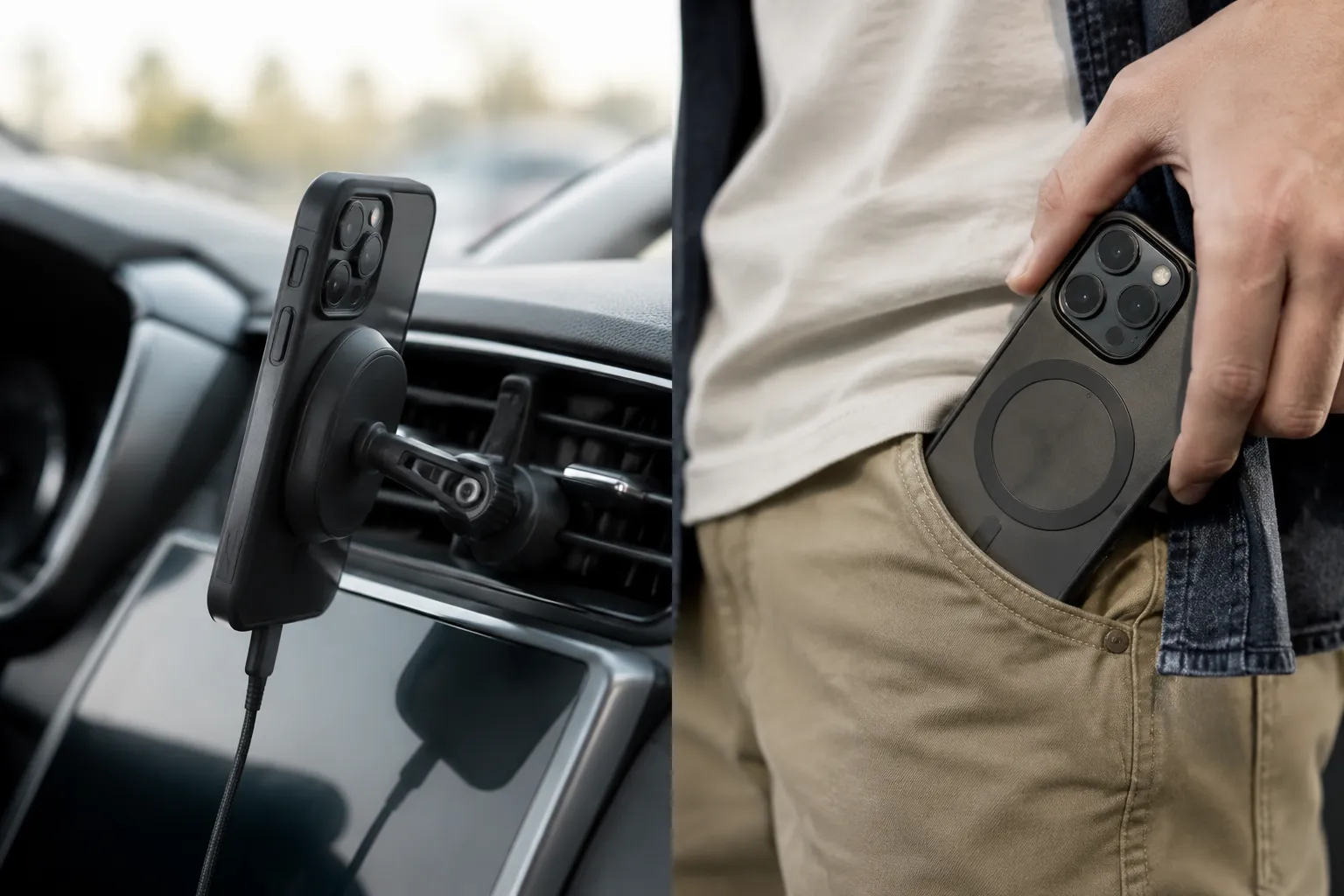
The MagSafe ring sits inside both cases, and the magnet strength holds up differently depending on the material surrounding it. The leather case has a rigid structure that holds the magnet ring firmly in place. After six months, the leather may soften, but the internal structure keeps the magnets positioned correctly against the back of the phone. Accessories snap on with the same satisfying alignment as day one.
The silicone case has a more flexible structure, and the material stretches slightly around the edges with repeated removal and reinstallation. The magnet ring, which sits in a molded pocket, can shift fractionally if the silicone stretches. This manifests as a subtle misalignment when attaching a MagSafe wallet or a car mount. The accessory still attaches, but the alignment is slightly off, and the wallet can feel less secure because the magnets are not sitting flush against the phone's internal magnet array.
There is also the pocket lint issue. Silicone attracts lint aggressively during the first few weeks, but that fades as the soft-touch coating wears down. Leather attracts almost no lint at all. The leather case also picks up a slight darkening at the edges where it rubs against pocket seams, but this reads as character rather than dirt.
The Slippery Middle Period Where Silicone Fights Back
Around the three-month mark, the silicone case enters its worst phase. The soft-touch coating has worn thin in the high-contact areas, but enough remains that the surface feels inconsistent. One part of the case feels grippy, another part feels slick, and the transition between the two is distracting rather than subtle. The case also starts to feel slightly sticky in humid conditions, a byproduct of the degraded coating interacting with moisture.
This is the phase where the case begins to attract visible dust and debris in a way that looks grimy rather than temporary. The worn patches hold onto pocket lint, and the contrast between the matte finish and the worn finish makes every speck noticeable. The case requires frequent wiping to look presentable, and even then, the worn patches do not clean up fully.
The leather case does not have a comparable middle period. It transitions gradually from the bright, dry new finish to a darker, smoother patina without any phase where the surface feels inconsistent. The leather can feel slightly dry around the four-month mark if it has not absorbed enough oils, but a small amount of leather conditioner or even hand cream transferred from the skin solves that. The case never feels bad. It just feels different from how it started.
Silicone Cases Eventually Start to Disintegrate
By the five or six month mark, the silicone case has usually reached a state where the degradation becomes structural rather than cosmetic. The soft-touch coating has worn away entirely from the edges and the center, leaving the base silicone exposed. This base layer is more slippery and less pleasant to hold. The corners have developed permanent shiny patches. Any drop leaves a visible scar.
Some silicone cases also start to tear near the charging port opening or the speaker cutouts. The thin edges of silicone around these openings flex every time the phone is plugged in or removed, and the material eventually weakens and splits. This is not a defect in a specific batch. It is the natural fatigue of silicone under repeated stress. The material simply wears out.
The leather case shows no equivalent structural failure. The edges may darken and soften, but the material maintains its integrity. The cutouts stay clean, the buttons remain responsive, and the case continues to protect the phone as well as it did on day one. The only real risk to leather is water damage or exposure to harsh chemicals, and even then, the damage is cosmetic rather than structural.
What Six Months Does to the Colors
Color behavior is where the two cases diverge most dramatically. The leather case in a dark color, like midnight or black, shows wear less obviously than the saddle brown version, but it still develops a subtle sheen and slight color shift in high-contact areas. The lighter leather colors, particularly the saddle brown and the now-discontinued California poppy, develop the most attractive patina, transitioning from bright and uniform to rich and varied.
Silicone cases in dark colors hide the soft-touch coating wear better than light colors, but they develop another problem. The silicone material itself can yellow or shift color slightly, particularly if the case is exposed to sunlight or heat. A white or light gray silicone case starts to look dingy after a few months. A bright color like the older product red or the current pink starts to look faded, drained of its original saturation.
The leather case also changes color in response to its environment in a way that silicone cannot replicate. A leather case that has lived in a bag with a leather wallet might pick up a slight transfer of dye from the darker leather. A leather case that has spent time in a sunny car dashboard develops a slightly lighter, more faded tone. These changes are subtle and often go unnoticed until the case is compared side by side with a fresh one, but they give each case a unique history.
Cleaning and Maintenance Reveals the Real Difference
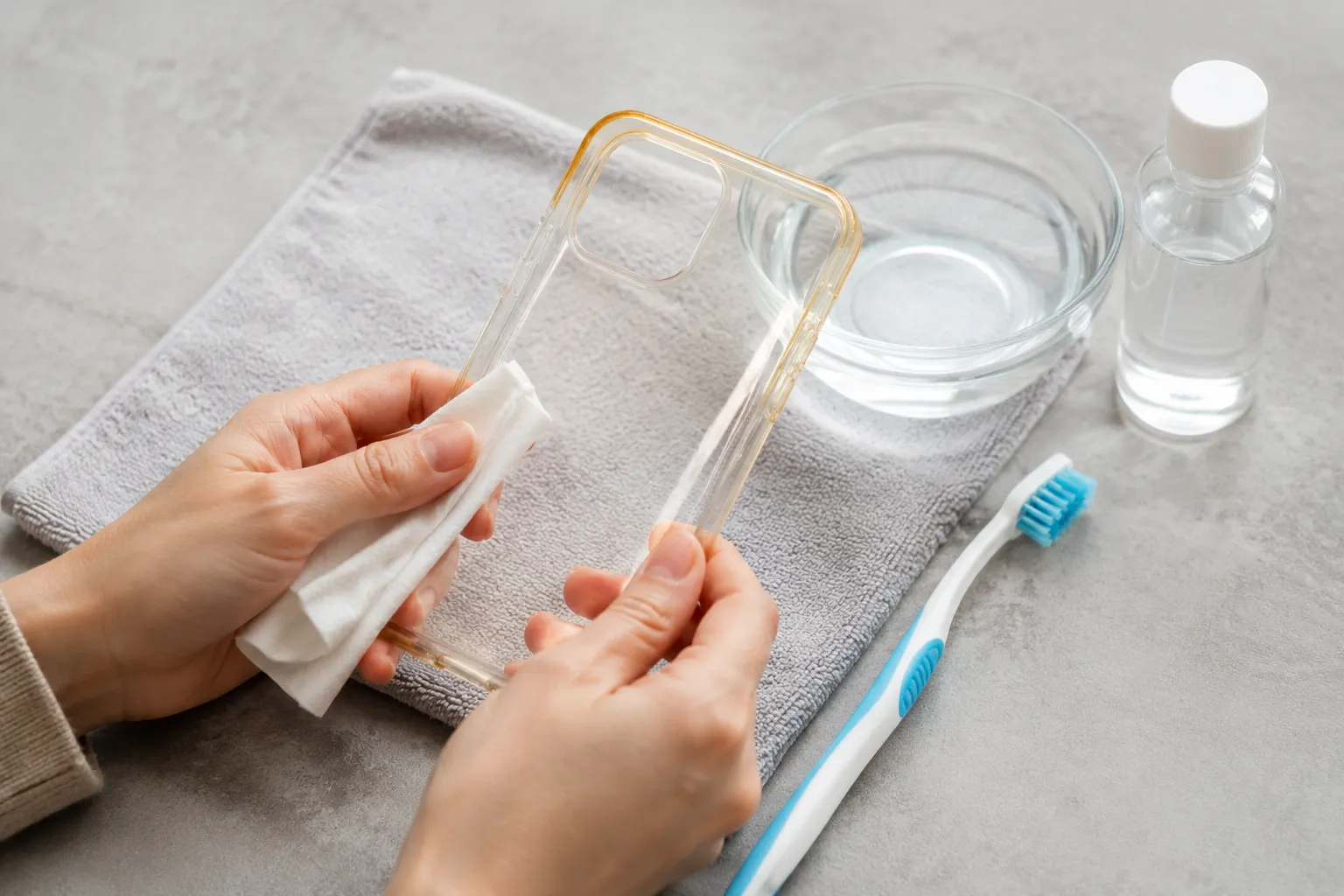
Silicone cases are marketed as easy to clean, and this is true in the short term. A damp cloth removes most surface dirt, and soap and water handles the rest. The problem is that cleaning accelerates the degradation of the soft-touch coating. Every wipe rubs away a little more of the finish. Every wash removes a layer of the material's surface treatment. The case becomes cleaner and more worn at the same time.
Leather cases require more careful treatment, but the maintenance produces better long-term results. A dry cloth removes surface dust. A small amount of leather conditioner, applied sparingly and buffed in, restores moisture and deepens the patina. The leather responds to care. It visibly improves with attention, whereas silicone visibly worsens with the same level of attention.
The practical difference shows up in a simple test. A silicone case that has been cleaned and dried looks slightly worse than it did before cleaning, because the cleaning has removed more of the already-thin coating. A leather case that has been conditioned looks better than it did before, with a richer color and a smoother surface. One material rewards effort. The other punishes it.
The Case That Earns Its Replacement Cycle
At the six-month mark, a person holding both cases side by side sees two very different objects. The leather case has darkened, gained a sheen, and developed a surface that feels personal and lived-in. The silicone case has lost its coating, picked up permanent scars from drops, and started to feel slippery in the hand. The leather case looks like it has aged well. The silicone case looks like it has aged at all.
Neither material lasts forever. The leather case will eventually develop enough wear that the coloring becomes uneven in a way that looks tired rather than characterful, and the material can crack if it dries out completely. The silicone case will eventually reach a point where the degradation makes it unpleasant to hold, and at that point, the only option is replacement. The difference is that the leather case reaches the end of its useful life gracefully, and the silicone case reaches it fighting.
The other difference is cost. Both cases retail in the same premium price range, but the leather case delivers six months of improving appearance, while the silicone case delivers six months of declining appearance. The leather case can make it to the end of a typical two-year phone ownership cycle with regular conditioning. The silicone case rarely makes it past a year before looking worn enough to replace. On a cost-per-month basis, the leather case is the better value, provided a person is willing to accept that the case will not look new for long.
The silicone case has one remaining advantage that keeps it relevant. It offers more consistent grip across the entire surface, even as the coating wears thin. It also provides slightly better drop protection because the softer material absorbs more impact. A person who drops a phone constantly might prefer the silicone case despite its cosmetic decline, because it protects better and grips better in the hand. A person who keeps a phone in a pocket, sets it on tables, and wants an object that looks better with time should choose leather.
Six months of daily use settles the question for most people. The leather case becomes something worth keeping, an object with a history written into its surface. The silicone case becomes something to tolerate, a reminder that synthetic materials resist wear only until they suddenly do not. The leather case ages like a wallet. The silicone case ages like a disposable umbrella, functional until it is not, and then quickly forgotten.