The magnetic phone mount industry solved a problem most drivers did not know they had, then spent a decade convincing everyone the problem was real. Dropped phones, fumbled cables, vents that snapped under the weight of a 6.7-inch slab. The MagSafe system, with its ring of magnets embedded in the back of the phone, turned mounting into a one-handed snap. But the pavement does not care about Apple's industrial design. Rough roads, expansion joints, and the kind of pothole that rattles the fillings out of a molar all punish the weak point of every magnetic mount: the hinge.
Most mount reviews are written from a desk, where the worst thing a mount faces is a gentle bump from a coffee mug. The real test happens on a stretch of potholed asphalt at 45 miles per hour, where a mount either holds the phone in a death grip or sends it bouncing across the floor mats. The market has split into two camps: mounts that grip the phone with mechanical claws and mounts that rely purely on magnets. The honest answer for rough pavement is that both can work, but only if the weak links are addressed.
The first weak link is the socket joint. Every ball-and-socket mount, regardless of brand, relies on friction to hold its angle. A ball joint that feels stiff on a kitchen counter will loosen after a few months of vibration, and a phone on a long arm amplifies every rattle. The second weak link is the adhesive plate that sticks to the dash or the CD slot. The third is the magnet itself. Apple's MagSafe array holds a phone securely against a flat surface, but shear force, the kind that pulls the phone sideways during a hard brake, is where magnetic connections fail first.
There is a way to think about this that cuts through the marketing. A mount is only as strong as its attachment to the car, its ability to hold an angle, and its grip on the phone. All three must be solid, or the whole system fails at the weakest point. A mount with an incredible magnet and a flimsy vent clip will drop the phone. A mount with a rock-solid dash mount and a weak magnet will also drop the phone. The trick is finding the combination that matches both the car and the phone.
The Vent Clip Trap
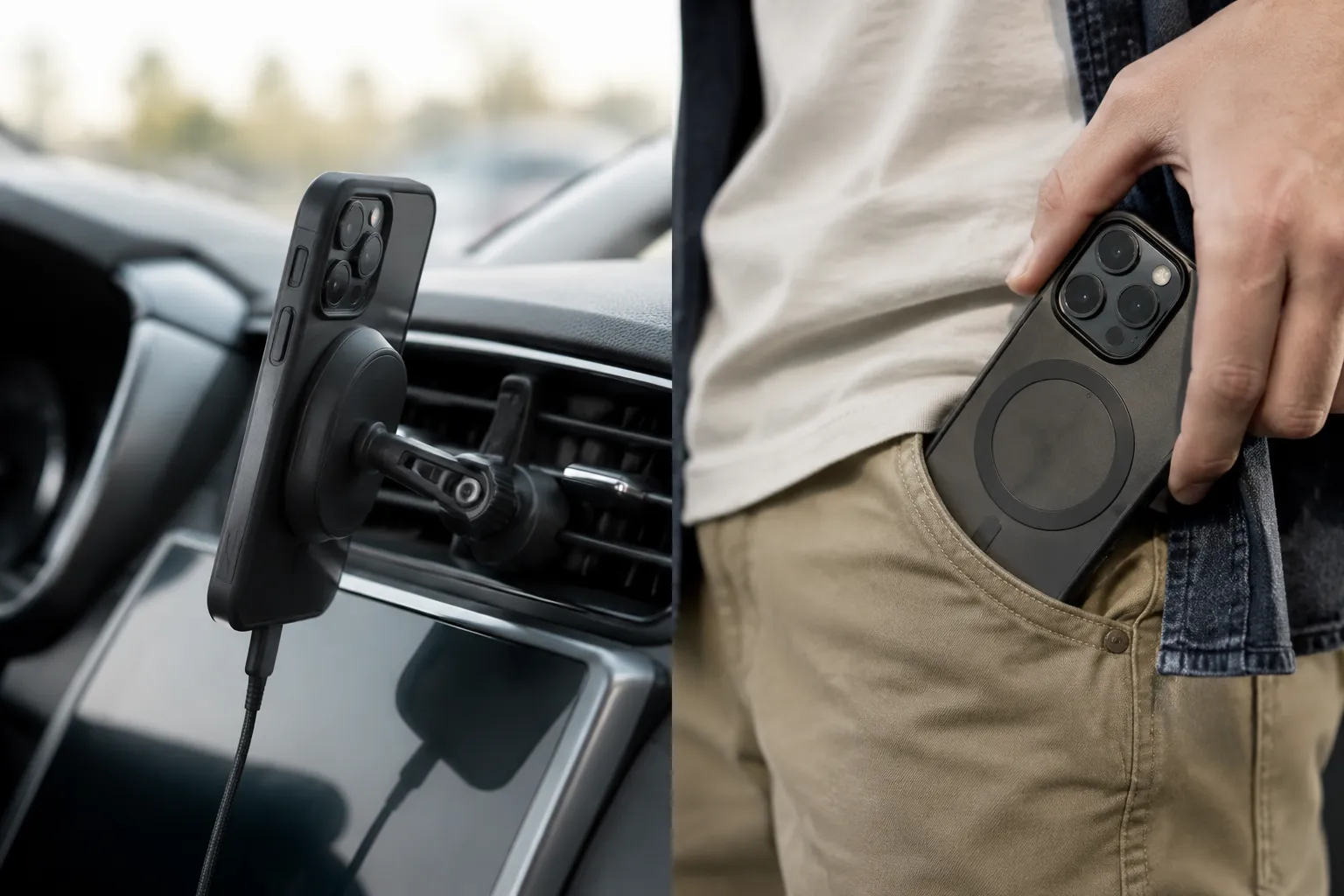
Vent mounts are the default choice because they require no installation and place the phone at eye level. They are also the most likely to fail on rough pavement. The plastic clip that slides over the vent slat relies on the vent's own friction to stay in place. A stiff suspension, a heavy phone, and a few months of summer heat turning the plastic soft are enough to make the whole assembly droop, then fall.
Some vent mounts solve this with a hook that reaches behind the vent slat, not just over it. The hook design distributes the load across the back of the vent and holds far better than a clip that pinches from the front. Even with a hook, the vent itself is the limitation. Most car vents are made of thin plastic fins that were never designed to carry a half-pound phone at the end of a lever arm. A rough road sends vibration through the vent, into the mount, and into the phone, and the whole assembly shakes like a tuning fork.
The other problem with vent mounts is airflow. Blocking a vent in July means the air conditioning has to work harder, and the phone gets cooked by the heater in winter. The mount position forces the phone to either block the driver's view of the road or sit low enough to require glancing down. Neither is ideal.
The vent mount has one genuine advantage: it works in almost any car without permanent modification. A person who swaps cars frequently or leases a vehicle has little reason to choose anything else. But for anyone who owns their car and drives on genuinely bad roads, the vent mount is a compromise that eventually fails.
The CD Slot and the Dash Mount Anchors
The CD slot mount is the quiet workhorse of the category. Most cars still have a CD slot even if the owner has never inserted a disc, and the slot provides a solid, factory-made anchor point that does not depend on adhesive or vent plastic. The mount slides into the slot and tightens with a screw or a spring-loaded arm, gripping the slot from both sides. This is a genuinely strong attachment point, and it places the phone in a useful position in the center of the dash.
The weakness of the CD slot mount is the arm that extends from the slot to the phone. Cheaper models use a single thin arm that flexes and vibrates. Better models use a two-part arm with a secondary joint near the phone. The secondary joint is what holds the phone's angle, and if it is not stiff, the phone will slowly droop over time, pointing toward the gear shifter instead of the driver's face.
A well-built CD mount is the best option for rough pavement among the non-adhesive category. The anchor is solid, the position is good, and the main risk is the quality of the joints. A person should look for a CD mount with a metal joint, not plastic, at both the base and the phone cradle. Metal joints hold their friction longer and survive temperature swings without loosening.
The adhesive dash mount is the strongest option in terms of sheer holding power, but it comes with a permanent commitment. The adhesive pad, usually a 3M VHB tape, bonds to the dash surface and does not want to come off cleanly. A person who installs an adhesive mount must choose the spot carefully, because moving it later is a fight involving fishing line and adhesive remover.
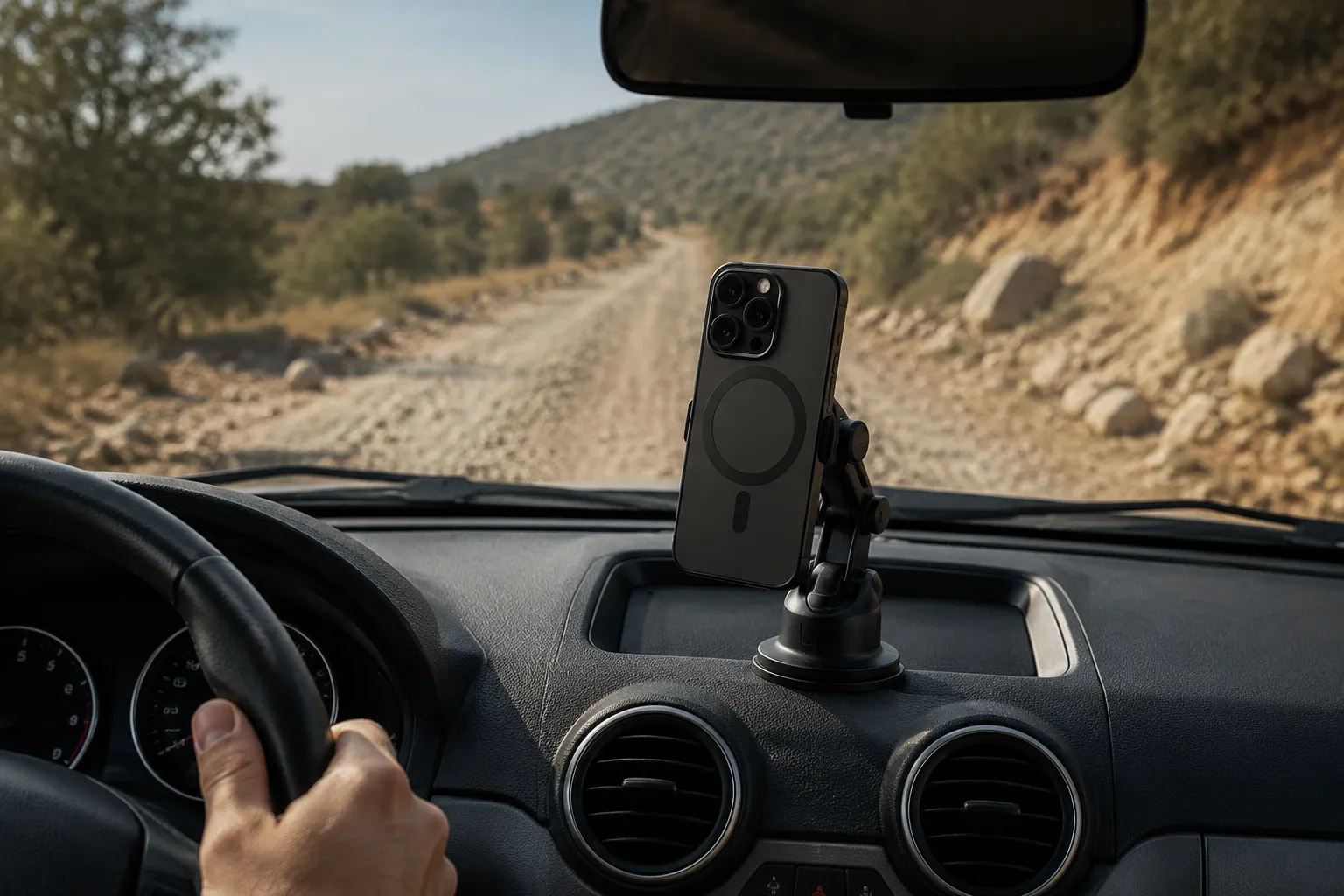
Once installed, the adhesive dash mount offers the most stable platform available. The base does not move, the arm does not rattle against a vent, and the phone sits exactly where the driver places it. The risks are the dash surface itself and the arm joint. On a textured or leather dash, the adhesive will not bond well. On a hot day, the adhesive softens. A mount that has been in place for a year can pull off with surprising ease when the interior temperature hits 140 degrees.
Magnetic Hold: The Snap vs. The Grip
MagSafe changed the physics of the phone mount. The ring of magnets in the iPhone 12 and later models provides a strong, centered pull that aligns the phone perfectly with the charging coil. The snap-on feel is satisfying, and the magnetic hold is genuinely strong when the phone is pressed flat against the mount.
The problem is that a flat magnetic connection resists pulling force (perpendicular to the mount) far better than it resists shear force (parallel to the mount). A phone mounted on a dash that faces the driver is pulled straight back by gravity, which the magnets handle easily. But a phone mounted sideways, or a phone subjected to a hard lateral acceleration during a turn, experiences shear force that can overcome the magnetic grip.
Some mounts solve this with a magnetic surface that is not flat. The MagSafe-compatible mounts with a lip or a recessed cup hold the phone with magnets plus a physical barrier. The phone slides into the cup, and the lip catches the bottom edge, so even if the magnets let go, the phone does not fall. These hybrid designs are the most reliable for rough roads.
Another approach is the mechanical grip mount that uses MagSafe as a convenience, not as the primary retention. These mounts have two or four arms that close around the phone when it snaps into place. The phone still aligns magnetically, but the arms provide the actual holding force. The trade-off is that the phone takes a second longer to release. A person cannot just pull the phone off with one hand. The arms must be pressed open.
For a driver who mounts and unmounts the phone constantly, the added friction of mechanical arms is a genuine annoyance. For a driver who mounts the phone once at the start of a commute and leaves it there, the mechanical grip is a small price for the certainty that the phone will not bounce into the footwell.
The Magnet Strength Ratings That Matter
Marketing materials quote magnet strength in kilograms of pull force. A mount rated at 15 kilograms sounds impressive, but the rating is measured with the phone pulled straight away from the magnet, not with the phone shaken side to side. Real-world vibration is a combination of pulling, shaking, and rotational forces, and the static pull force number does not capture how the mount behaves under those conditions.
What matters more than the raw pull force is the size and arrangement of the magnets. A larger magnet surface spreads the holding force across more of the phone's back, which reduces the chance of a localized failure. The phone cases also matter. A thick case with a MagSafe-compatible magnet ring built in will hold differently than a thin case or a bare phone. The air gap between the phone and the mount, created by the case material, is a killer. Every millimeter of distance between the phone's internal magnets and the mount's magnets exponentially weakens the hold.
The practical advice is to test the mount while wearing the case that will be used in the car. A case that works fine on a flat magnetic desk stand may fail on a mount that vibrates. The extra weight of the case, combined with the air gap, can be enough to cause slippage on rough pavement.
The Specific Mounts That Survive Bad Roads
A few mounts have built a reputation among drivers who actually put miles on rough pavement, and the reasons are specific enough to be worth naming.
The Belkin MagSafe Car Vent Mount Pro is the rare vent mount that can handle rough roads because it uses a hook that wraps around the vent slat and a stiff silicone base that grips the vent housing, not just the slats. It still depends on the vent itself, but it has survived more potholes than most vent mounts because the load is distributed across a wider area. The downside is the price and the fact that it blocks one vent opening entirely.
The Peak Design Magnetic Mount is the other standout, and it takes the mechanical grip approach. The phone snaps onto a small magnetic nub, and a pair of arms closes around the phone's edges. Once locked, the phone is not going anywhere. The mount is built to a standard that justifies its price, with a metal arm and a ball joint that stays stiff for years. The trade-off is the locking mechanism. Releasing the phone requires a squeeze on both sides, and doing that one-handed while driving is not easy.
The ESR CryoBoost MagSafe Car Charger Mount deserves mention for a different reason. It uses a vent mount design with a bottom lip that catches the phone. The magnet holds the phone against the charging pad, but the lip is the real safety net. If the magnet fails during a hard jolt, the phone slides down and rests against the lip instead of falling. The mount also pulls heat away from the phone during wireless charging, which matters because a phone that overheats throttles its performance and may shut down navigation entirely.
For a driver who wants the absolute strongest hold, the iOttie Velox Magnetic Dash Mount with the adhesive base is a solid choice. The mount itself is unremarkable in design, but the adhesive base is genuinely permanent, and the mount has a secondary grip that hooks the bottom of the phone. A person who installs this mount properly, on a clean, smooth dash surface, will not lose a phone to a pothole.
The Case Complication
No discussion of MagSafe mounts is complete without addressing the case problem. A bare iPhone with MagSafe holds strongly to any compatible mount. The moment a case goes on, the holding force changes. Apple's own clear case with MagSafe is thin enough that the magnetic hold barely degrades. A rugged case with a built-in kickstand, or a case with a wallet attachment, adds enough bulk that the phone may not hold at all on a vibrating mount.
The solution is to buy a case that explicitly lists MagSafe compatibility and to test the mount with the case installed before trusting it on the road. A case that snaps on easily at home may be the difference between a phone that stays mounted and a phone that ends up under the brake pedal.
The other case complication is the magnet ring that some cases include. These add-on metal rings, designed to make non-MagSafe cases work with magnetic mounts, are not all created equal. A thin steel ring can interfere with wireless charging and may not align properly with the mount's magnets. The phone may hold fine on a flat surface but wobble and detach in the car.
The Real-World Test Method
The only way to know if a mount survives rough pavement is to drive it on rough pavement. A person can test a mount the way a suspension engineer tests a car. Find a road with expansion joints, a pothole, or a set of railroad tracks, and drive over them at speed while watching the phone. The mount that holds without the phone shifting angle, bouncing, or sliding is the one worth keeping.
A slightly more scientific test involves a hard acceleration from a stop and a hard brake. Both maneuvers subject the phone to shear forces that magnets resist poorly. If the phone slides even slightly during a hard brake, the mount will eventually drop the phone on a road with a bumpy surface.
The test should also include a session with the car's heater on high. Heat softens plastic joints and weakens adhesive. A mount that holds at 72 degrees may sag at 90 degrees. Drivers in warm climates should specifically test the mount after the car has been sitting in the sun for an hour.
A Decision Based on the Car, Not the Marketing
The right mount depends on the car's interior. A car with stiff, thin vent slats should never use a vent mount, regardless of how well the mount is built. A car with a smooth, flat dash can use an adhesive mount with confidence. A car with a CD slot has an anchor point that most people overlook. A car with none of these, a modern EV with a minimal interior and no CD slot, leaves the driver with the vent mount as the only option, and the mount choice becomes a careful selection of a hook-style design.
The phone also dictates the choice. A Pro Max model, with its extra size and weight, needs a mount with a larger magnet surface or a mechanical grip. A standard model can get away with a simpler magnetic mount. The weight difference between a 6.1-inch and a 6.7-inch phone is noticeable at the end of a mount arm, and the heavier phone will stress the joints more.
The one mount feature that separates the rough-road survivors from the desk-queen failures is redundancy. A mount that relies on the magnet alone will eventually drop a phone. A mount with a lip, a cradle, or a mechanical arm will not. The extra fraction of a second it takes to release the phone is the price of that certainty.
Drivers who value a clean interior and a phone that stays put should accept that price. The pavement will keep being rough, and the phone will keep being expensive. The only variable is whether the mount meets the road's demands before the phone does.