Every pocket is a junk drawer, and the junk drawer is a lie we tell ourselves about how organized we are. The phone goes in one pocket, the wallet in another, the keys get clipped to a belt loop or dropped into a bag, and the earbuds, the earbuds are the ones that end up wadded into a knot at the bottom of everything. The average person performs this little ritual of chaos multiple times a day, patting down pockets, digging through bags, and coming up empty. The industry response has been a parade of "solutions" that are mostly just bigger bags with more compartments, which only moves the problem around instead of solving it.
What actually needs to happen is a consolidation of the things themselves, not the space they occupy. Four items, one bag, zero digging. This is not a fantasy, and it does not require a $400 tech pouch with a dozen velcro flaps. It requires thinking about the objects as a system rather than as four separate problems.
The physics of the pocket dump
Watch anyone empty their pockets onto a counter and the pattern is always the same. The phone slides out first, face down, because that is how it sat in the pocket. The wallet follows, often with receipts sticking out of it like flags. The keys land with a metallic clatter, and the earbuds, if they surface at all, arrive as a single tangled mass that takes a full minute to unravel. The pocket dump is a moment of truth, and it usually reveals that the person has been carrying around three pens, a crumpled receipt from a coffee they bought four days ago, and a USB cable that belonged to a device they no longer own.
The fix starts with admitting that pockets are terrible for these items. Phone screens scratch against coins. Wallet leather wears through from the pressure of sitting on it. Keys gouge whatever they touch. And earbuds, especially the wireless kind with their delicate charging cases, get crushed or lost with alarming regularity. A bag solves these problems, but only if the bag is treated as a deliberate tool rather than a sack of holding.
The real question is what kind of bag. Not every person wants a messenger bag, and not everyone wants a sling, and the tiny "everyday carry" pouches that have become popular on internet forums are often too small to actually hold a modern phone with a case on it. The bag needs to be big enough to hold the four core items plus one or two extras, small enough to not become a catch-all for everything else in life, and structured enough that items do not slide around and pile on top of each other.
Kill the wallet, keep the cardholder
The traditional bifold wallet is the single worst offender in the pocket ecosystem. It is bulky, it encourages the accumulation of loyalty cards and old business cards, and it forces the owner to sit on a lump of leather and paper for eight hours a day. The fix is brutal and effective: switch to a cardholder that holds no more than six cards and a folded bill or two. This is not a new idea, but the execution matters more than the concept.
A good cardholder is made of something with a bit of grip, like leather or a textured metal, so it does not slide out of a bag pocket. It should have an exterior slot for the most-used card, usually a transit pass or a work badge, so that card can be tapped without pulling the whole thing out. And it should be small enough that it disappears into a bag compartment without creating a bulge. The cardholder is not a compromise. It is an improvement, because it forces a person to decide what actually belongs in the wallet instead of letting the wallet decide for them.
For anyone who insists on carrying cash, a simple money clip attached to the cardholder solves that problem without adding bulk. The point is that the wallet should be the smallest thing in the bag, not the largest. When a person downsizes to a cardholder, they immediately reclaim space and reduce the weight they carry by a noticeable margin. The difference is felt the first time the bag is picked up.
Keys as a single flat object
Keys are the most awkward item to organize because they are jagged metal objects with no natural shape. A keychain with a dozen keys, a bottle opener, a miniature flashlight, and a lucky charm is a mess of protrusions that catch on everything. The solution is to reduce keys to a single flat layer. This means cutting down to the essential keys, removing the ones that no longer open anything, and using a key organizer that sandwiches the keys between two plates so they lay flat against each other.
These organizers, which come in various sizes and materials, turn a jangling clump into a single slim object about the size of a small lighter. The keys fan out when needed and fold back into a compact shape when done. The difference in daily experience is substantial. No more stabbing the thigh through a pocket. No more scratching the phone screen when they share a bag compartment. And no more of that distinctive jingle that announces a person's arrival from twenty feet away.
A key organizer also makes the keys easier to find in a bag, because they no longer slip into the crease at the bottom. They become an object with weight and shape, something the hand can identify by feel alone. This matters more than it sounds. The ability to reach into a bag and pull out exactly the right item without looking is the entire point of an organized carry system.
Earbuds need a home, not a pocket
Wireless earbuds come with a charging case that is supposedly designed for pocket carry, but the case is slippery plastic that slides out of shallow pockets and hides in the depths of bags. The charging case is also the single most lost item in modern life, because it is small, dark-colored, and easily mistaken for a pebble or a mint tin. The solution is to give the earbuds a dedicated spot in the bag that is not shared with anything else.
Many bag makers now include a small pocket specifically sized for a charging case, often in the lid or the front flap. If the bag lacks such a pocket, a small hard-shell case, the kind originally made for sunglasses or small electronics, can be repurposed to hold the charging case and a short charging cable. The key is that the earbuds case should always go in the same place, every single time, so the hand learns where to reach.
There is a secondary consideration for earbuds that many people overlook. The charging case is not the only thing that needs organizing. The earbuds themselves, when not in the case, are tiny and easy to drop. A person who takes an earbud out to talk to a coworker will often hold it in a fist or balance it on a knee, and that is how earbuds get lost. The habit of returning earbuds to the case immediately, before doing anything else, is the single most effective organizational practice for this item.
The phone dictates the bag size
Phones have grown to the size of small tablets, and the phone is the item that determines the minimum dimensions of any bag. A bag that cannot hold the phone in its case, with room to spare for the hand to reach in and grab it, is a bag that will not be used consistently. This seems obvious, but many people buy a bag that fits their phone at the store and then discover that the phone with a case on it barely squeezes into the slot. The case adds three to five millimeters on each side, and that is enough to turn a snug fit into a frustrating struggle.
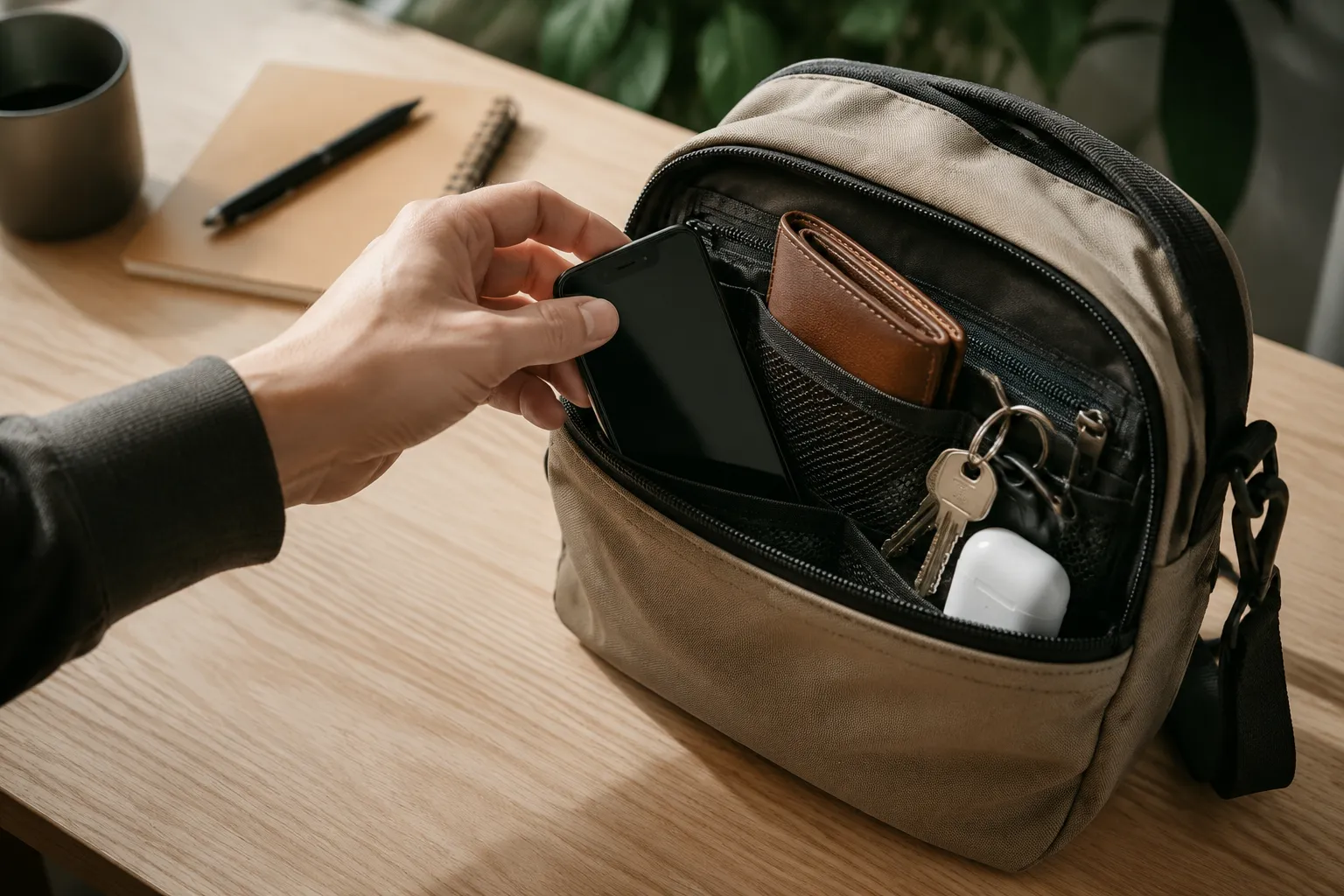
The phone should have a dedicated slot or compartment that is slightly larger than the phone with its case. This slot should be vertical, so the phone can be dropped in and pulled out without fumbling. The slot should also be positioned so that the phone does not share space with the keys or any other hard object. A phone screen scratched by a key is a preventable tragedy that happens every day.
Some bags solve this with a fleece-lined pocket at the back, which doubles as a place to keep the phone warm in winter. Others use an elastic band across an open compartment. The best solution is a simple vertical pocket with a bit of depth, wide enough for the phone but narrow enough that the phone does not slide sideways. This pocket should be the easiest to access in the whole bag, because the phone is the item that gets pulled out most often.
Choosing the bag that holds all four
Once the items themselves are optimized, the bag choice becomes much simpler. A bag that needs to hold a cardholder, a flat key organizer, an earbuds case, and a phone does not need to be large. A bag with a main compartment of roughly two to three liters is sufficient for these four items plus a few extras like a pen, a small notebook, or a charger. Anything larger invites the accumulation of clutter, and the whole system collapses back into a junk drawer.
The ideal bag has at least three distinct compartments. One for the phone, one for the small items like the cardholder and keys, and one for the earbuds. The compartments do not need to be elaborate, but they need to exist, because a bag with a single open space will have the phone at the bottom, the keys on top of it, and the earbuds case wedged into a corner. That is not organization. That is a sack.
A person should also consider the material of the bag. A floppy canvas tote will not hold its shape, and the items inside will migrate and pile up. A bag with some structure, whether from a stiff fabric, a wire frame, or a padded lining, keeps the compartments accessible and the contents stable. The bag should stand up on its own when placed on a desk, so the person can see inside and grab what they need without holding the bag open with one hand and digging with the other.
The closure matters too. A zipper keeps items secure but adds friction to every access. A magnetic flap is faster but less secure. A drawstring is neither fast nor secure. For most people, a magnetic snap or a single sturdy zipper across the top provides the right balance. The bag should also have a handle or strap that allows it to be carried comfortably while the person is also holding a coffee cup and a takeout bag. A bag that requires two hands to open is a bag that will be left unzipped, and an unzipped bag is just a sack again.
The daily rhythm of putting things away
Organization is not a one-time setup. It is a daily practice, and the practice is simpler than most people expect. Each item goes into its designated compartment, in the same order, every time the person comes home or arrives at the desk. Phone in the vertical pocket. Cardholder in the small-item pocket. Keys in the same pocket, placed on top of the cardholder or beside it. Earbuds in their dedicated spot. The whole routine takes about ten seconds, and it prevents the slow drift toward chaos that happens when items are set down wherever there is space.
The hardest part of this system is not the buying or the setup. It is the un-learning of the habit of dropping things into the nearest surface. A person who has spent years putting their keys on the kitchen counter and their wallet on the nightstand will need to consciously redirect those items into the bag for a few weeks before it becomes automatic. Once the habit forms, the relief is immediate. The frantic pre-work search for keys that were left in a jacket from three days ago disappears. The patting down of pockets before leaving the house becomes a single glance into the bag.
What the system does not solve
There are limits to this approach, and it is worth naming them. A person who carries a separate work phone and a personal phone will need a larger bag or a different arrangement. A person who carries medication, a water bottle, or a tablet will outgrow this system quickly. And a person who prefers to carry items directly in their pockets, with no bag at all, will find that the cardholder and key organizer still work, but the earbuds case remains a problem with no clean solution. The pocket-only approach requires a bag-free lifestyle that most people do not actually have.
The system also assumes that the person is willing to carry a bag at all. Some people simply refuse, and for them, the answer is to reduce the number of items. A phone with a built-in wallet case eliminates the cardholder. A key organizer reduces the key bulk. Earbuds that stay in a pocket are a risk, but a person who accepts that risk can manage. These are trade-offs, not failures.
The four-item system works because it aligns with how people actually move through the world. The morning rush, the commute, the sequence of reaching for a phone to check a message, pulling out keys to unlock a door, and grabbing earbuds to take a call. When each of those items has a known location, the hand moves without the eyes. The reach becomes muscle memory. The bag becomes an extension of the body rather than a portable junk drawer.
The proof is in the pocket dump. A person who uses this system empties their bag onto the counter and finds exactly four items. No receipts. No loose change. No mystery cables. The four items sit in a row, each one in the same condition it was in when it was put away. That is the entire point. Not a perfectly organized life, not a minimalist aesthetic, just the small daily victory of knowing where everything is and never having to dig for it.