The port cover was never the glamorous part of a laptop. It was the rubber flap, the hinged door, the little plastic shield that kept dust out of an HDMI socket and lint away from a USB-C port. For years, it sat there as a quiet promise: this machine was built for a road life, for bags full of gravel and crumbs and the general abuse of travel. In 2025, with ports disappearing entirely and the ones that remain sealed up tight, that promise is starting to look like a relic of a different computing era. And yet, the covers are still here, clinging to a shrinking class of machines, and their persistence raises an honest question: are they doing anything, or are they just decoration that survived the purge?
The honest answer is that they are doing far less than they used to, and what they still do has shifted from protection to psychology. A port cover in 2025 is not guarding a fragile mechanism. It is guarding a feeling. The question is whether that feeling is worth the cost of the flap, and there is a real cost, one that manifests the moment a person is in a hurry with a dead battery and a charging cable in hand.
What the cover actually protected in the old days
Back in the era of the chunky business laptop, the port cover was a functional necessity in a way that is hard to explain to anyone who has only known unibody aluminum. The old machines, think of a ThinkPad from 2008 or a Panasonic Toughbook, had ports that sat exposed on the rear or the side, with delicate pins inside a VGA connector and the long, fragile tongue of a serial port. Those connectors were mechanical parts, and mechanical parts fail when they fill with grit.
The cover kept the worst of it out. A rubber flap over a PC Card slot, a hinged door over the modem port, these were cheap insurance against a failure mode that was expensive and annoying. Dust in a PS/2 socket could cause a keyboard to stutter. A bent pin in a VGA port meant a dead projector connection in the middle of a sales pitch. The covers were not elegant, but they were honest engineering. They protected moving parts and exposed contacts from an environment that was actively trying to destroy them.
That world is gone. The modern port is a USB-C receptacle, which is a solid block of metal with no pins exposed to the air. It is rated for ten thousand insertion cycles. It does not care about dust in the same way an old D-sub connector did, because there is nothing inside it that can bend or snap. The same goes for HDMI and DisplayPort, both of which are shielded and recessed. The physical vulnerability that made the cover necessary has been engineered out of the port itself.
The new threat is not dust, it is liquid and momentum
What actually kills a modern port is a spilled coffee or a hard drop, and no rubber flap on earth is stopping either of those. A cover does nothing against a mug tipping over. It does nothing when a laptop slides off a table and lands corner-first on the connector. The failure modes that matter in 2025 are all impact and liquid related, and those bypass the cover entirely. A person buys a machine with a port cover thinking they have protected an investment, but the protection is aimed at a threat that has already been neutralized by better engineering.
Liquid is the more interesting case. Some manufacturers sell port covers as part of a ruggedized package, and there is a logic there, but it is a shallow one. A sealed flap over a port does slow down a spill for the few seconds it takes the liquid to find a different route. The keyboard is still open. The vents are still open. The hinge gap is still open. A laptop is not a submarine, and a port cover does not turn it into one. The machines that genuinely survive a soaking are the ones with conformal coating on the motherboard and sealed keyboards, not the ones with a bit of rubber over the USB slot.
The rugged machines that still justify the flap
There is a narrow category where the cover still earns its place, and it is worth naming it honestly. The fully rugged laptop, the kind used by field engineers, military contractors, and utility workers, operates in environments that are genuinely hostile. A Getac or a Dell Latitude Rugged is expected to function on an oil rig and in the back of a pickup truck on a gravel road. For those machines, a port cover is not a nicety. It is part of the sealing strategy, working in concert with gaskets and o-rings to keep the whole chassis at an IP rating. The cover there is not protecting a port from dust. It is maintaining the integrity of a sealed system.
But those machines are a rounding error in the laptop market. The person buying a $3,000 workstation for video editing or a $1,500 ultrabook for business travel is not working on an oil rig. They are working in an office, a coffee shop, or a home study. The port cover on those machines, and it still appears on a surprising number of them, is a stylistic leftover, a visual shorthand for toughness that does not correspond to any real protective function.
The semi-rugged category is where the dishonesty lives. These are the laptops that look like they have been through a war, with thick bumpers and reinforced corners, and they ship with port covers as part of the aesthetic. The covers are functional in the sense that they close, but the machine itself is not sealed. It has a standard keyboard, standard vents, and no conformal coating. The cover is a costume accessory. It is there to make the buyer feel like they have purchased something more durable than a standard consumer laptop, when in reality they have purchased a standard laptop with a thicker shell and a few rubber flaps.
The ergonomic tax of the rubber flap
What gets lost in the marketing language of protection is the daily cost of a port cover. It is a small cost, but it is paid in a currency that matters: friction. Every time a person needs to plug in a charger, they have to perform a two-step operation. Find the flap, open the flap, insert the cable, and then later, remove the cable, close the flap. That extra second or two does not sound like much, but it compounds over the life of a machine.
On a train platform with a boarding call already announced, that flap is a nuisance. In a meeting room with a projector warming up and twelve people waiting, that flap is an annoyance. In a workshop where a laptop is docked and undocked forty times a day, that flap is a genuine impediment. The worst design flaw is not the one that breaks a machine. It is the one that adds a step to a routine action, and the port cover is a masterclass in that kind of friction.
The more insidious issue is what happens when the flap is open. A cover that is hanging open is no longer protecting anything. It is a small rubber protrusion that can catch on a bag strap or a sleeve, and in the worst case, get snapped off entirely. The design assumes a disciplined user who always closes the flap after use. Real users are not disciplined. They leave the flap hanging because they are going to plug the cable back in later, and later turns into never. The cover becomes a dangling appendage, serving no purpose except to catch on things and look broken.
The ports that vanished while the covers stayed
There is an irony in the persistence of the port cover, and it has to do with what the cover is attached to. The machines that still ship with a full complement of legacy ports, the ones with an RJ45 Ethernet jack and a USB-A port and an HDMI output, are increasingly rare. The industry has been shedding those ports for a decade, and the covers have gone with them. The modern ultrabook has maybe two or three USB-C ports, and those ports are so small and so robust that no manufacturer bothers to shield them.
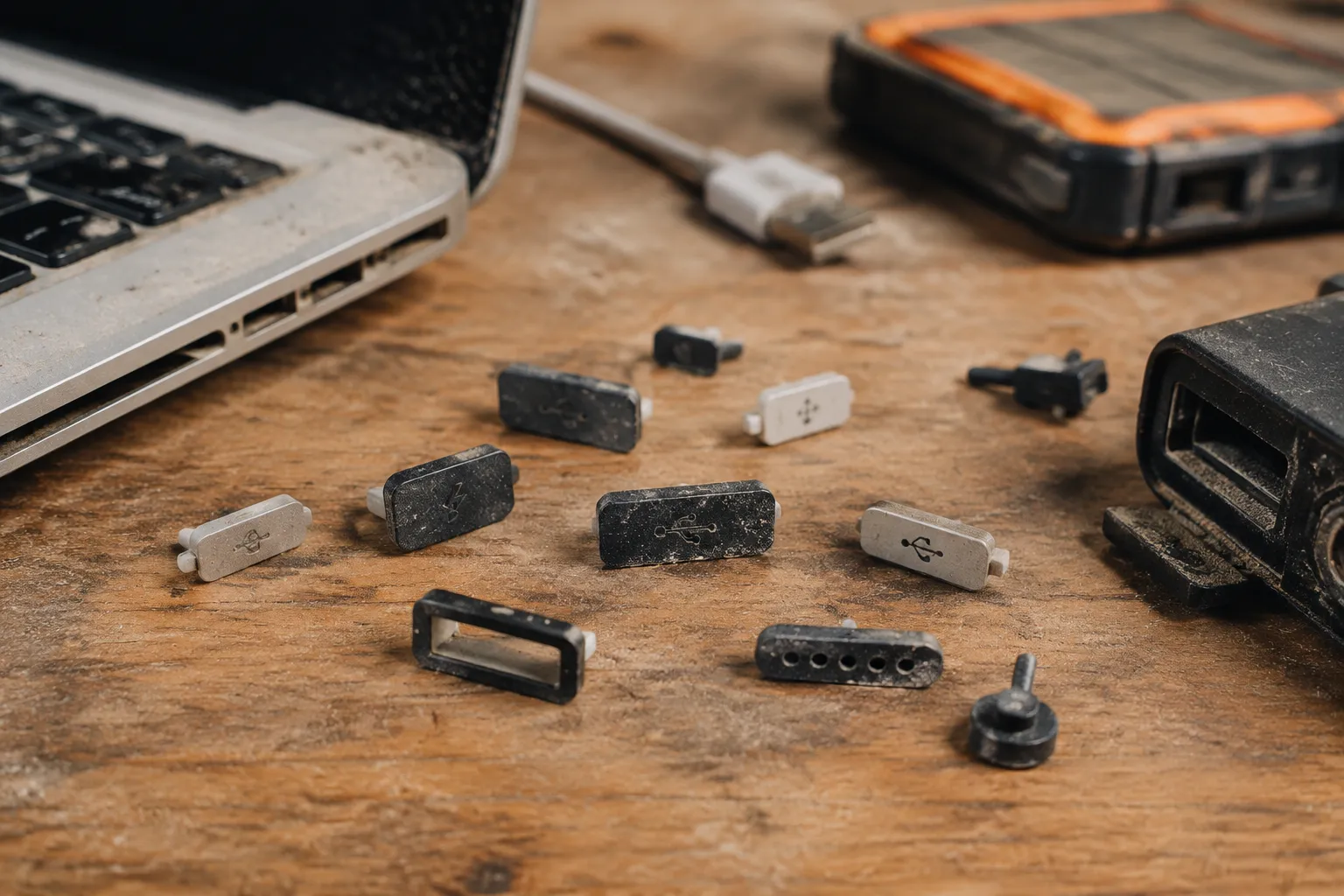
The port cover survives today in the most paradoxical place: on the laptops that still have the largest number of exposed connectors. A 16-inch mobile workstation with an SD card slot, a USB-A port, a Thunderbolt port, and a headphone jack will sometimes ship with a cluster of small rubber plugs or a single hinged panel. These are exactly the machines where the cover is least needed, because they are built on the same robust port technology as everything else. The cover is not protecting anything old and fragile. It is drawing attention to the fact that this machine has more ports than the market average, as if to say, look at all the connectivity this thing has, and we have put a door on it to keep it safe.
The user who buys that machine for creative work is not going to baby it. They are going to plug in an external drive, leave it for a week, unplug it, plug in a camera, and repeat. The cover will be opened once on day one and then left open forever, a small rubber flag that eventually gets caught and torn off. The manufacturer knows this. The cover is not designed for the actual use case. It is designed for the unboxing video, for the first impression, for the spec sheet that lists off a ruggedized feature set.
The psychological payload of a rubber door
What the port cover actually sells is the illusion of fragility reversed. A machine without a cover signals that it is durable enough to leave its ports exposed, which is the Apple approach. A machine with a cover signals that it is delicate enough to need protection, but rugged enough that the manufacturer bothered to add it. The second signal is a contradiction, and yet it works on a subconscious level. The cover makes a laptop feel cared for, as if the entire machine is a precision instrument that needs to be shielded from the elements.
That feeling is not entirely baseless. A laptop is a precision instrument, and a $3,000 workstation is a serious investment. But the cover protects the wrong part. The screen needs a sleeve. The keyboard needs a barrier against crumbs. The bottom panel needs to be kept off hot surfaces. The port, that solid little block of metal, is the last thing on the machine that needs a shield. The psychological benefit of the cover is that it makes the user feel responsible. The user performs the ritual of opening and closing the flap, and that ritual makes them more careful with the machine as a whole. There is a real value in that, but it is a value that could be achieved with a sticker on the palm rest or a nicer carrying case.
A broken hinge tells the real story
Spend a few years repairing laptops, or even just reading repair forums, and a pattern emerges. The port cover is never the part that fails. It is the part that is broken. The hinge on the flap snaps. The rubber plug stretches out and no longer seats properly. The little tether that connects the cover to the chassis tears. These are the failure modes, and they are entirely self-inflicted. The cover adds a component to the machine that can break, and that component protects a port that would not have broken in the first place.
The calculus is simple and damning. The probability of a modern USB-C port failing due to dust ingress is very low. The probability of a rubber port cover hinge breaking over a three-year ownership period is high, because it is a moving part made of plastic and rubber, and all moving parts wear out. The cover does not protect the port from its actual failure modes. The cover creates its own failure mode. It is a net negative on the reliability ledger, and the only reason it survives is that the failure is cosmetic rather than functional. A broken cover still covers the port, sort of. It just flaps around and looks bad.
The 2025 market has made a quiet decision about this. Look at the flagship business laptops from Lenovo, Dell, and HP. The port covers are gone from the premium lines. The ThinkPad X1 Carbon does not have them. The Dell XPS does not have them. The HP Elite Dragonfly does not have them. These are machines built for road warriors, and the manufacturers have concluded, correctly, that the cover is more trouble than it is worth. The only place they remain is on the budget lines, where they are used as a visual cue to suggest durability, and on the genuinely rugged lines, where they are part of a real sealing system.
The verdict is already written in the design language
The port cover in 2025 is a fossil, and like most fossils, it is most visible in the layers where it is least needed. The budget laptop with a plastic chassis and a low-resolution screen ships with a port cover because it makes the machine look tougher than it is. The rugged laptop ships with a port cover because it is genuinely sealed. The premium laptop, the one that costs more than a used car, ships with no cover at all, because its buyers have already proven they are willing to pay for durability without the visual theater.
The user who should be most angry about the port cover is the one who bought a semi-rugged machine, the one with the bumpers and the flaps, and discovered that the cover does not make the laptop any more resistant to the actual hazards of daily use. That user spilled a drink on the keyboard and fried the motherboard, while the port cover sat closed over a perfectly dry USB socket. The marketing said the machine was built for the elements. The engineering said otherwise.
So let the last word go to the port itself. The USB-C connector is a marvel of miniaturization, a single socket that carries power, data, and video, and it does it without a single exposed pin. It does not want for a door. It does not need a shield. It sits there, flush with the chassis, ready for ten thousand insertions, and the only thing a rubber flap adds to that arrangement is a reason to hesitate for a moment before plugging in. For a user in a hurry on a cold morning with a dead battery, that moment is not protection. It is an obstacle.