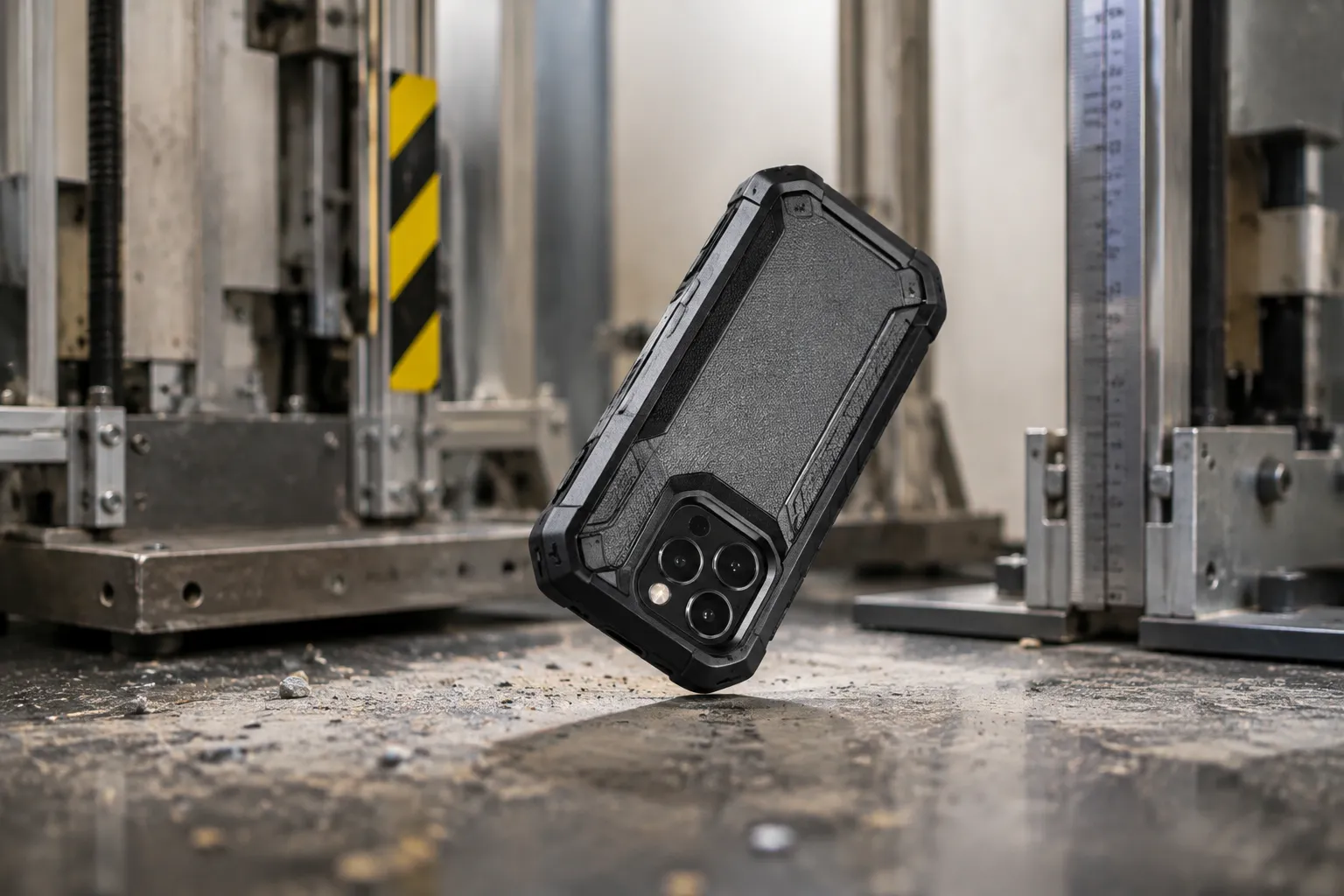
The phrase appears on packaging in a font that suggests ballistics testing and desert warfare. "Military Grade." On a phone case, it implies the thing inside survived something violent, that the aluminum and polymer layers were validated by people who would not hesitate to throw a device at a wall. The actual connection to the military is thinner than the case itself, and understanding what the label does not say matters more than what it implies.
Drop tests are the marketing battleground. Brands film cases tumbling from ladders, balconies, and the hands of people who look like they regret the decision immediately. The camera angle never changes, the concrete never gets softer, and the phone always survives. These videos exist to sell a specific feeling of security, and the term "military grade" exists to make that feeling feel official. Neither the video nor the label tells a person much about what happens when the phone hits the ground at an unlucky angle.
The Standard That Never Gets Named
The military does not have one universal specification for a phone case. It has standards for equipment it actually buys, written by procurement officers and tested by contractors, and those standards change depending on whether the item is a radio, a rucksack, or a vehicle part. A company that stamps "military grade" on a consumer accessory is almost never selling to the Department of Defense. It is borrowing the aesthetic of a procurement document to dress up an injection-molded slab of plastic.
The closest thing to a real standard in this space is MIL-STD-810, a United States military test method that covers environmental conditions like temperature, humidity, vibration, and shock. A case maker can claim compliance with MIL-STD-810 for a drop because that standard includes a transit drop test. But MIL-STD-810 is a set of laboratory procedures, not a pass-fail certification. A manufacturer chooses the procedures it wants to run, picks the parameters, and conducts the test in a way that often reflects the product's best possible performance rather than its real-world vulnerability.
The drop test within MIL-STD-810 usually involves dropping the item from four feet onto concrete or steel. That sounds rigorous until a person learns that the test is designed around the equipment's packaging and configuration. A phone case tested with the phone inside, screen down, onto a flat surface from four feet, can pass while still failing catastrophically when it hits a curb edge or a loose pebble. The standard measures a narrow event. The label makes it sound like a guarantee against all falling.
What the Drop Test Videos Actually Show
Watch a few of these videos in a row and the patterns become obvious. The drop surface is flat concrete or steel, always clean, always level. The phone falls from a height that sounds dramatic but stays within a range that most cases can survive with only superficial scuffs. The angle of impact is often flat on the back or flat on the face, which spreads the force across the whole surface rather than concentrating it on one corner. Corners are where phones die.
The corner drop is the one that matters. When a phone lands on its corner, the entire force of the fall funnels into a small area of the frame, and the frame transfers that force to the glass. A thick bumper can absorb some of it, but a thin "military grade" case with a hard exterior and no shock-absorbing interior structure will send that force straight through to the phone's chassis. The result is a cracked corner that spiderwebs across the screen, and no marketing video will ever show that because it is the outcome the product is designed to avoid demonstrating.
Some cases genuinely do protect against corner drops. They are usually thicker, softer on the inside, and made of materials like TPU (thermoplastic polyurethane) that flex and rebound. They have air cushions or honeycomb structures at the corners. They cost more and add bulk. They also do not need a military label to sell themselves, because their protection is visible in the design. The "military grade" cases that feel like a hard shell with a thin inner liner are often the worst performers in real falls, because the hard shell does not deform and the liner is too thin to absorb energy.
The Material Truth About Aluminum and Polycarbonate
The word "grade" suggests a hierarchy of quality, as if the case is made from material that exceeded some civilian threshold. In many cases, the aluminum used in a phone case is the same 6000-series alloy found in bicycle frames and camera bodies. It is strong, light, and machinable, but it is also stiff. Stiffness is not what a phone needs when it hits the ground. The phone needs something that will crush, flex, or bounce to keep the glass inside from experiencing the full shock.
Polycarbonate, the plastic that forms the backplate of many "military grade" cases, is tough and scratch-resistant. It is also hard, and hardness transfers impact. A case made entirely of polycarbonate with no softer inner layer will protect the phone's back from scuffs but will do little for impact absorption. The phone's glass back will meet the ground's force with only the thin polycarbonate as a buffer, and that buffer will send the shock through to the glass.
This is why the best cases combine materials. A soft inner TPU layer that hugs the phone and deforms under impact, paired with a hard outer shell that spreads the force, is a proven design. The soft layer does the work. The hard layer just looks rugged. The "military grade" cases that skip the soft layer or make it too thin are trading real protection for a slim profile and a chunky aesthetic. A person who wants protection should look for thickness at the corners and flexibility in the liner, not for a certification stamp.
The Extra Drop Nobody Talks About
There is a second drop test that matters more than any laboratory procedure, and no case maker advertises it. It happens when the phone slips out of a hand at shoulder height and lands on a rough sidewalk, or falls out of a car door onto gravel, or gets knocked off a table onto a tile floor that has a slightly raised edge at the grout line. These are the drops that break screens, and they are unpredictable in a way that no standard can capture. The ground is never flat. The angle is never perfect. The phone always lands on the corner or on a small stone.
Real drop protection is about managing these unlucky events. A case that adds 2 millimeters of raised rubber around the screen bezel can keep the glass from touching the surface in a flat fall. A case with pronounced corner bumpers can absorb a corner impact. A case with a lip around the camera lens can save the lens from a direct strike. These features matter more than the drop height a company claims in its advertising, because they address the geometry of real accidents rather than the geometry of a controlled test.
The "military grade" label usually says nothing about these features. It does not tell a buyer whether the case has corner protection, whether the screen lip is tall enough, or whether the buttons remain usable after a fall. It is a shortcut that replaces specific information with a vague suggestion of toughness, and it works because people want to believe that a phone case can be a simple purchase. Buy the rugged one, skip the research, move on.
What the Drop Tests Leave Out Entirely
Drop testing measures one event: the fall. It does not measure torsion, the twisting force that happens when a phone is in a back pocket and a person sits down. It does not measure the slow pressure of a phone being squeezed against a car seat or a bag's contents. It does not measure the heat of a car dashboard in summer, which can soften adhesives and warp thin plastics. A case can pass a four-foot drop and fail these everyday conditions, because those conditions are not part of the test.
The claim also ignores the phone itself. Modern phones are built with fragile glass on both sides, held together by precision engineering that does not tolerate flex. A case that protects the back but transfers shock to the front screen saves one surface at the expense of the other. A case that is too rigid can actually concentrate stress at the phone's weakest points, which are usually the corners of the glass and the area around the charging port. The best case is one that moves with the phone during impact, not one that fights it.
Few "military grade" cases are engineered with this level of thought. They are often designed to look like armor, with angular lines, exposed screws, and textured surfaces that evoke tactical equipment. The design language is about visual durability, not physical performance. A person who buys one of these cases is buying an aesthetic that says "this phone is protected" and the case may protect well enough in a mild fall. But the label did not help them choose. It just made them stop looking.
The Price of the Label
Slapping "military grade" on a product costs nothing to implement and adds a premium to the price. The tooling that creates the drop test video costs more than the certification, because there is no certification to buy. A company can print the words on the box, add a few stylized spec numbers, and charge 30 percent more than a comparable case without the label. The markup is pure margin, justified by a phrase that has no legal definition and no independent verification.
The Federal Trade Commission has taken interest in such labels in other categories, like "waterproof" electronics that fail in a shallow pool or "bulletproof" backpacks that stop only low-velocity rounds. Phone cases have not drawn the same scrutiny, partly because the consequences are just a cracked screen, not a safety failure. A person who buys a "military grade" case and breaks their phone has no recourse beyond the store's return policy. The label was a promise, but the promise was never written down.
Reading a Case Without Reading the Box
A person can assess a phone case in under a minute without any marketing claims. Pick it up and squeeze the corners. If they feel hollow or hard, keep looking. Press the inner liner. If it does not give under a fingernail, it will not give under a fall. Look at the lip around the screen. If it is flush with the glass, the screen will meet the table on a face-down drop. Check the corner thickness. If it matches the rest of the case, there is no impact zone. Flip it over and look at the camera cutout. A raised ring around the lens is a sign that someone thought about real use.
The most protective cases feel almost rubbery at the edges and have a visible air gap or cushioning structure at each corner. They are not the slimmest cases on the shelf, and they do not look like tactical gear. They look a little thick and a little plain, because the engineering is in the interior. These cases rarely carry the "military grade" label, because they do not need it. Their protection is in the hand, not in the wording.
There is a reason the phone industry settled on this phrase instead of a more specific one. "Certified to withstand a four-foot drop onto flat concrete from a specific angle in controlled laboratory conditions" does not sell cases. But it is the honest description of what those tests actually prove. The distance between that honest description and the rugged fantasy on the packaging is where cracked screens live.
The next time a drop happens, and it will happen, the case will do what it does. If it was chosen for its label, the phone's survival will be a matter of luck. If it was chosen for its corner thickness and the give in its liner, the odds shift. That is the entire difference, and it has nothing to do with the military.