The airline personal item allowance is the last honest constraint left in travel. Checked bags cost money. Carry-on bags cost money, and then they run out of overhead space and get gate-checked anyway. But that underseat rectangle, roughly 18 by 14 by 8 inches depending on the carrier, remains the one piece of luggage a person controls completely. The problem is that the rectangle is short. A 16-inch laptop, the size that has become standard for serious work in the last few years, does not fit in most bags built to that spec. The laptop is not the issue. The bag is. And the fix requires rethinking how the laptop sits inside it.
The typical 16-inch workhorse, something like a MacBook Pro or a Dell Precision, measures about 14 inches across and 9.8 inches deep. Those dimensions force a specific geometry. Lay the laptop flat in a bag that is 18 inches wide and it fits with room to spare. The problem is depth. A padded laptop compartment eats an inch or more of the bag's limited height, and the rest of the contents have to stack on top. A packing cube, a jacket, a charger brick, and suddenly the bag bulges past the 8-inch limit. The airline sizer does not care about the manufacturer's stated dimensions. It cares about whether the bag slides in. A bag stuffed to 9 inches fails.
The obvious solution is to buy a bigger bag. That misses the point entirely. The personal item allowance exists because airlines want to sell carry-on space. A bag that technically exceeds the limit invites scrutiny. A bag that fits but looks tight invites a second look. The better approach is to choose a bag designed around the laptop's actual footprint rather than around a marketing photo of a slim briefcase.
Why the laptop lies flat in most bags
Nearly every backpack on the market places the laptop sleeve against the back panel, flat, parallel to the wearer's spine. That position is comfortable for carrying. It puts the weight close to the body. It also wastes vertical space. A 16-inch laptop laid flat occupies a plane that is 14 inches wide and 9.8 inches tall. In a bag that is 18 inches wide and 14 inches tall on the inside, the laptop takes up the full height but only part of the width. The remaining width becomes a shelf for chargers and cables, but the depth of the bag above the laptop is mostly empty air. The bag's total thickness has to accommodate the laptop's 9.8-inch depth plus padding, which pushes the bag close to the 8-inch limit before anything else goes in.
This is the core design flaw. The laptop is the thickest object in the bag, and the bag's depth is the tightest constraint. Laying the laptop flat makes the bag's depth roughly equal to the laptop's width. A smarter layout turns the laptop sideways.
The vertical sleeve changes everything
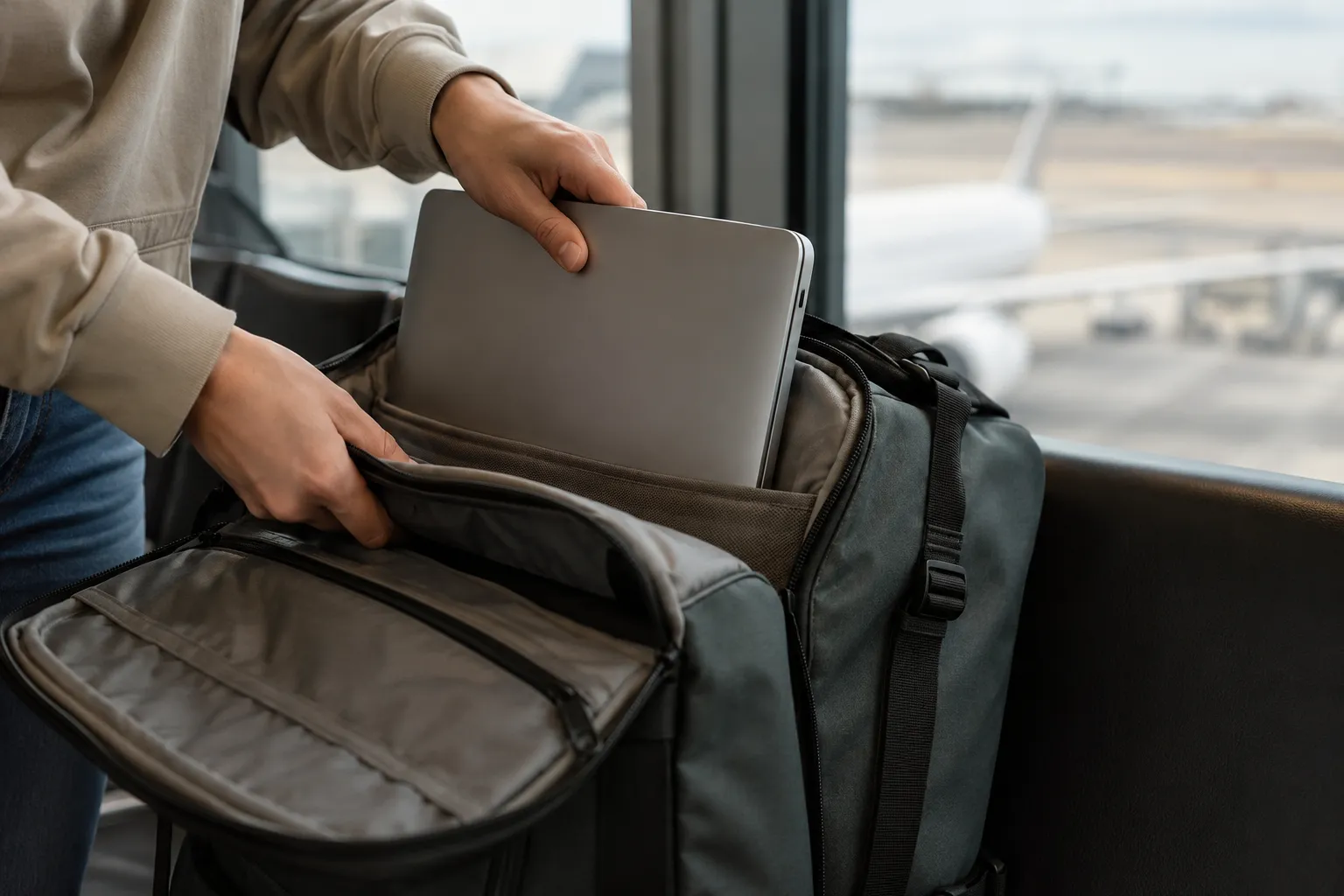
A handful of bag makers, mostly those oriented toward urban commuting and one-bag travel, position the laptop sleeve vertically. The laptop slides in edge-first, standing on its 9.8-inch side, with the screen facing the bag's side panel. This orientation uses the bag's height to accommodate the laptop's 14-inch width. A bag that is 16 or 17 inches tall can hold a 16-inch laptop standing up without the bag's depth ever exceeding 3 inches at the laptop's location.
The difference is dramatic. A bag with a vertical sleeve can be as thin as 5 inches at the bottom and still carry a 16-inch laptop comfortably. That leaves 3 inches of the 8-inch allowance for everything else. It also changes how the bag carries. The weight of the laptop sits lower, closer to the lumbar area, which makes a loaded bag feel noticeably lighter on the shoulders.
The catch is that vertical-sleeve bags are rare. A person walks into a typical electronics store and sees fifty backpacks with horizontal sleeves for every one with a vertical layout. The market assumed people want to open the top of the bag and pull the laptop straight out. That convenience costs several inches of usable depth, and for a 16-inch machine, it costs the ability to fit under a seat at all.
The 18-inch bag that actually fits
A few specific bags have solved this properly. The Tom Bihn Synik 30 and the newer Synik 26 both use a vertical laptop compartment, though the 26 is too small for most 16-inch machines. The Synik 30, at 18 by 12.5 by 8.5 inches, fits a 16-inch MacBook Pro in its vertical sleeve with room to spare, and the bag's depth stays within the letter of most personal item rules. Similarly, the Able Carry Max Backpack uses a vertical laptop compartment and measures 21.5 by 12.5 by 7.5 inches, which is taller than many airline limits but thin enough to slide under most seats when not overstuffed.
There is also the category of briefcase-style bags that carry the laptop in a vertical orientation by design. The Filson 24-Hour Tin Briefcase, despite its name, holds a 16-inch laptop in a sleeve that runs the full height of the bag. Its dimensions of 16 by 11 by 4 inches mean it fits under a seat even when fully packed, because the laptop is never the thickest thing in it. The trade-off is that a briefcase carries poorly for long distances. A person walking from a train to a hotel with 15 pounds of gear on one shoulder feels every block.
The bag does not need to be expensive to use this trick. Several budget brands on Amazon sell vertical-laptop backpacks, usually marketed for college students carrying large textbooks. A 17-inch vertical laptop sleeve is a common feature on bags in the 30 to 60 dollar range. The build quality is often mediocre, and the zippers fail after a year of heavy use, but the geometry is sound.
What a tape measure reveals before purchase
Before buying any bag for a 16-inch laptop, a person should measure the interior, not the exterior. The manufacturer's stated dimensions tell almost nothing about usable space. A bag advertised as 18 by 14 by 8 inches might have an interior that is 16 by 12 by 6 because of padding, stiffeners, and the structure of the back panel. The laptop sleeve itself is a separate constraint. Measure the sleeve's interior height and depth. The height needs to be at least 15 inches for most 16-inch laptops, and the depth of the sleeve needs to be at least 1.5 inches to accommodate the laptop's thickness plus a slim case.
The second measurement is the bag's depth at the bottom, not at the top. Many bags taper. The top opening might be 8 inches deep, but the bottom, where the laptop sits when the bag is upright, might be only 5 inches. That taper is fine for a vertical sleeve and disastrous for a horizontal one. A horizontal laptop sleeve at the bottom of a tapered bag pushes the bag's center of gravity forward and makes it tip over constantly.
The third measurement is the height of the bag when it is fully packed, not when it is empty. A bag with a rigid frame keeps its shape. A soft bag bulges upward when full, and that bulge destroys the fit under an airline seat. The sizer test happens with the bag full. A person should pack the bag to its intended travel load and then slide it into the sizer at home before committing to it.
Packing around the laptop instead of on top of it
With a vertical sleeve, the rest of the packing changes. The laptop sits on one side of the bag, against the back panel. The remaining space is a single deep cavity. Clothes go in vertically, rolled and standing on end, rather than stacked flat. A packing cube that is 14 by 10 by 3 inches fits easily next to a vertical laptop because the cube's height is the bag's depth. This arrangement uses the bag's full height for storage, which is why a well-designed 18-inch bag can hold several days of clothes plus a 16-inch laptop while staying under the 8-inch depth limit.
The charger and cables go in a small pouch that sits at the bottom of the bag, under the laptop's edge. The laptop's weight rests on the bottom panel through its sleeve. A person does not want the charger brick pressing into the laptop's underside, so the pouch should be no taller than 2 inches and should sit forward of the laptop sleeve.
The one item that still causes trouble is a second laptop or a large tablet. A 14-inch tablet flat in the main cavity pushes the bag's depth past the limit just as quickly as a flat laptop does. The solution is to carry the tablet in the same vertical sleeve as the laptop, with the tablet on the side away from the laptop's ports. The sleeve needs to be stretchy or generously sized to accommodate both, and a person gives up the convenience of grabbing the laptop without pulling out the tablet first.
The sizer test no bag can cheat
Airlines have been enforcing personal item sizes more strictly in recent years, and the enforcement is inconsistent. Budget carriers in Europe and Asia measure bags with a metal frame at the gate. A bag that is 1 inch too deep fails, and the passenger pays a fee that often exceeds the cost of the flight. US carriers tend to be more lenient, but the leniency varies by gate agent and by how full the flight is. The risk is not a matter of if a bag gets checked, but when.
The frame is unforgiving. It is a rectangular box with the airline's dimensions. A bag slides in only if it fits in all three axes at once. The vertical sleeve approach wins this test because it keeps the bag's depth low. The bag might be 19 inches tall in a frame that allows 18, which is a common failure mode for bags that fit in depth but exceed in height. A person should check the bag's height with the handle down and the top uncompressed. Many vertical-sleeve bags have a handle at the top that adds half an inch when standing upright.
Sliding the bag in handle-first often helps. The handle is the stiffest part, and if it clears the frame, the rest of the bag can flex to fit. A soft bag with a vertical laptop sleeve can often squeeze through a frame that is nominally too small, because the laptop sits in the least compressible part of the bag and the rest of the contents shift around it.
The weight trade nobody mentions
A 16-inch laptop with a charger and a few accessories weighs around 6 pounds. Add two days of clothes, toiletries, and a jacket, and the bag approaches 15 pounds. That weight is fine for rolling luggage but punishing for a backpack carried through an airport and onto a train. The personal item constraint forces a person to carry everything on their body, and the bag's harness becomes as important as its dimensions.
Bags with vertical laptop sleeves tend to be better in this regard because they are designed by companies that think about load distribution. Tom Bihn's bags have a reputation for excellent strap hardware. Able Carry uses a contoured back panel. The budget vertical-laptop backpacks often have thin straps and no frame sheet, which means the laptop's weight digs into the shoulders after twenty minutes. A person should look for a bag with a stiff back panel, even a simple sheet of high-density plastic, to distribute the laptop's weight across the whole back rather than concentrating it at the bottom of the bag.
A hip belt helps on longer carries, but most personal-item bags skip it to stay slim. A person walking from a parking garage to a gate, then from the arrival gate to a hotel, will not miss the hip belt. A person connecting through a massive airport like Denver or Frankfurt will regret its absence. The compromise is a bag with a stowable hip belt, which adds minimal bulk and provides support when needed.
The case for no sleeve at all
Some travelers skip the laptop sleeve entirely. A padded laptop case, 0.5 inches thick, goes into the main cavity of a simple duffel or backpack, and the laptop is oriented however it lands. This approach is more flexible but requires careful packing. The laptop case needs to be placed against the back panel or the bottom of the bag, and everything else packs around it. The advantage is that any bag can work. A person can use a 20-liter backpack that is 18 by 11 by 7 inches, put the laptop in its case against the back panel, and pack clothes in front. The bag's depth stays under control because the laptop case is only 1 inch thick and does not force the bag's depth to match the laptop's dimensions.
The risk is protection. A padded case offers less protection than a dedicated sleeve with a rigid back panel. A laptop thrown into a bag with a heavy water bottle or a hardcover book can suffer screen damage from a sharp impact. The dedicated vertical sleeve isolates the laptop from the rest of the contents, which is worth the price of admission for most people who carry a machine worth over a thousand dollars.
There is also the matter of how often the laptop comes out. A person who works at the gate, on the plane, and in the hotel will pull the laptop out several times per trip. A vertical sleeve requires lifting the bag's top flap and sliding the laptop out, which is a two-handed operation. A horizontal sleeve allows a one-handed grab from the top. That convenience is real, and it is the reason the horizontal layout persists. The choice comes down to whether the person prioritizes the single moment of laptop access or the entire journey of getting through the airport without paying a fee.
A final note on the 16-inch class itself
The 16-inch laptop is a recent compromise. For years, the standard was 15.6 inches, which is only 0.4 inches smaller in width and 0.2 inches smaller in depth. The difference is trivial on a desk and significant in a bag, because the bag's internal height is often engineered to a tolerance of less than half an inch. A bag that barely fits a 15.6-inch MacBook Pro will not fit a 16-inch model. A person moving from one size to the other should remeasure, not assume.
The practical reality is that most 16-inch laptops do not need to be carried daily. They are desktop replacements, often connected to external monitors and mechanical keyboards. The travel use case is occasional. A person who flies once a month can tolerate a slightly bulkier bag. A person who flies weekly should consider a 14-inch machine for travel and leave the 16-inch at home. The weight and size savings are substantial, and the trade-off in screen real estate is acceptable for a few days of work.
For those who must carry the big machine, the vertical sleeve is the answer. It is not a perfect answer. The bag selection is limited, the access is slower, and the price is often higher. But it is the only approach that makes a 16-inch laptop fit under a seat without turning the bag into a bulge that invites a gate agent's measuring tape. The alternative is a constant negotiation with gravity and with airline policy, and neither one is inclined to compromise.