The first time the back of a phone shatters, it usually happens at hip height, on a corner of tile or a lip of asphalt that did not look that aggressive from above. Glass is glass, and the Pixel 9 Pro, with its polished edges and camera visor that protrudes just enough to catch every downward fall, is not an exception to physics. The case market responded the way it always does, with slabs of thermoplastic polyurethane and polycarbonate that add a centimeter of girth and a layer of visual boredom. But the interesting corner of this market has nothing to do with drop ratings. It has to do with magnets.
MagSafe was an Apple invention, a ring of 18 magnets embedded in the back of the iPhone 12 that aligned perfectly with a matching ring in Apple's chargers and accessories. Android phones never got the hardware, and for years the accessory ecosystem simply ignored them. The Pixel 9 Pro does not ship with MagSafe built in. What it does ship with is a growing library of cases that bolt the magnet ring onto the outside of a rugged shell, turning a phone that was never designed for magnetic accessories into something that sticks to car mounts, battery packs, and desk chargers with a satisfying click.
The catch is that rugged cases and magnets have competing priorities. A rugged case wants to be thick, grippy, and sealed. A magnet wants to be close to the surface, unobstructed, and strong enough to hold against vibration and gravity. Most manufacturers solve this by making the magnet ring slightly stronger than the one Apple uses, often 20 to 30 percent stronger, to compensate for the extra material between the phone and the accessory. The result is a category that did not exist three years ago and now has more than forty options for a single phone model.
Spigen's Tough Armor MagFit is the baseline, the case that most people buy when they search for the phrase in the title and pick the first result with good reviews. It uses a dual-layer design, a soft inner sleeve that wraps the phone and a hard outer shell that takes the impact. The magnets sit between those layers, which means they are not actually touching the accessory. The gap is maybe a millimeter and a half. In practice, the MagFit holds a car mount securely on smooth roads, and it rattles loose on washboard gravel. The kickstand on the back is useful for watching video, but it is a thin strip of metal that folds flat against the case, which means it does not interfere with charging. The case adds real bulk, the kind that makes the phone feel like a tool rather than a jewel. That trade is acceptable for a person who drops things.
The more interesting option is the Mous Limitless 6.0, which takes a different approach to the magnet problem. Instead of embedding the ring behind a layer of plastic, Mous exposes the magnet ring directly on the back surface, covered only by a thin layer of fabric or aramid fiber. This gets the accessory closer to the magnet, and the holding force is noticeably stronger than Spigen's. A person can hold the phone by the accessory alone, give it a firm shake, and the connection holds. The case itself uses a material called AiroShock, a recycled polymer that Mous claims absorbs impact better than air-cushion corners. The claims are hard to verify without dropping a phone repeatedly, but the case feels dense and solid in the hand. The button covers are machined aluminum, which is a small luxury that makes a real difference in daily use. The buttons click with authority instead of mushing into the side of the case.
Mous has a problem, though. The case is expensive, often over sixty dollars, and the back panel is smooth. The aramid fiber version, which looks like carbon fiber but is not, gets slippery when a hand is dry. The fabric version has better grip but picks up pocket lint. Neither surface is what a person wants when holding a phone on a crowded train with one hand. The solution is a textured edge, which Mous does provide, but the texture stops halfway up the sides. The top and bottom edges are smooth. That is exactly where a phone slides out of a loose grip during a fumble.
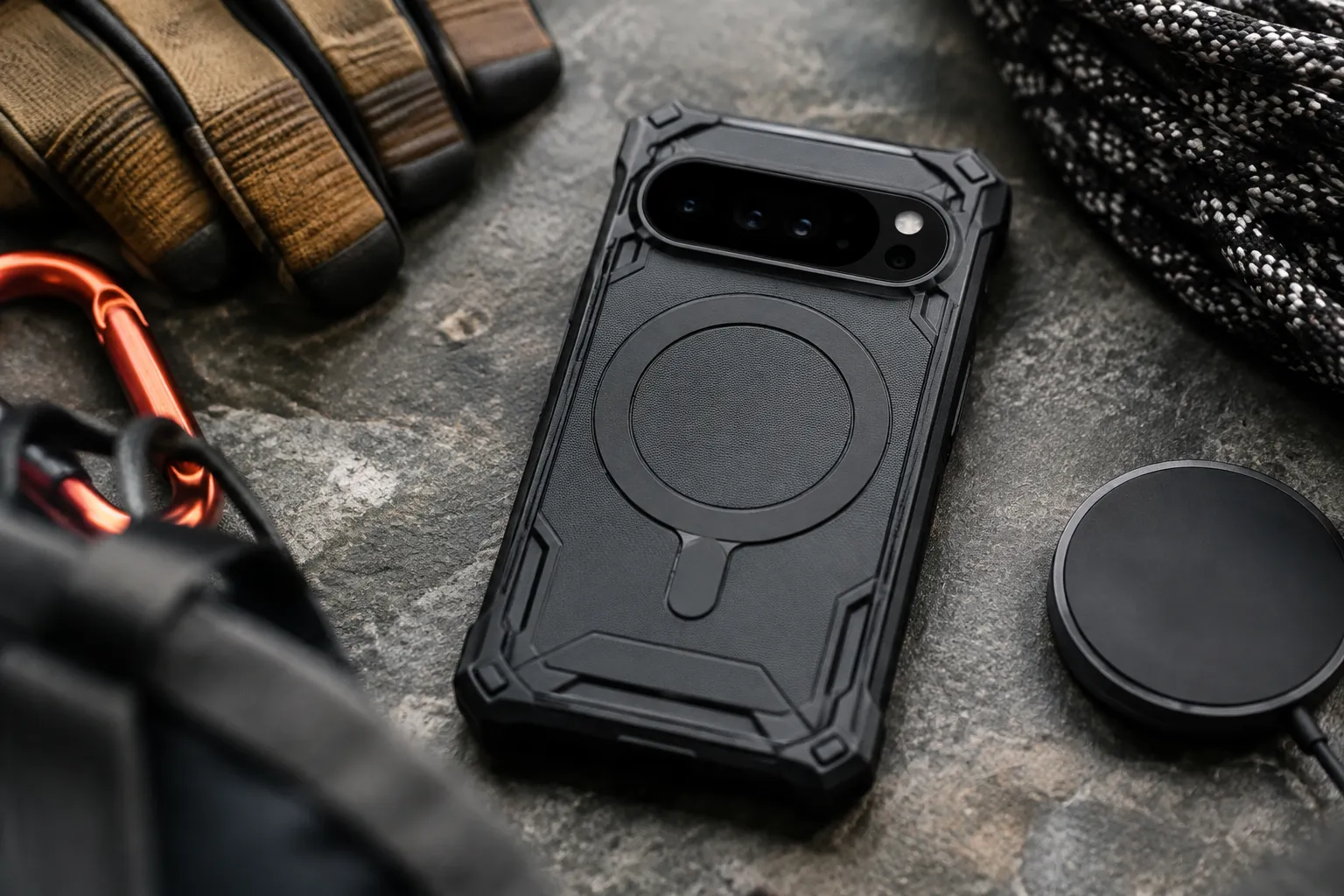
For people who live in actual dirt and rain, the OtterBox Defender Series XT is the old guard answer. OtterBox has been making rugged cases since the Palm Treo era, and the Defender is their flagship. The XT version adds MagSafe compatibility by replacing the built-in screen protector of older models, which was a dust magnet and a fingerprint smudge factory, with a raised lip that does the job without the plastic film. The case is a three-piece system: a polycarbonate shell, a synthetic rubber outer layer, and a belt clip holster that doubles as a kickstand. The magnet ring is embedded in the rubber layer, which is thick. The holding force is weaker than Mous, weaker even than Spigen, because the rubber adds distance. A phone in a Defender with a MagSafe battery pack attached will hold for a desk session, but it will detach if the whole assembly is picked up by the battery pack and swung.
OtterBox made a deliberate choice here. The Defender's job is protection, not accessory adhesion. The rubber layer that weakens the magnet is the same rubber that absorbs the energy of a drop from a truck cab. A person who carries a phone on a worksite, uses it for navigation in a side-by-side, and drops it on concrete weekly does not care that the battery pack needs to be seated carefully. They care that the screen survives. The Defender is the only case in this category that feels like it could survive being run over by a bicycle, and the magnet ring is a convenience bolted onto the side, not the reason to buy it.
The middle ground, and the place where the category gets genuinely interesting, is the Dbrand Grip Case with MagSafe. Dbrand is best known for skins, the adhesive vinyl wraps that people apply to laptops and game consoles. The Grip case is their hardware product, and it solves the grip problem better than any other case in this category. The sides are covered in a textured pattern that Dbrand calls "grip", and it is not marketing. The texture is aggressive, like the surface of a climbing hold, and it provides traction even with wet hands or gloves. The back is flat and covered with a skin, which means a person can customize the look. The MagSafe ring is embedded under the skin, and Dbrand sells the case with the ring pre-installed, not as an add-on.
Dbrand's magnet strength is comparable to Mous, strong enough for most uses, but the case has a quirk. The back panel is completely flat, which means the camera bump does not have a lip around it. On a table, the phone rocks slightly when the back is pressed near a corner. The phone rests on the camera visor when laid flat. A person who types on a desk with the phone flat will feel the rocking. The compromise is that the case stays thin, around 12 millimeters, which is slim for a rugged case and makes the phone feel closer to its bare dimensions.
There is also the option of a case that does not try to be rugged at all but still carries the magnet ring. The Google官方 case for the Pixel 9 Pro, made of recycled materials with a soft-touch finish, includes MagSafe compatibility in its second iteration. It is a slim case, closer to a bumper than an armor shell. It will not save a phone from a serious drop, and it offers almost no protection to the camera visor, which is the most expensive part to repair. But it is the only first-party option, which means the magnets are tuned exactly to the phone's internal components, with no interference from third-party manufacturing tolerances. The magnet ring is perfectly centered, and the alignment with accessories is flawless. For a person who wants a minimal case that still snaps onto a magnetic car mount, this is the cleanest solution. For a person who drops phones, it is a gamble.
The charging angle deserves attention because it is where the magic of the magnet ring shows up. A rugged case without MagSafe requires a person to lay the phone on a charging pad and hope the coil lines up. If the coil is off by a few millimeters, the phone charges slowly or not at all, and the phone gets warm from the wasted energy. A MagSafe case with a properly aligned ring snaps onto a charger and locks the coil into place. The connection is repeatable, every time, without checking the phone's screen for the lightning bolt icon. The Pixel 9 Pro charges at up to 15 watts wirelessly, but only if the charging pad supports the Extended Power Profile. A MagSafe charger from Apple will charge the Pixel at 7.5 watts, which is slow but acceptable for an overnight top-up. A charger that supports the Qi2 standard, which is MagSafe's open cousin, will charge at the full 15 watts.
Here is where the category falls apart in a specific way. The Qi2 standard was supposed to create a unified magnetic charging ecosystem, but the rollout has been messy. Some chargers labeled Qi2 do not have the same alignment tolerances as Apple's original. Some rugged cases with embedded magnets interfere with the charging coil more than others, generating heat even when aligned. The Mous case, with its exposed magnet ring and thin back, charges cleanly. The OtterBox Defender charges slowly, not because the magnet is weak, but because the thick rubber back insulates the heat and the coil distance is greater. A person who wants fast wireless charging with a rugged case should look for a case that specifies the back panel thickness, and should expect that the most protective cases will be the slowest chargers.
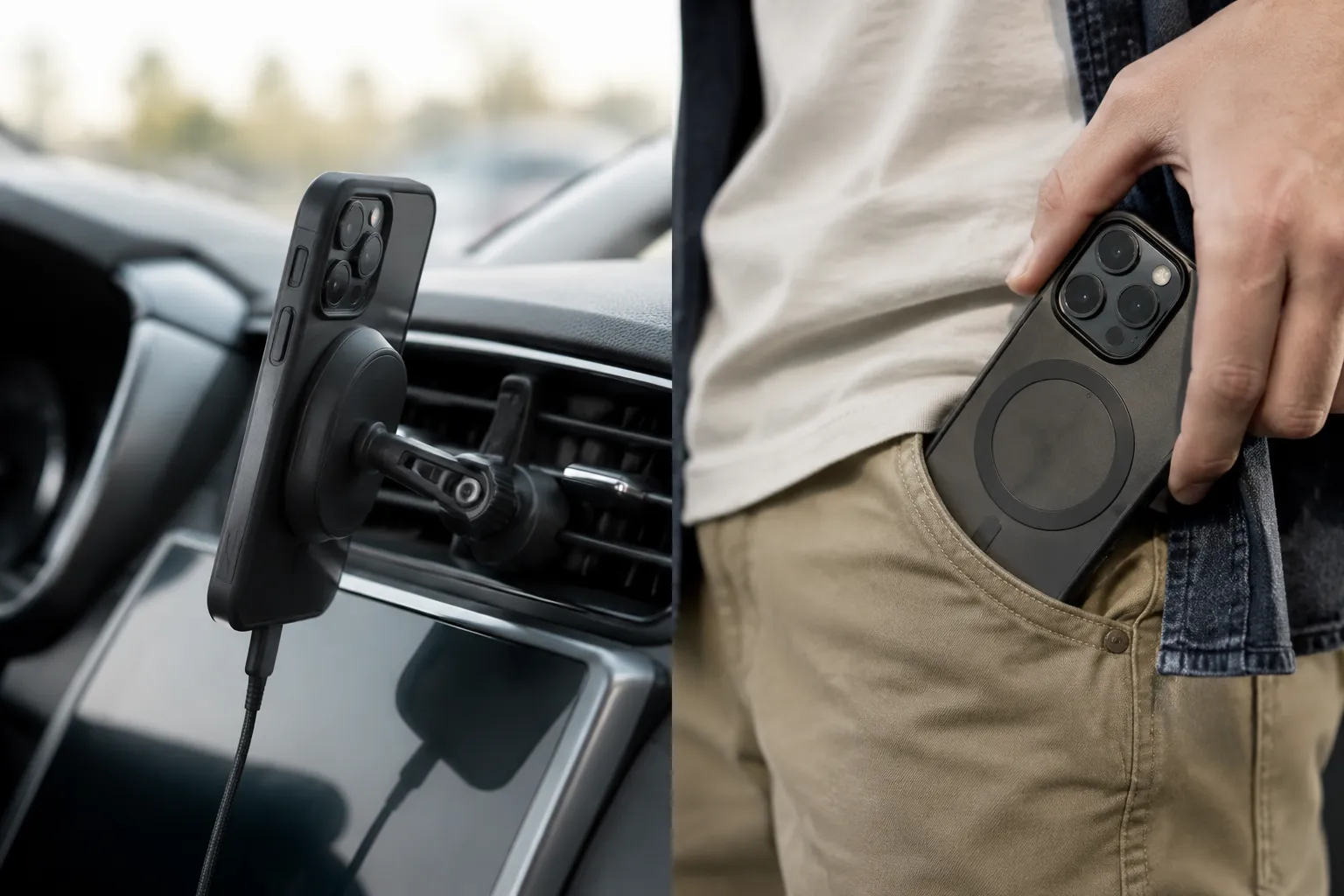
The car mount experience is the real reason to buy a MagSafe-compatible case in the first place. A vent mount or a dashboard mount with a magnetic head holds the phone firmly, allows one-handed attachment and removal, and does not require wrestling with a spring-loaded clamp. But the vibration from a car's engine and suspension transmits directly through the magnet ring into the phone. The Pixel 9 Pro's camera module, with its optical image stabilization, is sensitive to vibration. A long drive over rough roads can cause the OIS system to work overtime, draining the battery and potentially damaging the stabilization mechanism over months of exposure. This is a known issue with magnetic phone mounts in vehicles, and it applies to every case in this category. The solution is to use a mount with vibration dampening, or to accept the risk for the convenience of one-hand attachment.
Testing these cases side by side reveals patterns that the spec sheets do not capture. The Spigen is the workhorse, with a boring aesthetic and dependable performance. The Mous is the premium option, with a stiffer price and a sleeker profile. The OtterBox is the tank, built for a specific kind of user who values survival over style. The Dbrand is the enthusiast's pick, with the best grip and the most customization. The Google case is the minimalist's compromise. Each one makes the same fundamental trade: adding material to protect the phone while keeping the magnet ring close enough to the surface to be useful. The manufacturers that get this balance right are the ones that treat the magnet as a structural component, not an afterthought.
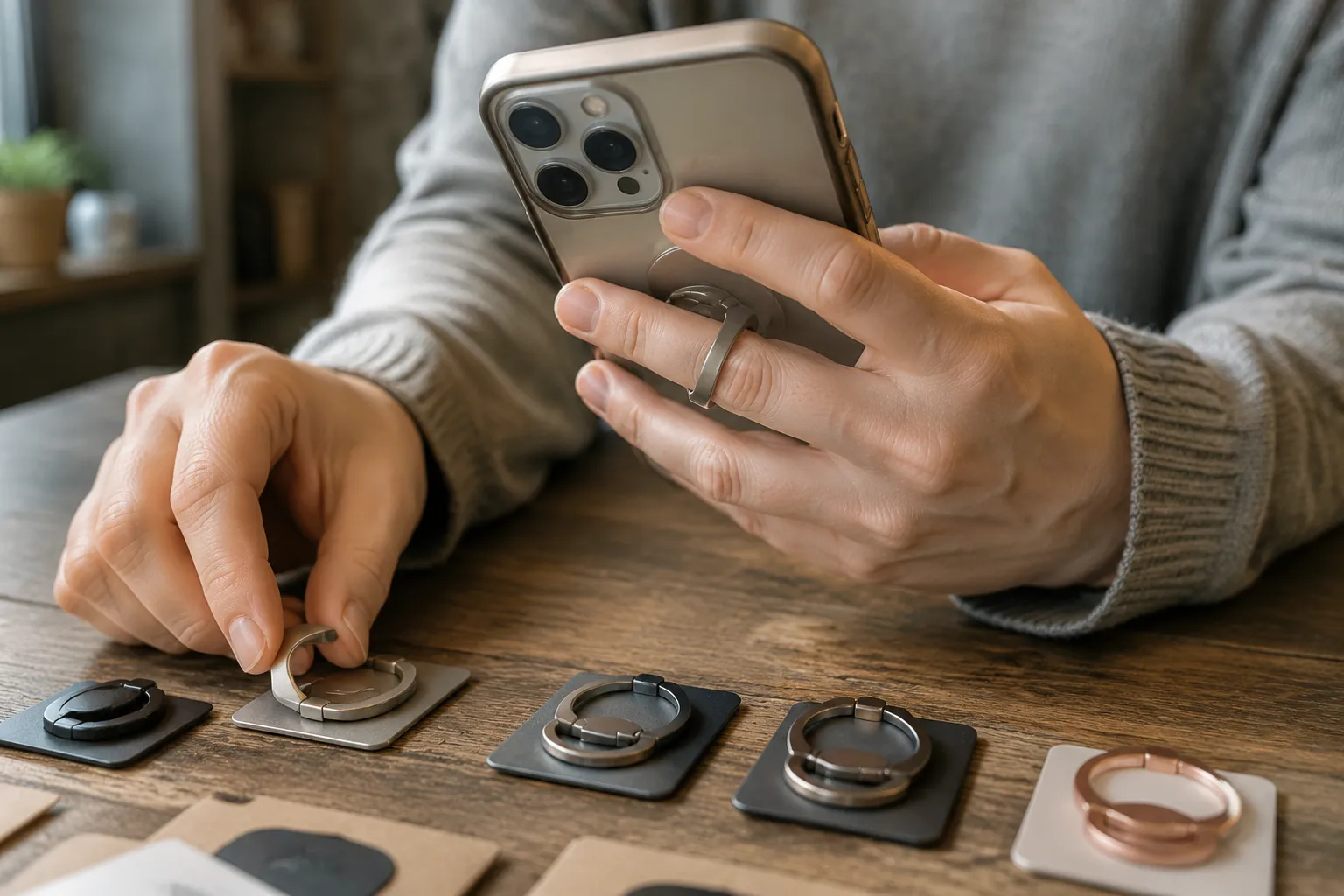
A person could also skip the case entirely and buy a MagSafe-compatible adhesive ring that sticks directly to the back of the phone. These rings cost less than ten dollars, add almost no bulk, and work with any case or no case at all. The problem is that the adhesive fails over time, especially in heat, and the ring peels off at the worst moment, usually when the phone is attached to a mount and the temperature inside the car is high. The ring also sits on top of the glass back, which means it does nothing to protect the phone from a drop. The case manufacturers have built a better solution because they bake the magnets into the structure, making them a permanent part of the protective layer rather than a temporary addition.
What the market still lacks is a rugged case that gets the magnet strength and the charging speed exactly right. The Mous is close, but the back is too slippery. The Dbrand is close, but the flat back rocks on tables. The Spigen is close, but the magnet is weak. The OtterBox is built for a different purpose entirely. There is room for a manufacturer to combine the Dbrand's grip texture, the Mous's exposed magnet ring, and the Spigen's price point. Until that case exists, a person has to decide which compromise matters least. The decision usually comes down to where the phone spends its time: in a pocket, on a dashboard, or on a construction site. Each location favors a different case, and no single product serves all three well.
The last consideration is the camera visor, which is the Pixel 9 Pro's most vulnerable feature. The visor spans the full width of the phone and houses three lenses, a flash, and a temperature sensor. A drop on a corner can crack the glass covering the visor, and a replacement costs nearly half the price of the phone. The rugged cases in this category all provide a raised lip around the visor, but the height of that lip varies. The OtterBox has the tallest lip, at about 2 millimeters, which means the visor never touches a flat surface. The Google case has the shortest lip, at less than a millimeter, which means the visor glass slides on a table and picks up micro-scratches over time. A person who cares about resale value should check the lip height before buying.
MagSafe compatibility has become a checkbox feature in the Android case market, similar to how wireless charging was a decade ago. The first generation of these cases was clumsy, with weak magnets and poor alignment. The second generation, which includes the current Pixel 9 Pro options, has mostly solved the alignment problem. The remaining issues are strength, heat dissipation, and durability. The next generation will likely integrate the magnets more deeply into the case's structure, reducing the distance between the phone and the accessory further. A case that can hold a phone on a mount, charge it at full speed, and survive a drop from shoulder height is not a fantasy. It is a product that is one iteration away from existing.