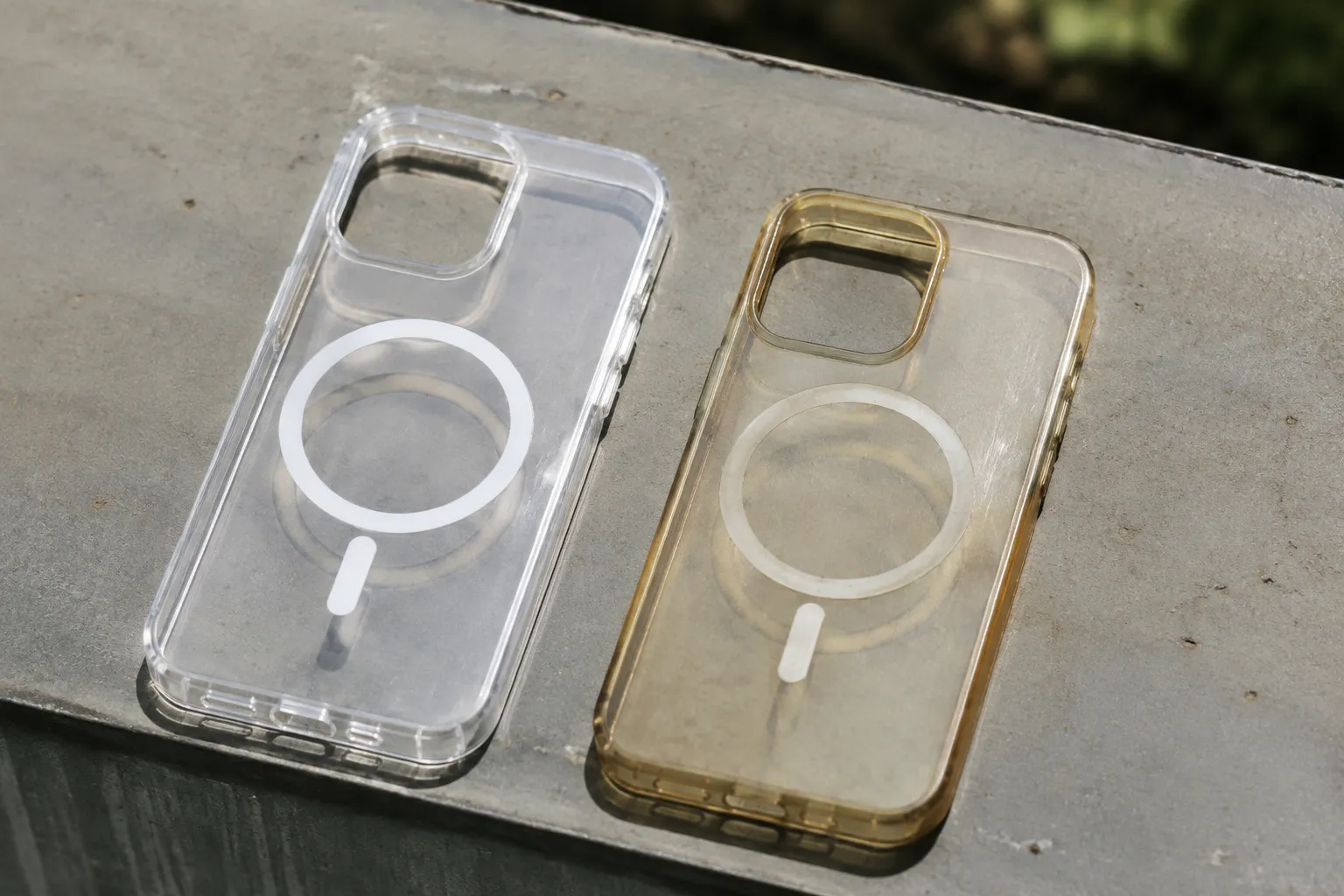
Six weeks is enough time for a clear phone case to write its own biography. The first week, a transparent case looks like a mistake, a thin shell of nothing that barely registers against the phone's actual color. By week three, the narrative shifts. By week six, the case has either stayed honest or surrendered to a yellow tint that makes a white phone look like it was stored inside a cup of tea. The difference between clear TPU and hybrid cases shows up right around that fourth week, and it is not a subtle difference.
TPU, thermoplastic polyurethane, is the soft, flexible material most cheap clear cases are made from. It bends easily, grips well, and absorbs shock decently. It also yellows. This is not a defect in any particular brand; the material itself oxidizes when exposed to UV light and heat. Hybrid cases, on the other hand, combine a rigid back panel, usually polycarbonate, with a softer TPU bumper around the edges. The back stays clear because polycarbonate resists UV damage far better than TPU does. The bumper still yellows, but the part a person actually looks at, the back, holds its color.
That distinction matters more than most shoppers realize when they buy a clear case. The phone is what gets looked at. The edges disappear in the hand. A hybrid case protects the visible surface with polycarbonate while accepting that the bumper is a consumable part. A full TPU case makes the entire back a consumable part, and it shows.
The Test Setup and the Daily Grind
To see how this plays out in real conditions rather than lab charts, two cases were run through a normal six-week stretch. One was a standard clear TPU case, the kind that sells for under twenty dollars and arrives in a plain box. The other was a hybrid case with a polycarbonate back and TPU bumper, roughly double the price. Both were installed on the same model of phone, carried in the same pocket, set on the same desk, and left on the same car dashboard during the commute. Neither was treated specially. Both saw sun through a window, heat from a car vent, and the ordinary friction of daily use.
The TPU case started yellowing around day nine. At first it was barely detectable, a warmth in the tint that could be dismissed as lighting. By day fourteen, the yellow was obvious when the case sat next to a white sheet of paper. By day twenty-one, the back of the phone looked like it had aged five years. The sides yellowed faster than the back, likely because the curved edges got more handling and more skin oil, which accelerates the oxidation process.
The hybrid case held its color on the back through the entire six weeks. The polycarbonate panel stayed water-clear, showing the phone's original finish without any shift. The TPU bumper, however, yellowed noticeably around the edges by week four. From the front, the phone showed a faint amber outline. From the back, the logo and color remained untouched. The visual difference was stark: one case aged into a dirty-looking shell, the other kept its face clean and only showed wear on the parts that wrapped around the frame.
Where the Yellow Actually Comes From
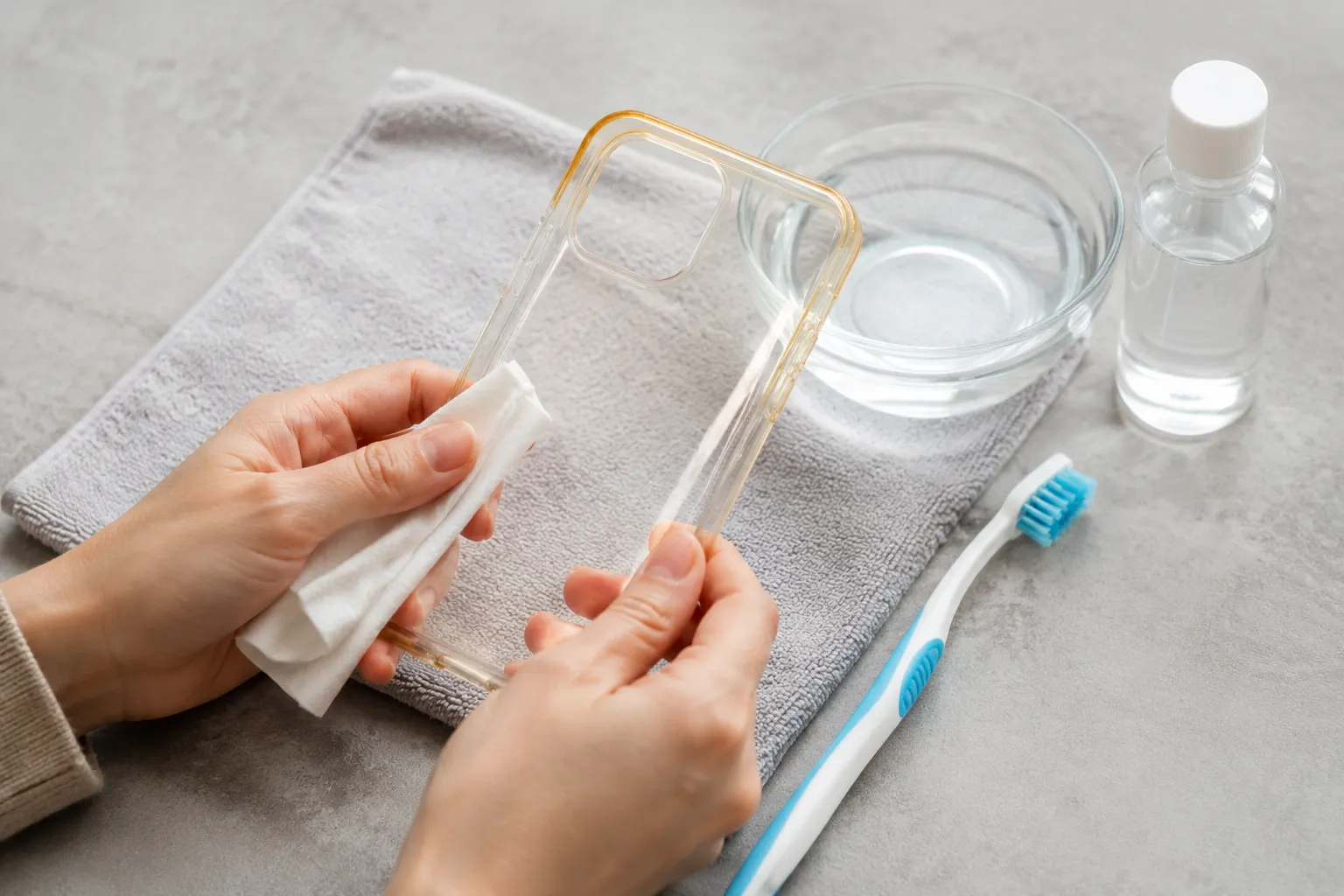
Yellowing in TPU is a chemical reaction, not a surface stain. UV light breaks molecular bonds in the polymer, and the byproducts of that breakdown absorb blue light, which makes the material appear yellow. Heat speeds up the process. Skin oils and certain chemicals, including some hand sanitizers and sunscreen ingredients, can also trigger or accelerate the discoloration. A person cannot wipe it off because it is not on the surface; the color change runs through the material's thickness.
Polycarbonate goes through a similar aging process but much more slowly. The molecular structure is more stable under UV exposure, which is why clear polycarbonate is used in safety glasses, greenhouse panels, and automotive headlight lenses. It still degrades eventually, but on the timescale of a phone case, it stays visually clear for months rather than weeks. The tradeoff is that polycarbonate is hard and brittle; it does not absorb shock well on its own. That is why hybrid cases wrap it in a TPU bumper. The design splits the job: polycarbonate takes the visible load, TPU takes the impact load.
Some manufacturers add UV inhibitors or anti-yellowing agents to TPU to slow the process. These additives help, and some premium TPU cases do perform better than cheap ones. But the chemistry has limits. An inhibitor can delay the reaction, not stop it. After enough sun exposure, even the best-treated TPU will shift. The material simply is not stable enough for long-term clarity.
The Feel Factor and the Grip Tradeoff
Clarity is not the only difference between these two case types. The feel in the hand is completely different, and that difference matters for daily use. A full TPU case has a soft, almost rubbery texture. It grips the palm without being sticky, and it has a slight give when squeezed. Dropping a TPU case usually means the phone bounces rather than cracks, because the entire shell flexes on impact. The softness is a feature, especially for people who drop their phones regularly.
A hybrid case feels rigid on the back and soft only on the edges. The polycarbonate panel does not flex; it stays flat and firm against the phone's back. Some people find this reassuring, since it means the case does not shift or bend during use. Others find it slippery; polycarbonate is smooth, and a phone with a hybrid case can slide out of a loose grip more easily than one wrapped in grippy TPU. Some hybrid cases add a matte texture or a micro-texture to the back to improve grip, but that treatment can reduce clarity slightly. The tradeoff between grip and visibility is real, and each person has to decide which matters more.
The buttons are another point of difference. Full TPU cases usually have molded button covers that are part of the same soft material. They press easily and give a satisfying click. Hybrid cases use separate button inserts, often made of hard plastic or a harder grade of TPU, and the feel varies widely between brands. Some are crisp, some are stiff, some rattle slightly. A person who presses buttons a lot, which is everyone who uses a phone, will notice the difference within an hour.
Dirt, Dust, and the Camera Bump Problem
Beyond yellowing, the two case styles handle dirt differently. A full TPU case clings to the phone, and because it is soft, it forms a fairly tight seal around the edges. Dust still gets in, particularly around the speaker grilles and the charging port, but it tends to stay on the surface. The bigger problem with TPU is that it attracts lint and pocket fuzz. The material has a slight tackiness that grabs onto fabric fibers, and over time the edges and corners develop a grayish buildup that is hard to clean off completely.
Hybrid cases collect dust between the polycarbonate back and the phone itself. Because the back panel is rigid, it does not conform perfectly to the phone's contours, and tiny gaps can open up around the camera module or the edges. Dust migrates into those gaps and shows through the clear back, creating small specks that are visible against the phone's finish. Taking the case off to clean it helps, but the dust returns within days. Some hybrid cases solve this with a small adhesive strip inside the back panel, but not all of them include that detail.
The camera bump area is where hybrid cases typically win. A polycarbonate back can be molded with a raised lip around the camera module that sits flush with the lenses or slightly above them. This protects the camera glass when the phone is set down flat. Full TPU cases also have raised lips, but because the material is soft, it compresses under pressure. A firm press on the back of the phone can push the lip down far enough that the camera glass touches the surface. Hybrid cases keep the lens protected under more force.
The Case That Bullies Its Way Out of Fashion
There is a social dimension to case yellowing that gets left out of most reviews. A clear case is usually bought because the owner wants to show off the phone's color. The entire point is visibility. When the case yellows, it not only looks bad, it undermines the reason it was bought in the first place. The phone's original finish is still there, but it is now viewed through a jaundiced filter. A person who would never choose a yellow case is suddenly carrying one, and the only way to fix it is to buy a new case.
Hybrid cases delay that moment of disappointment considerably. The back stays clear, so the phone continues to look like it is supposed to look. The bumper yellows, but the bumper is thin and sits at the edges; it reads as a shadow or a frame rather than a discoloration of the whole phone. A person can live with a yellowed bumper for a year. A yellowed TPU back is harder to ignore, and most people replace the case before the season is over.
The replacement cycle matters for the environment, too. Clear TPU cases are cheap, which makes them disposable. A person who buys a six-dollar case every two months spends about thirty-six dollars a year, produces six pieces of plastic waste, and never has a clear case for more than a few weeks at a time. A hybrid case at twenty dollars lasts through the year with minor bumper discoloration, and the polycarbonate back keeps working as a clear window the whole time. The math favors the hybrid on cost and waste, even though the upfront price is higher.
Anti-Yellowing Claims and What They Actually Mean
Brands have started marketing "anti-yellowing" TPU cases, and the phrase deserves some scrutiny. In most cases, the manufacturer has added a UV stabilizer or antioxidant to the TPU formulation. These additives genuinely extend the material's clear life, but they do not make it permanent. The question is how much extension a buyer gets. Some budget cases with anti-yellowing claims still turn noticeably yellow within three weeks. Higher-end TPU cases with better inhibitors can stay clear for two or three months before the shift becomes visible.
The honest way to read an anti-yellowing claim is as a relative improvement, not an absolute promise. A TPU case that resists yellowing for three months is better than one that yellows in two weeks, but it still eventually yellows. Anyone who wants a clear back that stays clear for a year should choose polycarbonate. That is the material that will hold the line.
Some hybrid cases also claim to coat the TPU bumper with a yellowing-resistant layer. That coating helps, but the bumper is still TPU at its core, and the coating wears off from handling and cleaning. The bumper will yellow eventually. The advantage of the hybrid design is that the bumper's yellowing does not ruin the overall look, because the dominant visual surface, the back, stays clear.
A Note on Drop Protection That Most Reviews Miss
Drop tests tend to treat cases as if they either work or fail, but real-world drops are more varied. A phone falls at different angles, onto different surfaces, from different heights. The case's corner protection matters most, because the corner is what takes the majority of impacts when a phone slips from a hand or a pocket. Both TPU and hybrid cases put TPU on the corners, so both offer similar corner protection. The difference shows up in edge protection and back protection.
A full TPU case flexes on impact, spreading the force across a larger area. This is good for the phone's frame, but it also means the case can pop off on a hard hit. A hybrid case, with its rigid back, stays in place better, but it transmits more shock through the phone's body. Neither is categorically safer. The best protection depends on the drop angle and the surface, and a case that saves a phone on a tile floor might fail on concrete.
What is less discussed is how case material affects the phone's heat management. TPU is an insulator. It traps heat against the phone's back, and during heavy use, such as navigation in a car mount or extended video recording, the phone can get noticeably warmer inside a full TPU case. Polycarbonate is also an insulator, but the hybrid design leaves small air gaps between the back panel and the phone, which allows a little more airflow. The difference is not massive, but for people who run their phones hot, the hybrid case runs slightly cooler in practice.
The Final Disassembly at Week Six
At the end of the six weeks, both cases were removed and held side by side. The TPU case had taken on a uniform amber tone, darker around the edges and lighter in the center where it had been pressed against the phone's back. It no longer looked like a clear case at all. It looked like a case that had been smoked or stained, and no amount of soap and water changed the color. The material itself had aged, and it was not going back.
The hybrid case showed a clear back that could pass for new. The polycarbonate had no yellowing, no clouding, no visible wear beyond a few micro-scratches that only showed at an angle under direct light. The bumper told a different story. It had yellowed noticeably, particularly on the bottom edge where the phone rested against the car's phone mount and on the side where the thumb swiped up a thousand times a day. The yellowing was contained, though, a thin frame around a clear window. From the front, the phone looked fine. From the back, the phone's original color remained true.
The person who owned this phone did not want a case that changed the phone's appearance. That is why they bought clear in the first place. The TPU case failed that requirement within a month. The hybrid case held it for the entire test. The question of which to buy comes down to whether the visible surface of the phone matters more than the feel of the edges, and whether a few extra dollars are worth not having to re-buy a case every few weeks. For anyone who bought a phone partly because of how it looks, the hybrid case is the one that keeps the promise a clear case makes. The TPU case breaks that promise, slowly and in plain sight, until the yellow is impossible to ignore.