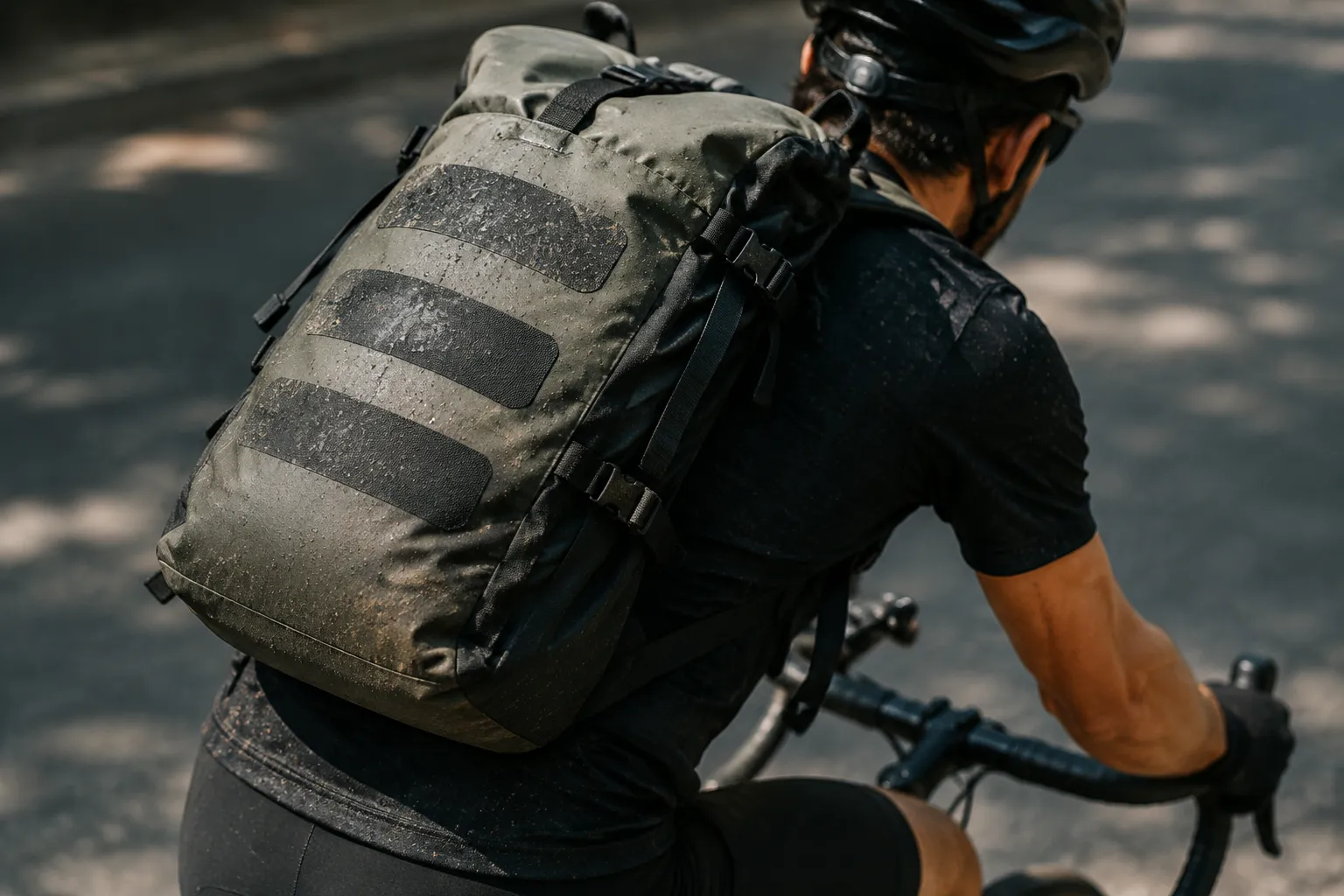
The first time a shoulder strap slipped during a hard commute, the reaction was annoyance. The second time, on a wet morning with a loaded pack, it became a question worth answering: does any anti-slip texture on an everyday carry pack actually hold a strap where it belongs, or is the whole category a marketing shrug?
For three weeks, several packs with different strap treatments were ridden through the same loop: 14 kilometers of mixed pavement, chip seal, and a short stretch of gravel along a river path. The load stayed constant at roughly seven kilograms, enough to make a pack feel alive without turning the test into a strength exercise. The goal was not to measure adhesion in a lab. It was to find out which textures kept a strap off the shoulder point and which ones slowly migrated outward until the wearer noticed and shoved it back.
The shoulder point matters because that is where a strap does its best work. Centered on the trapezius, the load transfers cleanly down the skeleton. When a strap slides toward the deltoid, the body compensates, the pack starts to sway, and the wearer develops a subtle hitch that looks like a tic. The fix is either a sternum strap, a pack design that forces the geometry to stay put, or a texture that grabs the shirt and refuses to let go.
What follows is a breakdown of the textures tested, the conditions that broke them, and the one conclusion that held up across every ride.
The baseline: a smooth nylon strap with no treatment
Before judging any anti-slip claim, a control run was in order. The pack used for the baseline was a standard commuter model with plain nylon webbing, no rubber, no silicone, no woven gripper. On a dry day with a cotton t-shirt, the strap stayed put for the first four kilometers. Then, gradually, it began its creep. By kilometer nine, it had moved roughly three centimeters off center. By the end of the ride, the edge of the strap was pressing into the soft tissue just past the shoulder bone.
The movement was not dramatic. It was a slow, insidious drift, the kind a person does not notice until the pack feels wrong and the hand reaches up to correct it. That correction happened six times over the course of a 45-minute ride. Each time, the rider had to shrug, reach back, and pull the strap inward, a motion that becomes exhausting when repeated daily.
This baseline matters because it establishes the problem. A strap does not need to fall off the shoulder to fail. It only needs to move enough that the wearer has to think about it.
Silicone stripes: the most common claim, the most inconsistent result
The most popular anti-slip treatment on the market is a set of silicone stripes printed or molded onto the underside of the strap. The theory is sound: silicone has a high coefficient of friction against most fabrics, and the raised pattern creates a mechanical lock as well as a frictional one.
The first pack tested had three wide silicone bands near the midpoint of the strap. On a dry cotton t-shirt, the grip was impressive. The strap did not move a millimeter over the full route. The rider forgot the pack was there, which is the highest compliment a commuter pack can earn.
Then the weather changed. A light rain turned the t-shirt damp, and the silicone bands became slick. Not slightly less grippy, but actively slippery. The strap slid outward with almost no resistance, reaching the shoulder edge within two kilometers. The same pack that had felt locked in place on a dry day became the worst performer in the test under moisture.
The reason is straightforward. Silicone grips best against dry, static fabric. Add a thin film of water, and the interface changes from friction to hydroplaning. The pack tested was not defective. It was simply designed for a climate that does not include sweat or rain.
A second pack with the same silicone stripe design but a different pattern, smaller dots instead of wide bands, performed slightly better in the wet. The dots created channels for water to escape, restoring partial contact. But partial is not the same as secure, and the strap still migrated about a centimeter and a half over the ride. That is enough to notice, not enough to fix.
Woven gripper webbing: the quiet underdog
Less common than silicone, but more interesting, is the woven gripper. This is a section of webbing with a raised ribbed texture, created by weaving a different yarn, usually a thermoplastic or a coarser nylon, into the strap itself. There is no coating. The texture is structural.
The pack tested with this treatment had a gripper section about 15 centimeters long, positioned exactly where the strap crosses the shoulder. On dry cotton, it performed nearly as well as the silicone stripes, holding position for the entire ride with only a minor shift of half a centimeter.
In the wet, it outperformed every other texture tested. The ribbed surface shed water quickly, and the mechanical friction of the raised weave against damp cotton remained substantial. The strap moved maybe a centimeter over the full route, and crucially, it did not slide in one smooth motion. It moved in tiny increments, each one requiring a small bump or shift in the rider's gait to overcome the grip.
The trade-off is comfort. A woven gripper against a bare shoulder, or against a thin merino base layer, feels abrasive. The ribs dig in slightly, creating a texture that some riders will find acceptable and others will find intolerable. This is not a texture for a pack worn over a tank top on a hot day. It is a texture for a commuter who wears a shirt.
The rubberized patch: heavy duty, heavy compromise
One pack took a different approach entirely, attaching a large rubberized patch, roughly the size of a hand, to the underside of the strap. The patch was not smooth. It had a molded honeycomb pattern that looked aggressive and felt even more so.
On dry cotton, this was the single most secure strap of the entire test. It did not move. Not a centimeter, not a millimeter. The rubber compound grabbed the fabric with a tenacity that felt mechanical, as if the pack had been sewn to the shirt.
In the wet, it was a mixed story. The honeycomb pattern channeled water reasonably well, and the strap held better than the silicone stripes, moving only about a centimeter and a half over the route. But the patch had a different problem. It was heavy and stiff, and it created a pressure point on the shoulder that became noticeable around kilometer eight. By the end of the ride, the rider was consciously shifting the pack to relieve the discomfort, which defeated the purpose of a strap that stayed put.
The rubberized patch solves the slip problem but creates a comfort problem. For a short commute under 20 minutes, it is arguably the best choice. For a longer ride, the pressure point becomes the limiting factor.
No texture at all, just geometry: the sternum strap effect
One pack in the test had no anti-slip texture whatsoever. Instead, it relied on a sternum strap, the small horizontal connector that clips across the chest and pulls the two shoulder straps inward toward the center of the body.
The sternum strap is not a texture. It is a geometric solution. By connecting the two straps at chest level, it prevents them from splaying outward, which is the primary mechanism of strap slip. A strap slides off the shoulder because the force of the load pulls the top of the strap outward and down. The sternum strap resists that force directly.
In this test, the sternum strap pack outperformed all of the textured packs on dry surfaces, holding position for the entire ride with zero adjustment. In the wet, it also performed well, though not perfectly. The smooth nylon strap still crept slightly, but the sternum strap limited the movement to about a centimeter before the geometry stopped it.
The catch is that a sternum strap requires the wearer to use it. Many riders clip it, then forget to adjust it, or skip it entirely because it feels restrictive across the chest. When the sternum strap was left unclipped, the same pack performed no better than the baseline control.
The other catch is that a sternum strap does nothing for a pack worn over a bulky jacket or a backpack with a irregular load. It works best when the pack is snug against the body and the load is evenly distributed.
The test that changed the ranking: a long climb in the heat
All of the tests up to this point were conducted on a relatively flat route with a moderate pace. The final test was different. It was a 12 kilometer ride with a sustained 300 meter climb, done in the middle of a warm afternoon with the temperature pushing 31 degrees Celsius.
The purpose was to introduce sweat, not as a thin dampness, but as a full soak. By the halfway point of the climb, the t-shirt was wet through, and the shoulder area of the pack was resting against saturated fabric.
This test destroyed the silicone stripes. Within two kilometers of the climb, the strap on the silicone pack had slid completely off the shoulder, forcing the rider to stop and adjust. It happened three more times before the top. The woven gripper pack fared better, holding position for most of the climb, only slipping in the final steep section when the rider was out of the saddle and the pack was bouncing.
The rubberized patch pack held its position but became genuinely uncomfortable. The sweat softened the skin, and the stiff rubber patch chafed with every pedal stroke. The rider finished the climb with a red, irritated patch on the shoulder.
The sternum strap pack, with its smooth nylon, was the only one that completed the climb without a single strap adjustment. The sweat made the nylon slightly tacky against the wet cotton, and the sternum strap held the geometry in place. It was not the most comfortable option, but it was the most functional.
What this means for a daily commuter
The honest conclusion is that anti-slip textures are a solution to a problem that is better solved by design. A texture that works on a dry day fails in the rain. A texture that works in the rain chafes in the heat. The only consistent performer across all conditions was the one that did not rely on friction at all, but on geometry.
That does not mean textures are useless. For a rider who commutes in a dry climate, who wears a cotton or synthetic shirt, and who never rides hard enough to sweat through a layer, a silicone stripe or woven gripper will provide a noticeable improvement over bare nylon. The grip is real, and it reduces the frequency of adjustment from every few minutes to almost never.
For a rider who faces weather, hills, or heat, the texture is a gamble. The better investment is a pack with a well-designed sternum strap and a strap shape that curves gently inward toward the neck. That geometry works in every condition, requires no material science, and never wears out.
The woven gripper deserves a mention as the best texture tested, because it fails less dramatically than the others. It does not become slick when wet, it does not chafe when sweaty, and it provides a consistent, moderate grip that is good enough for most commutes. It is not the most secure option on a dry day, but it is the most reliable across a range of conditions.
The rubberized patch is a specialist tool for short, dry trips. The silicone stripes are a fair-weather friend. The sternum strap is the answer that most pack makers have already figured out, which raises a question about why so many of them still cover their straps in silicone instead of simply shaping the strap correctly and adding a $2 piece of webbing and a clip.
The pack that stayed on the shoulder through every test, in every condition, without complaint, was the one that treated the problem as a matter of physics rather than chemistry. The next pack purchase should do the same.