The nightstand has become a charging dock by accident. A person accumulates a phone, a watch, and a pair of earbuds, and suddenly the bedside table is a nest of cables that tangle into a single frustrating knot by Tuesday. The three-in-one MagSafe charger promises to solve this, but the category has a dirty secret: most of them are cheap plastic towers that wobble when a phone vibrates, or they charge the watch so slowly that morning comes with a dead wrist. A good one earns its place within a week. A bad one gets unplugged and shoved into a drawer by Saturday.
The market splits into two philosophies. One camp builds a single rigid puck, usually a flat disc or a folding stand, where the phone snaps onto a MagSafe circle and the watch and AirPods sit on smaller pads below. The other camp makes what amounts to a desktop sculpture with arms and angles, something that looks like a modern art piece until it falls over at 3 a.m. Neither approach is inherently wrong. The difference is in the details: magnet strength, coil alignment, weight, and whether the thing actually holds three devices at once without requiring a degree in geometry to set them down.
The most important fact about MagSafe charging is that it is a 15-watt standard, but only for the iPhone. The Apple Watch charges on its own proprietary puck, and AirPods with a wireless case top out at 5 watts on any Qi pad. A three-in-one charger is therefore three separate charging systems bolted into one housing. The quality of each system matters more than the brand name stamped on the base.
The Flat Disc That Actually Works
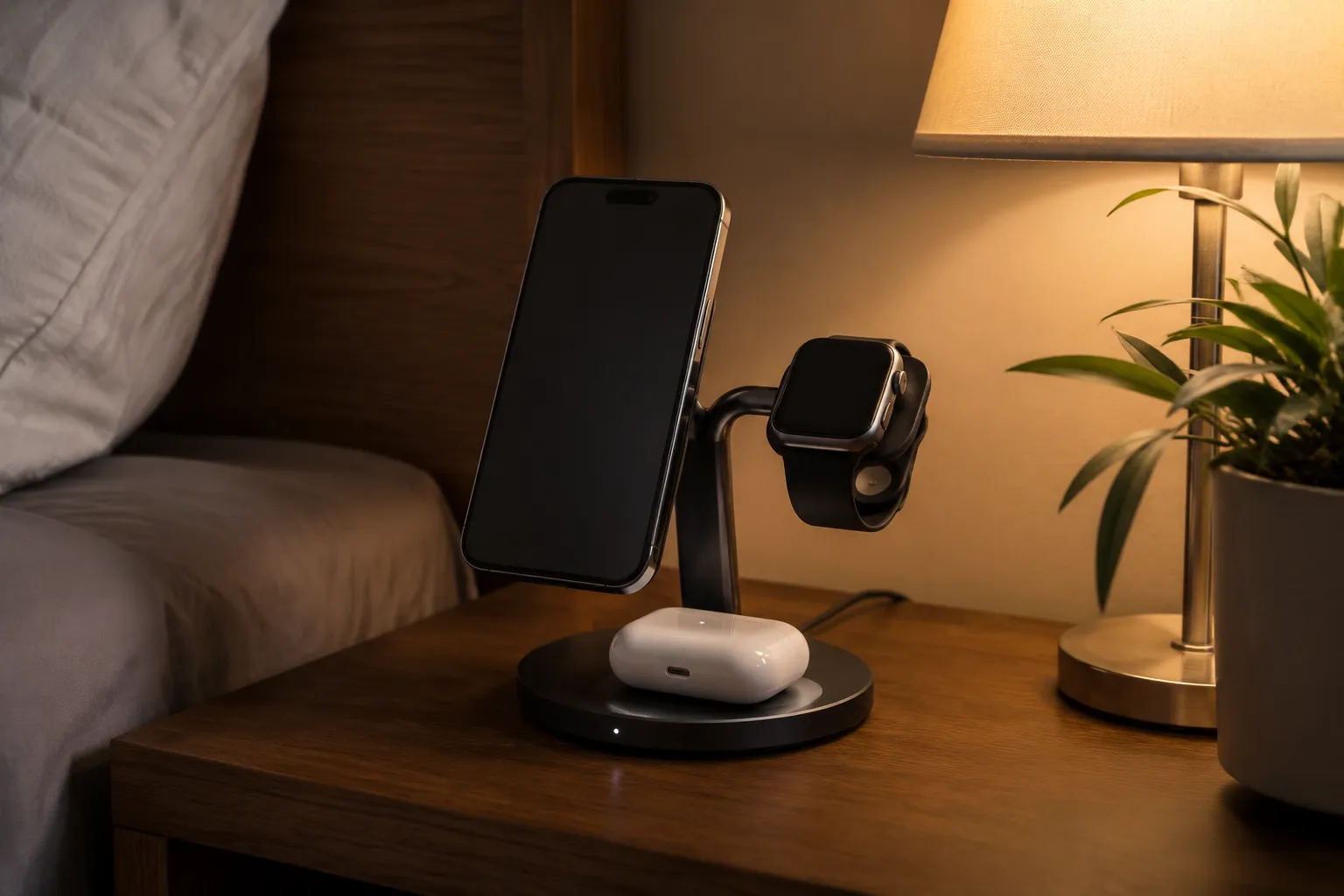
Belkin's 3-in-1 Wireless Charging Stand with MagSafe has been the default recommendation for years, and it holds that position for a reason. The phone sits upright in a landscape orientation, which means a person can glance at the time or an incoming message without lifting the device. The watch charges on a flat raised puck at the base, and the AirPods sit on a small pad in front. The whole unit is heavy enough that knocking it with an elbow does not send it skittering across the nightstand.
The catch is price. Belkin charges a premium that feels excessive until a person buys a cheaper alternative and discovers why the premium exists. The magnet alignment is precise, the watch charger works with fast charging on recent Apple Watch models, and the build quality does not creak. A person pays for the absence of frustration.
What Belkin gets wrong is the footprint. The base is wide and flat, taking up more nightstand real estate than a phone, watch, and earbuds deserve. On a cramped bedside table shared with a lamp, a glass of water, and a book, the Belkin becomes the dominant object in the room. It works flawlessly, but it demands space.
The Foldable Travel Compromise
Mophie's Snap+ 3-in-1 Travel Charger solves the footprint problem by folding into a compact bundle roughly the size of a glasses case. The phone snaps onto a MagSafe puck that folds flat, the watch puck folds out from the side, and the AirPods sit on a small pad that tucks underneath. It is the best option for people who move between home and hotel rooms, and it is a reasonable permanent nightstand charger for those who value a clean surface over a dramatic presentation.
The trade-off is stability. A foldable charger is inherently lighter than a solid block, and the phone's weight sits higher above the pivot point. Jostling the nightstand can knock the whole assembly sideways. The magnets hold the phone, but they do not hold the charger itself to the table. A person who sleeps aggressively or shares a bed with someone who flails will find the Mophie on the floor more than once.
There is also a subtle annoyance with the watch puck. It folds out at an angle that works fine for nightstand mode, where the watch face turns into a bedside clock, but the angle is fixed. A person who wants to charge the watch flat, with the band spread out, has to fold the puck to a position that lifts the watch awkwardly. It is a minor quibble, but it surfaces every single night.
The Watch Charger Problem Nobody Mentions
Every three-in-one charger has to solve the same puzzle: how to position the Apple Watch charger so it actually works. Apple's watch charger has a flat magnetic surface that only charges when the watch back makes full contact. The watch band gets in the way. A watch with a chunky link bracelet or a thick sport loop will not lie flat against a standard puck, which means the charger needs a raised surface or a groove to accommodate the band.
Cheap chargers ignore this entirely. They glue a watch puck flat onto the base and assume the user will fold the band neatly. Real people do not fold bands neatly at 11 p.m. The result is a watch that does not charge, a morning alarm that never goes off, and a charger that gets returned.
Anker's Cube is the notable exception. The device literally looks like a small white cube, about three inches on each side. The phone charges on the top face via MagSafe, the AirPods sit on one side, and the watch charges on a pop-up arm that rises from the corner. That arm is the key: it holds the watch puck vertically, so the watch hangs in a natural position with the band draping downward. Any band works, from a Milanese loop to a chunky leather strap. The design is clever enough that a person forgives the cube's slightly odd silhouette on the nightstand.
The Weight Test Matters More Than Wattage
Spec sheets list wattage and compatibility, but they never list the number that matters most: the weight of the base in grams. A three-in-one charger that weighs less than a phone is a liability. The phone's magnets will happily pull the entire charger toward the phone, rather than the phone snapping onto the charger. This is the failure mode of nearly every budget option from no-name brands on Amazon.
A charger needs at least 300 grams of mass in the base to feel planted. The Belkin is heavier, around 400 grams, which is why it never moves. The Cube is dense too, with metal in the base that keeps it grounded. The moment a person picks up a charger that feels hollow, that weighs less than the phone it is meant to hold, the product has already failed.
There is also the rubber grip factor. A smooth plastic base on a polished wooden nightstand will slide. A base with a silicone ring or a rubberized bottom stays put. This sounds like a trivial detail until a phone vibrates at 2 a.m. with a notification and the entire charger does a slow shuffle toward the edge of the table.
The Case Compatibility Trap
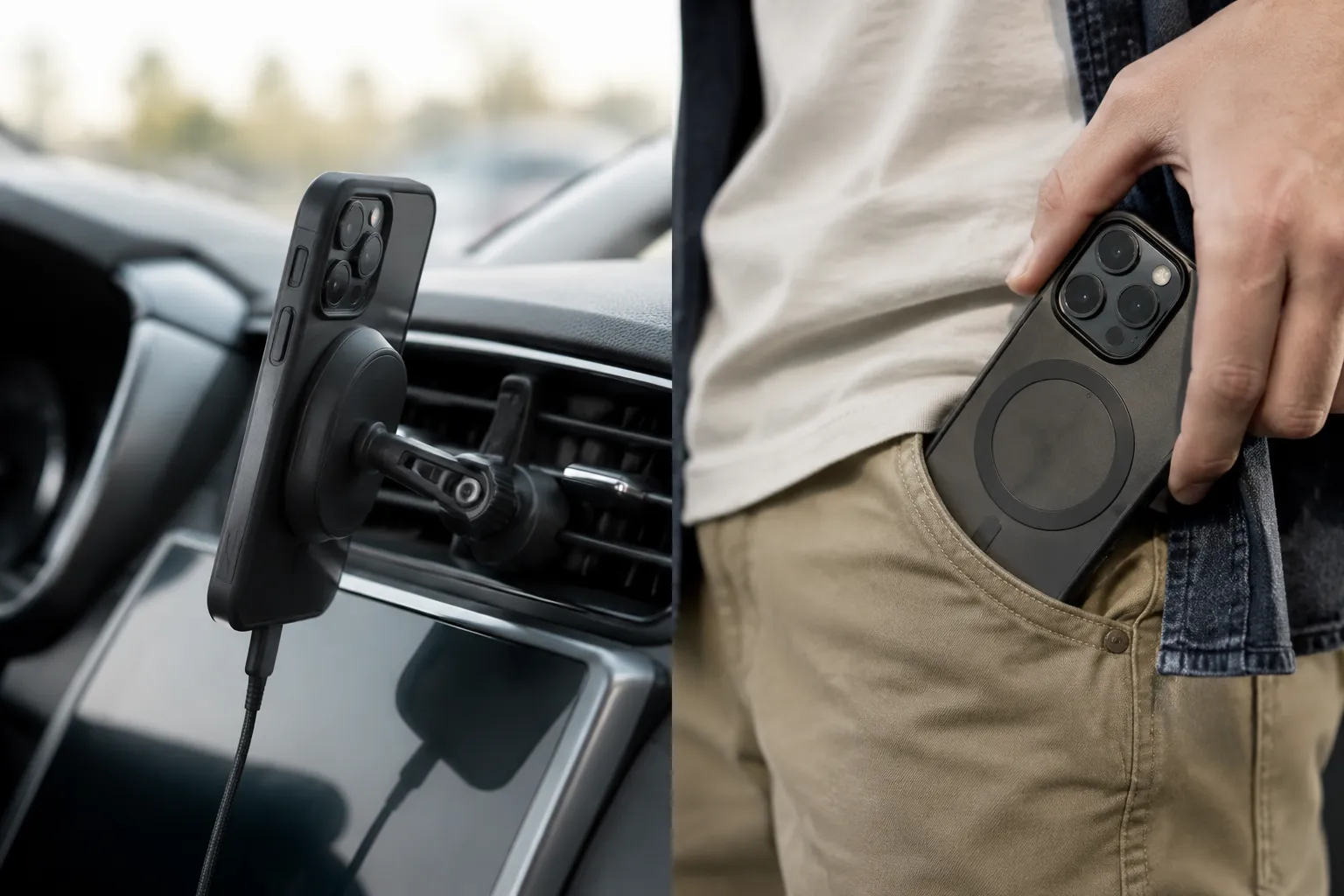
MagSafe chargers work through cases, but only through cases with the right magnets. A cheap silicone case without a magnet ring will slide around on the charger and refuse to align properly. The phone will still charge, at reduced speed, but it will sit at a slightly wrong angle that looks broken.
Apple's own cases have the magnet ring, as do most cases from Spigen, OtterBox, and Casetify. The problem emerges with cases from brands that treat MagSafe compatibility as an afterthought. A person buying a three-in-one charger already invested in the Apple ecosystem, so the case is usually compatible. But it is worth checking before assuming the charger is defective.
One more trap: thick cases with built-in battery packs or heavy card holders will defeat even a strong magnet. The phone will attach, wobble, and drop. This is not a charger failure. This is physics. A person with a battery case needs to remove it at night or buy a charger with a non-magnetic flat pad and rely on Qi charging instead.
The AirPods Pad Is an Afterthought Everywhere
Every three-in-one charger treats AirPods as an obligation, not a feature. The pad is small, flat, and positioned wherever there was leftover space. This works fine for AirPods with a wireless charging case, which are round and sit anywhere on a Qi pad. It fails for AirPods Pro, whose case is wider and needs to be centered with some precision. It also fails for anyone who uses wired AirPods or an older case without wireless charging, because the pad is useless to them.
The Cube handles this best by placing the AirPods pad on a vertical face, so the case slides in and rests against a lip. The Anker design assumes the user will place the case with the LED facing out, which is the natural way to grab it. Other chargers just leave a blank circle and hope.
There is also the question of whether the pad charges other devices. A person with wireless earbuds from Sony or Samsung can use the AirPods pad for those instead, as long as the case is Qi-compatible. The chargers do not care what brand sits on the pad. They only care about coil alignment. This makes the three-in-one a de facto four-in-one for households with mixed gear.
Nightstand Mode Needs a Brightness Setting
The Apple Watch has a nightstand mode that turns the screen into a clock when the watch is charging on its side. It is a genuinely useful feature, but it requires the watch puck to hold the watch in a vertical or near-vertical orientation. Flat pucks do not trigger nightstand mode reliably, and a watch lying flat just shows a dim charging screen.
The Belkin and the Cube both support nightstand mode because their watch pucks are raised and angled. The Mophie does too, but only when the fold-out arm is positioned just right. The cheap chargers with a flat embedded puck do not, which means the watch is a dead black rectangle all night instead of a usable clock.
This matters more than it should. A person who wakes up at 3 a.m. and wants to check the time without reaching for the phone will glance at the watch. If the watch is dark, the glance becomes a reach, and the reach becomes a fully awake brain. Nightstand mode is the difference between a peaceful midnight and a spiral into doomscrolling.
The Recommended Pick Depends on the Nightstand
For a permanent fixture on a roomy nightstand, the Belkin remains the safest choice. It is boring, reliable, and expensive, but it does exactly what it promises with zero fuss. The watch charges quickly, the phone sits at a useful viewing angle, and the AirPods pad works. A person who wants to set it once and never think about it again should buy the Belkin and stop reading.
For a smaller surface or a person who travels frequently, the Mophie foldable is the pick despite its stability flaws. It disappears into a bag, charges everything overnight, and the occasional tumble is a fair price for the portability.
For the best engineering, the Anker Cube wins on almost every practical measure. It holds the watch properly, supports nightstand mode, has a stable footprint, and looks like a minimalist desk accessory rather than a medical device. The only reason to skip it is the shape: a cube does not lie flat in a bag, and it takes up roughly the same footprint as the Belkin while being taller.
The real advice is to avoid anything under 300 grams, anything with a watch puck glued flat to the base, and anything made by a brand that also sells phone cases for $9. The three-in-one charger is a purchase made once and used nightly for years. A person who skimps on it will replace it within six months, and the replacement will cost more than the good one would have from the start.
A good nightstand charger disappears into the routine. The phone goes down, the watch goes on its arm, the AirPods case drops onto its pad, and the lights go out. No searching for cables, no awkward angles, no morning disappointment. That quiet, frictionless evening ritual is the entire point, and it is worth paying for.