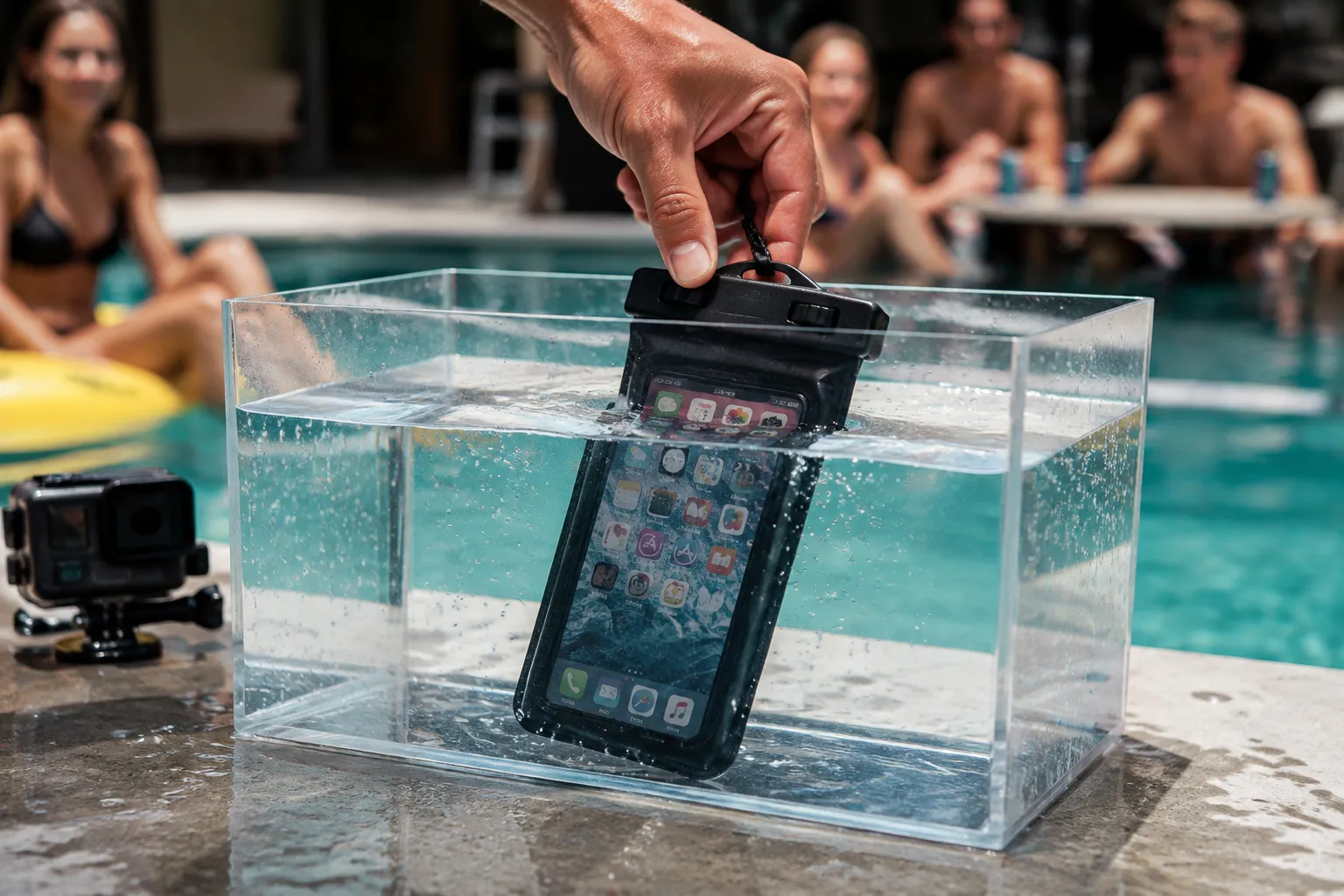
The swimming pool at the local recreation center drains every March for maintenance. For two weeks, the empty basin sits there like a giant beige bathtub, and the lifeguards walk around inside it picking up hair ties and pennies. Last year, a man in his sixties stood at the edge with a phone in a waterproof pouch, arguing with the front desk staff that he needed to test it before the pool refilled. He had bought the pouch online, and the listing promised it could handle thirty meters. He wanted to drop it in the dry deep end to make sure the seal worked. The staff said no. He left frustrated, and honestly, his frustration was understandable. Every waterproof case on the market claims a depth rating, and almost no buyer ever gets to verify that claim before trusting it with a device that costs more than the case does.
The problem is that the ratings are real, but they are also kind of fake. An IP68 rating means the device survived being submerged in a laboratory under specific conditions. It does not mean the device will survive a cannonball into the shallow end, a splash fight with toddlers, or a drop onto tile while wet. The rating is a floor, not a promise. The industry knows this. The marketing departments know this. The person who bought the $12 pouch from an unknown brand might not.
What the IP68 Number Actually Covers
The International Electrotechnical Commission wrote the standard, and it is worth reading the fine print because the fine print is where the fantasy dies. An IP68 rating means the product can be immersed in water continuously under conditions the manufacturer specifies. The manufacturer picks the depth and the duration. One company might test at 1.5 meters for 30 minutes. Another might test at 10 meters for 24 hours. Both can legally print IP68, and both would be telling the truth.
The test itself is not a vigorous activity. The device sits in a tank of still, clean water at room temperature. Nobody throws it in. Nobody drags it across a concrete pool deck. Nobody opens the port while water beads on the gasket. The water is calm, the seals are dry, and the pressure is steady. It is the easiest possible pass, the aquatic equivalent of a driver's license written test with no road portion.
Real pool water is different. Chlorine attacks rubber gaskets over time. Sunscreen oils get into the seams. Sand from the beach bag grinds between the seal and the housing. A phone case that survived a laboratory submersion last Tuesday might fail on Saturday because a single grain of silica broke the contact line. The ratings never account for the debris of actual human recreation.
The Paper Towel Test That Reveals More Than Any Spec Sheet
Before trusting any case with a phone, a person should spend five minutes and one sheet of paper towel. Put the phone inside the case, seal it exactly as the instructions say, and then wrap the whole thing in a dry paper towel. Submerge it in a sink or a bucket for fifteen minutes. Pull it out. If the paper towel has a single damp spot, the case fails. Send it back.
This test is brutally effective because paper towel shows water migration that a dry phone hides. A phone can survive a few drops of ingress. The speaker might sound muffled for an hour, then dry out fine. The paper towel catches that near-miss and exposes a seal that is merely adequate instead of actually good. The test also forces a person to practice the exact motions they will use at the pool, which matters more than any depth rating.
The people who skip this test are the same people who discover the case leaks at the water park, which is the worst possible place to discover it. A sink test takes less time than reading the manual, and it answers the only question that matters: does this particular unit, with this particular seal, hold water in this particular moment?
The Squeeze Factor No Manufacturer Mentions
Every waterproof case relies on pressure differentials. When a case is sealed at the surface, the air inside is at normal atmospheric pressure. Submerge it a meter down, and the water pushes in with about 10 percent more pressure than the trapped air pushes out. That differential is what compresses the gasket and keeps water out. The design assumes the seal starts at equilibrium.
On a hot pool deck, the air inside a phone case expands. The case puffs up slightly, and the seal gets harder to close. A person who forces it shut traps that expanded air inside. When the case hits the cooler water, the internal air contracts, the pressure differential reverses, and the case essentially sucks water in through any microscopic gap. This is not a rare failure mode. This is physics happening reliably to thousands of swimmers every summer.
The fix is simple: open the case in the shade, let the phone cool for a minute, then seal it. A warm phone in a warm case heading into cold water is a leak waiting to happen. The rating never mentions this because the rating assumes the device starts at room temperature, which is not where pool decks live.
The Buoyancy Problem Nobody Buys A Case To Think About
A sealed waterproof case with a phone inside is often buoyant enough to float. This sounds convenient until the person lets go of it for a second to adjust goggles, and the case drifts away on the surface current. Pool water is not still. The return jets push water in a circular pattern, and a floating case will ride that loop toward the deep end drain covers or the lane lines.
Some cases come with a lanyard or a wrist strap, and those are worth using even when they feel annoying. The alternative is watching a $60 case with a $900 phone inside bob gently out of reach while the lifeguard blows a whistle and asks everyone to clear the pool. That scene happens more often than manufacturers admit, because the marketing photos show phones held aloft in one hand, not strapped to a wrist.
The heavier cases, the ones with thick polycarbonate frames and aluminum bezels, sink instead of float. That is its own problem. A dropped sinking case sits on the pool floor, and finding it in a crowded public pool requires either goggles and a deep breath or waiting until the pool clears. Both options are worse than a lanyard.
Why The Expensive Cases Are Usually Worth It
The cheap cases, the ones that cost less than a pizza, are not all bad. Some of them pass the paper towel test and survive a full season of pool use. But the cheap ones share a common weakness: the gasket material degrades quickly. A $10 case uses a gasket that hardens after a few dozen openings or cracks in UV light. The $40 case uses silicone that stays supple for years. The difference is not visible at purchase. It shows up in month four, when the cheap case starts letting in a few drops on every dive.
The other difference is the latch mechanism. Cheap cases use a single plastic clasp that flexes with every open and close. Plastic fatigues. The clasp on a cheap case will eventually snap at the hinge, usually while the case is full of water and the owner is trying to get the phone out. The better cases use metal pins or over-center latches that distribute force across a wider area. A person can feel the difference in the closing action. The good latch clicks with a solid thunk. The cheap one flexes and creaks.
This is not a recommendation to spend $80 on a case for a phone that cost $200. The price should scale with the device. But for a flagship phone, the $12 pouch from a brand nobody can pronounce is a false economy. The case protects the single most important communication and payment device a person owns. Skimping there is like buying a $2 helmet.
The Touchscreen Reality Check Underwater
Capacitive touchscreens stop working reliably underwater. The screen registers the water itself as a conductor and produces ghost inputs, random swipes, and frozen interfaces. A person submerged with a waterproof case can usually use the physical buttons, the camera shutter key if the case has one, but trying to scroll through a photo gallery while treading water is an exercise in frustration.
This limitation is universal across cases because it is a limitation of the phone, not the enclosure. The marketing videos that show someone tapping away at a screen while fully submerged are either using a pressure-sensitive stylus or editing the video. Real underwater usage means setting up a shot, pressing the shutter, and reviewing it later on the surface. The case enables photography, not interaction.
A person planning to take underwater photos should test the camera controls through the case before the trip. Some cases have a dedicated shutter button that works well. Others require pressing the phone's side button through a flexible membrane, which can take more force than expected. Forearms fatigue fast when holding a phone underwater, and missing the shot because the button was stiff is a small tragedy that happens in real time.
Pool Chemistry Versus Ocean Salt Versus Lake Silt
The same case performs differently in different water. Chlorinated pools are the easiest environment because the water is clear and chemically balanced. The ocean adds salt, which leaves a crystalline residue that can glue a latch shut if the case is not rinsed afterward. Lakes and rivers add silt, which is the real killer. Silt particles are fine enough to wedge into the tiniest gaps, and once a grain of sediment gets between the gasket and its sealing surface, the case will leak regardless of the depth rating.
Every manufacturer instructs owners to rinse the case in fresh water after saltwater use. Fewer warn about silt because silt is a less glamorous problem. But a person who drops a case in a muddy riverbank should treat that case as compromised until it is fully disassembled, rinsed, dried, and retested with the paper towel method. Skipping that step turns a one-time silt exposure into a permanent seal failure.
The retest matters because gaskets can look fine and still fail. The seal surface on the case body might have picked up a micro-scratch from the sand. The paper towel test catches that. A person who does not retest after a dirty water exposure is gambling that the scratch missed the critical zone, and that is a gamble with worse odds than the marketing department suggests.
The Drop Test That Matters More Than Depth
Waterproof cases get dropped on tile. It happens constantly. The case is wet, the hands are slippery from sunscreen, and the phone goes flying onto the pool deck. A case that protects the phone underwater but shatters the screen on a two-foot drop has failed at its actual job. The rigid cases with raised bezels and corner bumpers handle this well. The soft pouches offer almost no drop protection at all.
A person choosing between a hard case and a soft pouch should weigh the drop risk against the water risk. The pouch is simpler and often more reliably waterproof, but it leaves the phone defenseless on land. The hard case adds bulk but absorbs impact. In a real pool day, the phone gets dropped on concrete far more often than it gets submerged deeper than a meter. The case should match that reality.
No manufacturer combines perfect waterproofing with perfect drop protection. The two goals pull against each other. A soft pouch seals easily because it has no rigid frame to distort. A hard case protects against impact because it has that rigid frame, but the frame introduces seams and hinge points that can leak. Every product is a compromise, and the best a buyer can do is pick which failure mode is less common in their own life.
The Annual Reseal Ritual for Regular Swimmers
Anyone who swims weekly with the same case should inspect the gasket once a month. Pull the seal out of its groove and look for flat spots, cracks, or embedded debris. Run a finger along the sealing surface to feel for nicks. A gasket that has lost its roundness will not hold pressure evenly, and the leak will start at the flat spot during the exact moment the case is deepest underwater.
The replacement gaskets for reputable brands cost a few dollars and take thirty seconds to install. The gaskets for generic brands often cannot be replaced at all, which means the entire case is disposable. That is the hidden cost of the $12 pouch: it is not a case, it is a rental that expires on its own schedule. The owner discovers the expiration date at the worst possible moment, usually with a phone in hand and a body of water nearby.
A good case, maintained properly, lasts through several phones. The case outlives the device it protects, moving from one upgrade to the next. That longevity is the real metric that separates the pool-party fake from the underwater proof. The cheap case works on day one. The good case still works on day three hundred, after a hundred openings, a dozen drops, and a summer of chlorine. The spec sheet cannot tell a buyer which one they own.